Big and Little Diomede: The Strange Time Gap Across the Bering Strait
Two Islands Separated by Waters and Hours
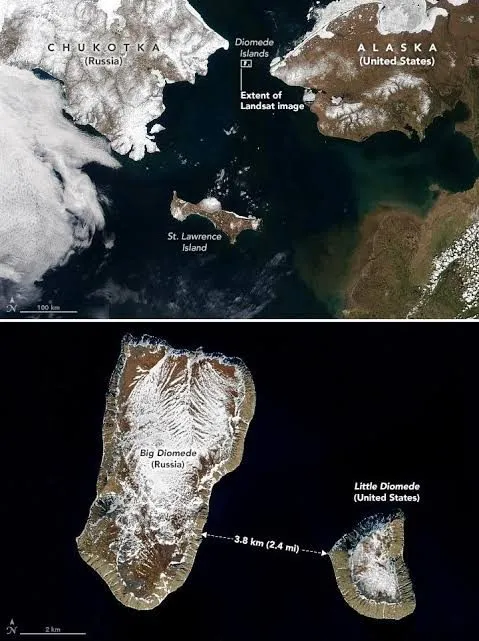
Set within the frigid, wind-swept expanse of the Bering Strait lie two rocky islands of basalt: Big Diomede and Little Diomede. Known collectively as the Diomede Islands, these landmasses are separated by a maritime channel measuring just $3.8$ to $5$ kilometers wide. Yet across this narrow stretch of water lies a staggering chronological gulf: a twenty-one-hour time difference.
When it is 3:00 PM on a Sunday afternoon on Little Diomede, it is already 12:00 PM (noon) on Monday on Big Diomede. A person standing on one island can look across the narrow strait and gaze directly into tomorrow.
The International Date Line and Geopolitical Division
This temporal paradox occurs because the International Date Line (IDL) passes directly between the two islands. Established in 1884 by international agreement, the IDL generally follows the $180^\circ$ meridian of longitude, zig-zagging where necessary to avoid dividing sovereign nations or population centers. Passing through the Bering Strait, the line cleanly bifurcates the passage between the two islands.
This geographic boundary also demarcates the national border between two superpowers:
- Big Diomede (Tomorrow Island): Governed by the Russian Federation (Chukotka Autonomous Okrug), operating on Kamchatka Time (UTC+12). It hosts a permanent Russian meteorological station and border-guard military post, with civilian access prohibited.
- Little Diomede (Yesterday Island): Governed by the United States (State of Alaska), operating on Alaska Standard Time (UTC-9). It is home to a traditional native Inupiat village where roughly eighty residents maintain customary marine subsistence hunting.
Winter Ice Bridges Across the Cold War Frontier
During the bitter sub-zero temperatures of arctic winter, the maritime channel between the Diomede Islands completely freezes over, forming a contiguous ice bridge across the strait. In physical terms, one could walk from Little Diomede to Big Diomede in less than an hour, stepping across both an international border and nearly an entire day on the calendar.
However, crossing the ice is strictly forbidden by both Washington and Moscow. During the Cold War, this boundary became known as the “Ice Curtain,” completely cutting off familial ties between indigenous families residing on opposite sides of the channel.
The Ancient Beringia Land Bridge and Human Migration
The unique geographic location of the Diomede Islands also carries profound anthropological importance. During the last glacial maximum of the Pleistocene epoch, sea levels were more than one hundred meters lower than today, transforming the Bering Strait into an expansive sub-continent known as Beringia.
Anthropologists and geneticists confirm that ancient hunter-gatherer populations walked across this dry steppe corridor from northeast Asia into North America, founding the indigenous civilizations of the Americas. Today, the Diomede Islands stand as the surviving rocky pinnacles of that vanished intercontinental bridge.
Conclusion
The Diomede Islands present one of the most intriguing geographical and temporal curiosities on our planet. Suspended between Alaska and Siberia, yesterday and tomorrow, they remind us how human-made boundaries intersect with the natural contours of the Earth.