Antimatter Mystery: Cosmic Asymmetry and Particle Physics at CERN
Pop Culture and Particle Physics at CERN
In his bestselling thriller Angels & Demons, novelist Dan Brown wove a gripping plot around an ultra-dangerous stolen substance: a canister containing a fraction of a gram of antimatter lifted from the laboratories of CERN. Situated along the Franco-Swiss border near Geneva, CERN (the European Organization for Nuclear Research) operates the world’s most powerful particle accelerator, the Large Hadron Collider (LHC).
While the explosive thriller entertained millions worldwide, antimatter itself is no science fiction device. It is an extraordinary, empirically verified reality of modern physics.
What Is Antimatter? The Mirror Image of Physical Reality
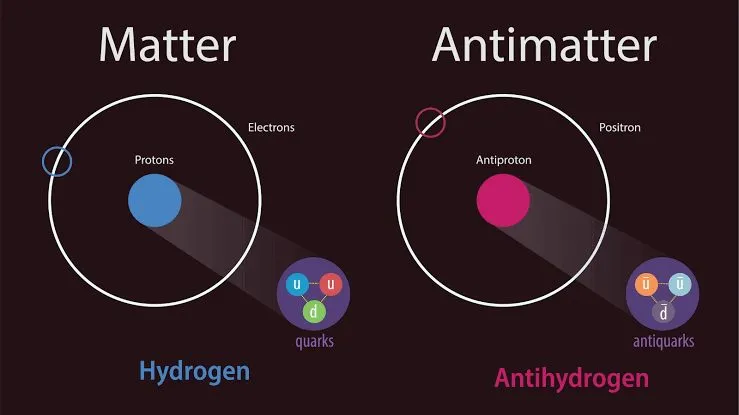
Every fundamental particle comprising ordinary matter possesses a corresponding antiparticle. An antiparticle matches its ordinary counterpart in exact mass, lifetime, and spin, but carries equal and opposite quantum numbers, such as electrical charge.
When matter and antimatter meet, they annihilate instantaneously in a flash of pure energy, converting their total rest mass into high-energy gamma-ray photons according to Einstein’s mass-energy equivalence equation ($E = mc^2$). Because conversion efficiency is $100\%$, antimatter-matter reactions release energy orders of magnitude greater than conventional chemical or nuclear fission weapons.
Theoretical Prediction and Experimental Discovery
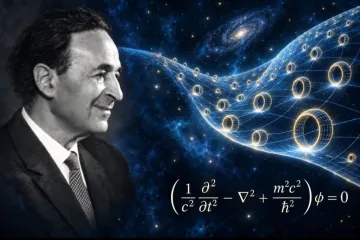
The existence of antimatter was first deduced theoretically by British physicist Paul Dirac in 1928. Unifying quantum mechanics and special relativity into the celebrated Dirac equation, he discovered that electron solutions permitted both positive and negative energy states. Dirac interpreted these negative states as anti-electrons carrying positive electrical charge.
In 1932, American experimentalist Carl Anderson discovered this predicted anti-electron in cloud chamber observations of cosmic rays, naming it the positron. For this landmark discovery, Anderson received the 1936 Nobel Prize in Physics. In 1955, Emilio Segrè and Owen Chamberlain confirmed the existence of the antiproton at Berkeley’s Bevatron, followed shortly by Bruce Cork’s identification of the antineutron in 1956. By the late twentieth century, physicists had identified antiparticles for every fundamental constituent in the Standard Model, including antiquarks and antileptons.
The Great Cosmic Mystery: Baryon Asymmetry
The existence of antiparticles exposes the greatest antimatter mystery in modern cosmology. Under the laws of quantum physics and Big Bang cosmology, the intense primordial thermal energy of the early universe should have synthesized matter and antimatter in precisely equal quantities.
Had this symmetry remained absolute, mutual annihilation during the cooling phase of the early universe would have eliminated every single particle, leaving behind a cosmos filled solely with diffuse photons. Yet our observable universe is composed almost exclusively of ordinary baryonic matter—forming galaxies, stars, planets, and life. Antimatter appears only fleetingly in high-energy cosmic-ray collisions and radioisotope decays.
Astrophysicists estimate that a tiny asymmetry existed in the primordial cosmos: for every billion antimatter particles created, there were approximately one billion and one matter particles. Following catastrophic annihilation, that lone surviving fraction of matter formed all the visible structures of our universe.
Searching for Answers at CERN
Why did nature favor matter over antimatter? Physicists suspect subtle CP-violation (Charge Parity symmetry violation) within the weak nuclear interaction allows antiquarks and antileptons to decay at rates slightly different from their matter counterparts. However, the CP-violation observed thus far within the Standard Model is insufficient to account for the total observed cosmic asymmetry.
To investigate this puzzle, researchers at CERN’s Antiproton Decelerator facility produce antiprotons and combine them with positrons to create stable atoms of antihydrogen. To keep antimatter from contacting ordinary container walls, scientists trap it using sophisticated vacuum magnetic devices known as Penning traps.
Antimatter remains the rarest and most expensive substance in existence. Producing a single gram of antimatter using current accelerator technology would require approximately sixty-three trillion dollars and centuries of beamtime. Through precision spectroscopy of trapped antihydrogen, physicists continue to test whether matter and antimatter obey identical physical laws, seeking the clue that will solve the cosmic antimatter mystery.