Ramanujan’s Lost Notebook: From Math to Black Holes
The Untimely Passing of a Mathematical Prodigy
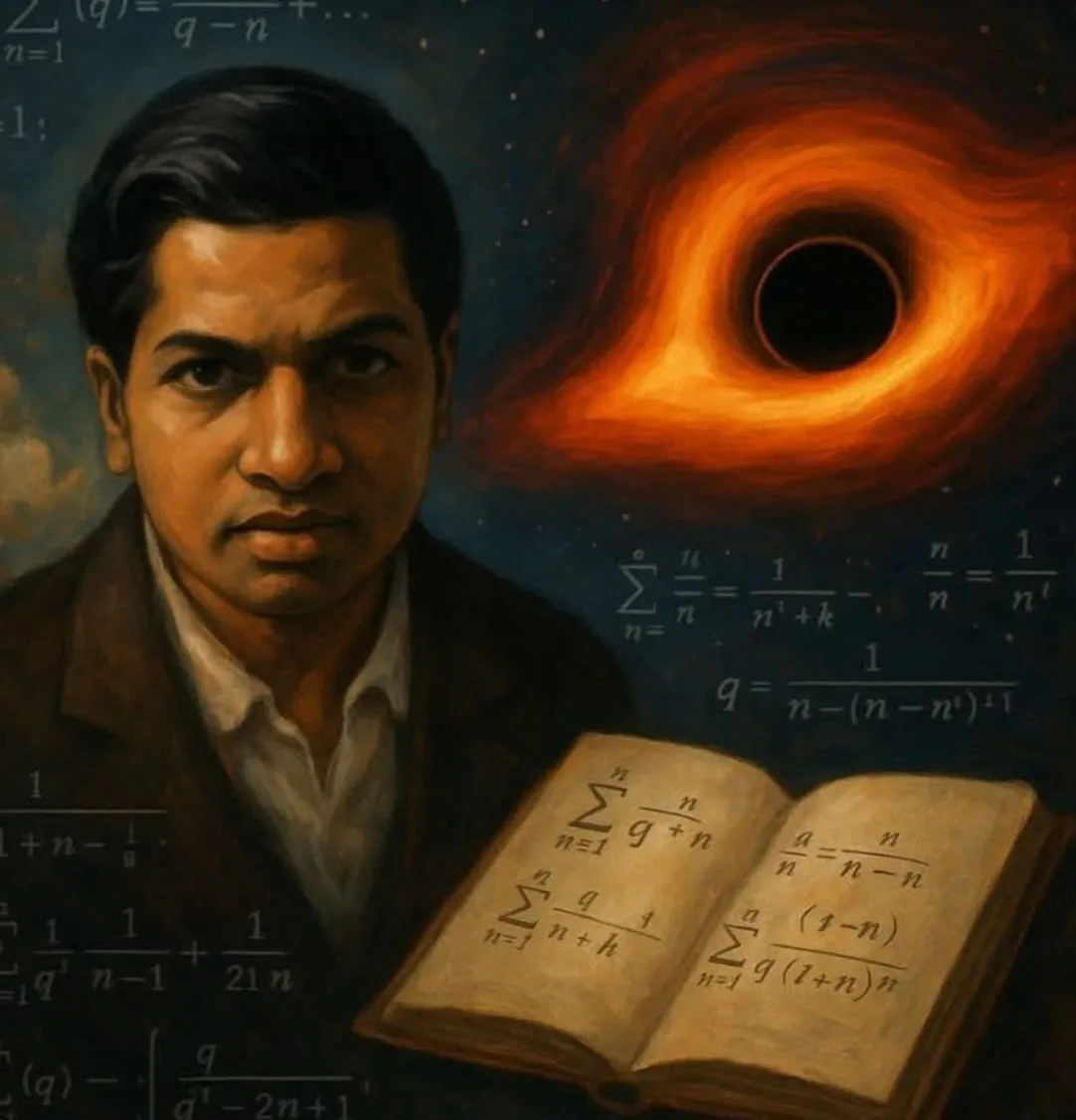
In January 1920, the mathematical world lost one of its greatest intuitive geniuses when Srinivasa Ramanujan passed away at just thirty-two years of age. Confined to his sickbed in India during his final year, Ramanujan feverishly filled loose sheets of paper with hundreds of handwritten mathematical formulas.
Decades later, in the spring of 1976, American mathematician George Andrews made a startling discovery while browsing uncataloged archives at Trinity College, Cambridge. He unearthed over one hundred loose manuscript pages—a treasure trove now celebrated globally as Ramanujan’s lost notebook.
Mock Theta Functions: An Eighty-Year Enigma
In his final manuscripts, Ramanujan introduced a mystifying family of mathematical formulas he called “mock theta functions” (now recognized as mock modular forms). These equations exhibited subtle modular-like symmetries, yet resisted classical modular classification.
For more than eighty years, contemporary mathematicians struggled to decipher the theoretical foundation underlying these functions. Finally, in 2002, mathematicians Ken Ono, Kathrin Bringmann, and Sander Zwegers established the rigorous framework, showing that Ramanujan’s equations are holomorphic components of harmonic Maass forms.
Connecting Pure Mathematics to Black Hole Entropy
The most breathtaking surprise arrived from theoretical physics. In modern string theory and quantum gravity, calculating the quantum microstates and thermodynamic entropy of supersymmetric black holes requires complex partition functions.
Astrophysicists Atish Dabholkar and Sameer Murthy discovered that the partition functions calculating the quantum entropy of N=4 supersymmetric black holes match Ramanujan’s mock modular forms with absolute precision. A century after an ailing, self-taught mathematician scribbled formulas by hand in colonial Madras, his equations are solving the quantum paradoxes of cosmic black holes.
Conclusion
Ramanujan’s lost notebook demonstrates that pure mathematics is far more than abstract numerical manipulation. It is an intrinsic cosmic code, revealing profound physical laws long before experimental instruments can observe them.