Professor J. N. Islam: Fate of the Expanding Universe

Contemplating Cosmic Destiny
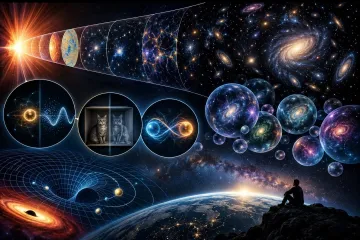
Discussions in modern cosmology frequently gravitate toward the beginning: the Big Bang, cosmic inflation, and the genesis of space and time. Yet few theoretical physicists dared to look in the opposite direction and calculate the ultimate end of existence. Will cosmic expansion persist eternally? Will all stellar fires eventually burn out into frozen void? Or will gravity reverse the outward rush and pull all matter back into a fiery primordial singularity? Among the pioneering mathematical physicists who systematically charted these cosmic trajectories was Professor Jamal Nazrul Islam (widely known as J. N. Islam).
Academic Journey and the Cambridge Intellectual Circle
Born on February 24, 1939, in Jhenaidah in undivided Bengal, Islam demonstrated an exceptional aptitude for mathematics from early childhood. After completing his undergraduate degree with honours from St. Xavier’s College in Kolkata, he proceeded to Trinity College, Cambridge. He earned his doctorate in applied mathematics and theoretical physics, subsequently conducting postdoctoral research at the prestigious Cambridge Institute of Theoretical Astronomy alongside eminent figures such as Fred Hoyle, Stephen Hawking, and Roger Penrose.
The Mathematical Architecture of Cosmic Fate
In the mid-twentieth century, the discovery of the Cosmic Microwave Background (CMB) validated the Big Bang model, confirming that cosmic expansion commenced 13.8 billion years ago. However, the ultimate fate of the universe remained an open question governed by Einstein’s field equations of general relativity. Whether cosmic geometry was open, flat, or closed depended on whether total cosmic density exceeded the critical density parameter ((Omega)).
The Landmark Book: The Ultimate Fate of the Universe
In 1977, Professor Islam published a seminal paper surveying the long-term future of cosmic matter, followed in 1983 by his acclaimed Cambridge University Press monograph, The Ultimate Fate of the Universe. Utilizing rigorous relativistic mechanics, he analyzed the distinct astrophysical horizons facing our cosmos:
- The Closed Universe (The Big Crunch): If cosmic mass density exceeded the critical threshold, mutual gravitational attraction would halt expansion and trigger a catastrophic contraction, collapsing all galaxies and spacetime into an ultra-dense singularity.
- The Open Universe (The Big Freeze / Heat Death): If density fell below the critical value, expansion would continue unabated. Over trillions of years, star formation ceases, stellar remnants burn out into white dwarfs, neutron stars, and black holes, and Hawking evaporation slowly disperses all matter into an icy, uniform equilibrium at maximum entropy.
Decades before the discovery of accelerating dark energy cemented the Big Freeze as the standard cosmological model, Professor Islam had laid out the comprehensive mathematical framework analyzing these far-future scenarios.
Returning Home: Fostering Pure Science in Bangladesh
In 1984, at the pinnacle of his international academic career, Professor Islam chose to resign from his prestigious position abroad and return to Bangladesh. He joined the Department of Mathematics at the University of Chittagong, where he established the Research Centre for Mathematical and Physical Sciences (RCMPS). Driven by the conviction that developing nations must produce foundational knowledge locally rather than merely consuming imported technology, he mentored generations of theoretical physicists and advanced pure mathematical research.
Advocating Science in the Mother Tongue and Lasting Legacy
Beyond research treatises such as An Introduction to Mathematical Cosmology and Rotating Fields in General Relativity, Professor Islam passionately championed popular science education in Bengali. His Bengali book Krishnabibor (Black Holes) introduced relativistic astrophysics to thousands of young readers, while his writings on language emphasized that true scientific intuition flourishes when communicated in one’s mother tongue. Awarded the Ekushey Padak in 2001 and posthumously conferred Bangladesh’s highest civilian honor, the Independence Award (Swadhinata Padak), in 2025, Professor J. N. Islam remains an enduring beacon of theoretical astrophysics.