Smart Rice: Transforming Agriculture in Climate Crisis
Agriculture on the Frontlines of Climate Disruption
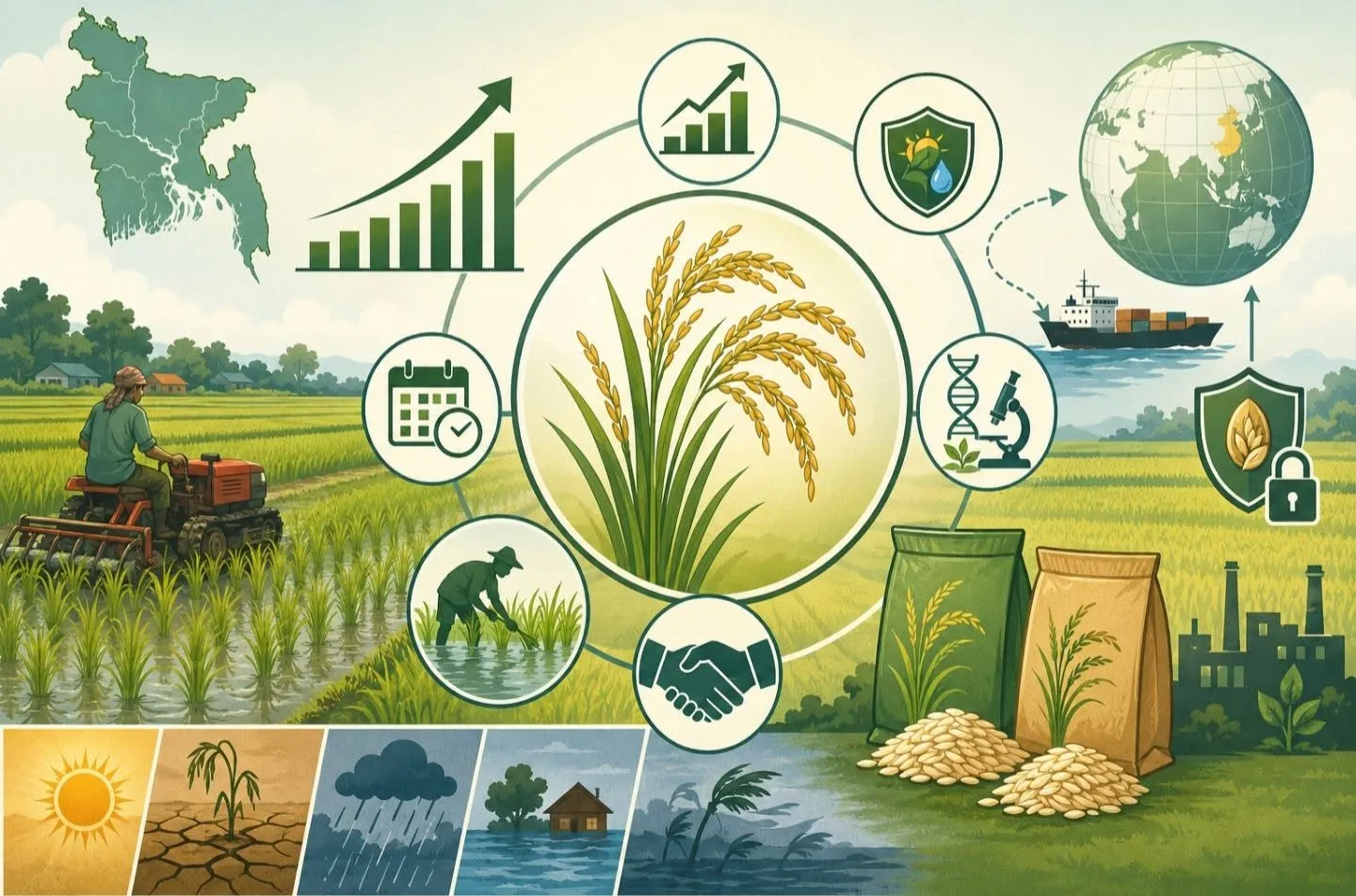
Throughout Bengal’s history, rice has formed the cultural and nutritional cornerstone of civilization. Rivers have shifted and boundaries have evolved, but paddy cultivation remains central to human survival. Today, traditional rice farming faces unprecedented ecological stress. Rising sea levels, saltwater intrusion, sudden flash floods, extended seasonal droughts, and surging pest outbreaks threaten global yields. In this precarious climate era, smart rice represents an indispensable scientific frontier in agricultural adaptation.
Combating Coastal Salinity: BRRI Innovations
The Bangladesh Rice Research Institute (BRRI) has spearheaded climate-resilient crop breeding. In vulnerable southern coastal belts, high soil salinity once forced vast tracts of arable land to lie fallow during dry winter seasons. BRRI developed salinity-tolerant cultivars such as BRRI dhan67, which thrives in saline conditions up to 8–10 dS/m during the seedling stage. Other notable salinity-tolerant varieties—including BRRI dhan47, BRRI dhan73, and BRRI dhan97—enable reliable yields across both Boro and Aman cropping seasons, restoring thousands of hectares of coastal land to productive farming.
Flood and Submergence Tolerance
In low-lying river basins and flood-prone floodplains, monsoon surges routinely drown young crops. Incorporating the submergence-tolerant Sub1 gene, varieties like BRRI dhan51 and BRRI dhan52 can survive submerged underwater for up to two weeks, resuming vigorous vegetative growth after floodwaters recede. Similarly, BRRI dhan79 exhibits remarkable regenerative capacity following flash flood inundations.
Drought Resilience and Wetland Adaptation
In the drought-prone Barind tract of northwestern Bangladesh, moisture deficits severely impair standard crops. Drought-tolerant cultivars such as BRRI dhan56 and BRRI dhan57 mature early, requiring significantly less irrigation while sustaining reliable yields. In northeastern wetland haors subject to premature spring flash floods, short-duration varieties like BRRI dhan96 allow farmers to harvest their grain before torrents submerge the wetlands. Meanwhile, varieties like BRRI dhan91 and BRRI dhan111 are tailored for semi-deep water and waterlogged agricultural zones.
Biofortification and Pest Resistance
Beyond abiotic climate tolerance, smart rice addresses micronutrient malnutrition. Biofortified varieties such as BRRI dhan62 and BRRI dhan84 feature elevated grain concentrations of bioavailable zinc and iron, combating stunting and maternal anemia. Other genetic lines integrate host-plant resistance against devastating biotic threats like the brown planthopper (BPH) and bacterial leaf blight, reducing dependence on chemical pesticides.
High-Temperature Breeding and Sustainable Food Systems
With global average temperatures climbing, extreme heat during the flowering stage can trigger spikelet sterility and abort pollination. Agricultural scientists at BRRI and the International Rice Research Institute (IRRI) are evaluating heat-tolerant breeding lines capable of successful anthesis under temperatures exceeding 35–38°C. Coupling smart genetic varieties with efficient water management (such as Alternate Wetting and Drying) and balanced fertilization creates a climate-smart agricultural system capable of nourishing future generations.