Peter Higgs: The Solitary Architect of the God Particle
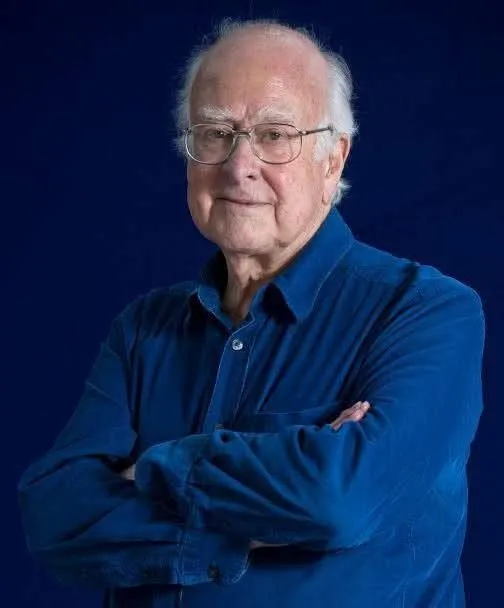
Remembering Peter Higgs
April 8, 2025 marked the first anniversary of the passing of Peter Higgs. A gentle, quiet scholar who spent his life immersed in contemplative thought, Higgs left an indelible mark on the landscape of modern physics.
A Monumental Contribution to Theoretical Physics
Peter Higgs was a giant of twentieth-century physics. Through sheer mathematical intuition, he solved one of the deepest mysteries of the universe. In 1964, Higgs predicted the existence of a new scalar particle, known today as the Higgs boson, when it was nothing more than an audacious equation scrawled on paper.
Early Life and Intellectual Solitude
Born in Newcastle in 1929, Higgs grew up in England and Scotland. Childhood asthma and solitary schooling led him to cultivate a deeply independent intellectual life. His fascination with physics was ignited after reading about the work of Paul Dirac at his Bristol school. Higgs went on to King’s College London and later joined the University of Edinburgh, where he dedicated decades to theoretical investigation away from public fanfare.
The Higgs Field and the Mystery of Mass
In the early 1960s, particle physicists faced a crisis: according to gauge symmetry, the gauge bosons mediating fundamental forces should be massless. Yet experiments proved that the W and Z bosons mediating the weak nuclear force possess substantial mass. In 1964, Peter Higgs—independently alongside François Englert and Robert Brout—proposed an elegant mechanism: an invisible energy field permeating all space. Particles moving through this “Higgs field” acquire mass through their interactions with it. The quantum excitation of this field was christened the Higgs boson. Detecting it, however, required fifty years of engineering innovation due to the particle’s fleeting lifespan.
CERN and the Large Hadron Collider
To detect the elusive particle, the European Organization for Nuclear Research (CERN) constructed the largest scientific instrument on Earth: the Large Hadron Collider (LHC), located near Geneva. Spanning a 27-kilometer underground ring built at a cost of nearly $9 billion, the LHC collided protons at nearly the speed of light to recreate the conditions of the early universe.
The 2012 Discovery and the Nobel Prize
On July 4, 2012, CERN announced that ATLAS and CMS had discovered a new particle matching the predicted Higgs boson at 125 GeV. Peter Higgs sat in the auditorium, visibly wiping away tears of emotion. In 2013, Peter Higgs and François Englert were awarded the Nobel Prize in Physics.
A Humble Scientist Shunning the Limelight
Higgs remained remarkably immune to fame. He never owned a television or mobile phone, rarely granted press interviews, and went on a solitary walk to avoid the media storm on the day his Nobel Prize was announced. He openly remarked that in today’s fast-paced academic culture of publish-or-perish, a thoughtful, slow-working researcher like himself would likely never have survived.
The Enduring Legacy of a Scientific Sherpa
Peter Higgs proved that quiet, patient thinking can revolutionize our understanding of reality. His passing is a profound loss for physics, but the Higgs field and the Higgs boson will forever carry his name across every atom of the cosmos.