The Birth of Space from Time: A Quantum Perspective
Spacetime in Einstein’s Relativity
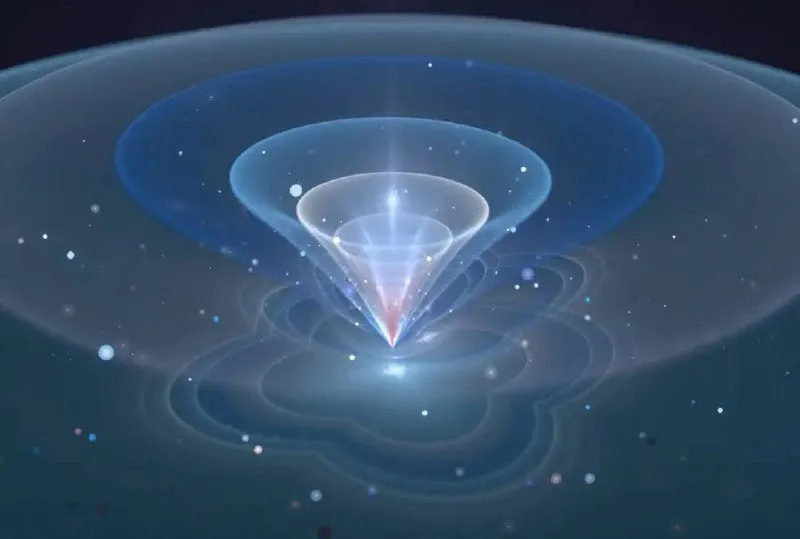
For over a century, physics taught us that the fundamental canvas of reality is a unified four-dimensional continuum known as spacetime. Albert Einstein’s general theory of relativity treats space and time as equal partners in this fabric, curved and contoured by the presence of matter and energy. However, recent theoretical research suggests a provocative alternative: space may not be fundamental at all, but an emergent property born out of time.
The Primacy of Time in Quantum Physics
In April 2025, an intriguing paper highlighted in New Scientist explored whether time is the sole fundamental substrate of the cosmos. According to this model, the early universe contained time without spatial dimensions. Space as we know it—the three-dimensional expanse where matter resides and moves—emerged gradually through temporal dynamics.
Qubit Geometry and Emergent Dimensions
This radical proposal builds upon the fundamental unit of quantum information: the qubit. While a classical bit exists strictly as 0 or 1, a quantum bit can exist in a superposition of both states simultaneously. By analyzing how a single qubit evolves through time, theorists mapped an underlying geometric structure that mirrors a three-dimensional spatial manifold. The evolution of quantum information across time naturally unfurls into spatial dimensions.
Quantum Uncertainty and Cosmic Expansion
The researchers investigated the relationship between the Heisenberg uncertainty principle and cosmic expansion rates. They found a complementary uncertainty: precisely defining the passage of time renders the cosmic expansion rate indeterminate, while fixing the expansion rate blurs temporal certainty. Much like position and momentum at subatomic scales, space and time exhibit quantum complementarity on cosmological scales.
Space as a Phase Transition of Time
A core concept in this framework is that space arose as a physical phase transition of time—comparable to water freezing into solid ice or vapor condensing into liquid. In this cosmological picture, the primordial cosmos consisted of a pure flow of time. At a critical evolutionary threshold, this temporal stream condensed into the three-dimensional spatial fabric of our observable universe.
Before the Big Bang: A Void of Pure Time
Under this theoretical model, the Big Bang was not an explosion occurring inside pre-existing empty space. Instead, it was the moment space itself crystallized out of time. Prior to this emergence, there was no distance or spatial volume—only the relentless tick of temporal reality.
Theoretical Prospects and Quantum Gravity
This model remains theoretical and awaits experimental validation. Physicists are now investigating whether emergent spatial signatures could be discerned in cosmic microwave background fluctuations or quantum gravity anomalies.
Reframing the Architecture of Reality
If validated, this framework fundamentally alters our perception of the universe. The three-dimensional world we inhabit may be an elaborate holographic projection spun from the loom of time, uniting information theory, cosmology, and quantum reality into a breathtaking tapestry.