'Oumuamua: The Mysterious Interstellar Visitor Explained
A Historic Discovery at Pan-STARRS
On October 19, 2017, astronomer Robert Weryk was analyzing routine astronomical survey data from the Pan-STARRS1 telescope on Haleakala, Hawaii. He spotted a faint, fast-moving celestial object located roughly 33 million kilometers from Earth. Tracking its orbital trajectory revealed something unprecedented: with a hyperbolic eccentricity of 1.20, the object was not bound to the Sun’s gravity. It had traveled across deep interstellar space from elsewhere in the Milky Way galaxy. Officially cataloged as 1I/2017 U1, it was christened ‘Oumuamua, a Hawaiian term meaning “a messenger from afar arriving first.”
Anomalous Shape and Properties
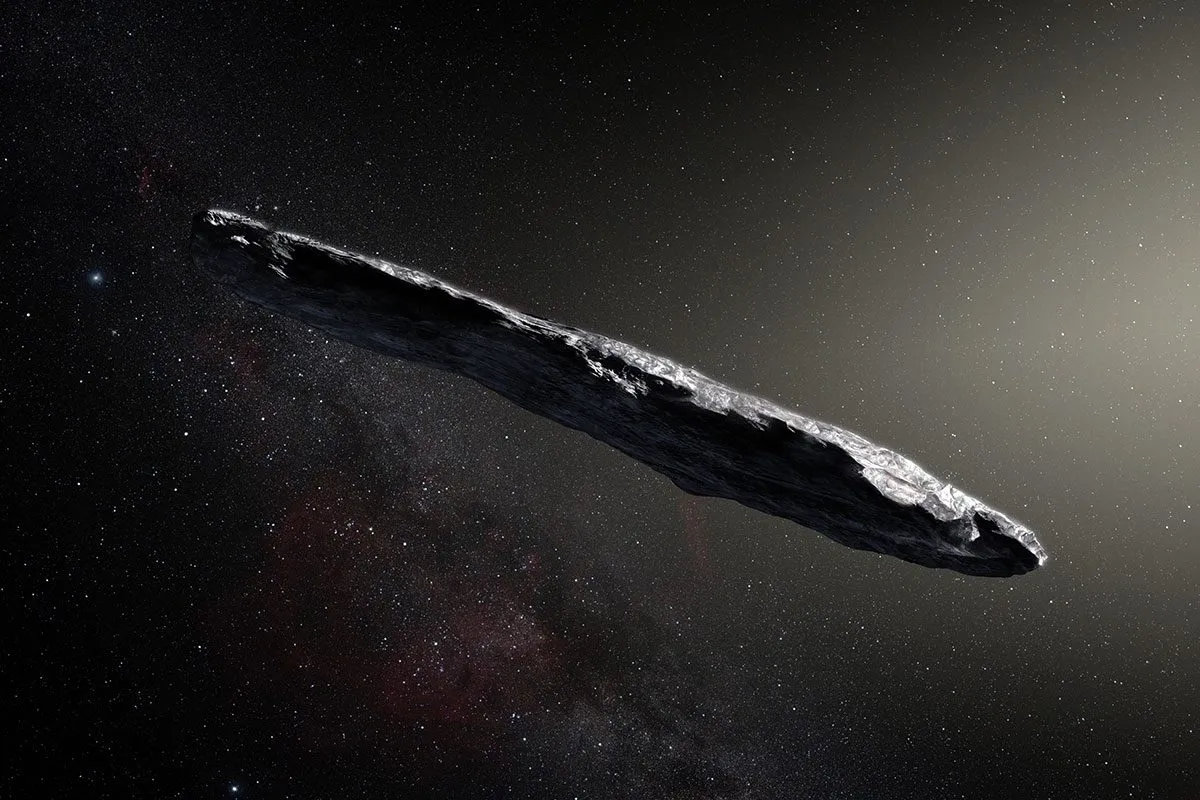
Intensive observations conducted by the world’s premier telescopes uncovered striking anomalies. As ‘Oumuamua tumbled end-over-end through space every 7.3 hours, its brightness varied by a factor of ten—suggesting an extraordinarily elongated, cigar-like or pancake-like geometry with an estimated length of 100 to 400 meters and a width of several tens of meters. Spectral analysis revealed a reddish surface hue resembling organic tholins.
The Enigma of Non-Gravitational Acceleration
Most perplexingly, as ‘Oumuamua swung around the Sun and headed outward, high-precision telemetry showed that it accelerated slightly faster than predicted by gravitational calculations alone. Comets routinely exhibit non-gravitational acceleration when solar heat vaporizes subsurface volatile ices into jets of outgassing gas. Yet ‘Oumuamua showed no visible cometary coma, no dust emission, and no gas signatures in ultra-sensitive infrared spectroscopy.
Alien Lightsail or Exotic Nitrogen Iceberg?
‘Oumuamua’s unexplained acceleration sparked intense scientific controversy. Harvard astrophysicist Avi Loeb controversially proposed that ‘Oumuamua might represent an artificial extraterrestrial artifact—such as a discarded light sail propelled by solar radiation pressure, reminiscent of Arthur C. Clarke’s science-fiction classic Rendezvous with Rama. However, radio searches conducted by the SETI Institute and Breakthrough Listen detected no artificial radio transmissions.
Mainstream astrophysicists favor natural hypotheses: ‘Oumuamua may be an exotic chunk of solid nitrogen ice carved from an exoplanetary Pluto-like body, or a porous, hydrogen-rich molecular iceberg whose outgassing was invisible to optical sensors.
Farewell to an Interstellar Nomad
‘Oumuamua has long passed the orbit of Neptune and is hurtling irrevocably out of our solar system into deep interstellar space, destined never to return. While humanity may never fully resolve its deepest secrets, ‘Oumuamua inaugurated a thrilling new era in observational astronomy: the study of macroscopic material traversing the gulf between stars.