Karl Schwarzschild: Solving Einstein's Field Equations
The Mathematical Foundation of Black Holes
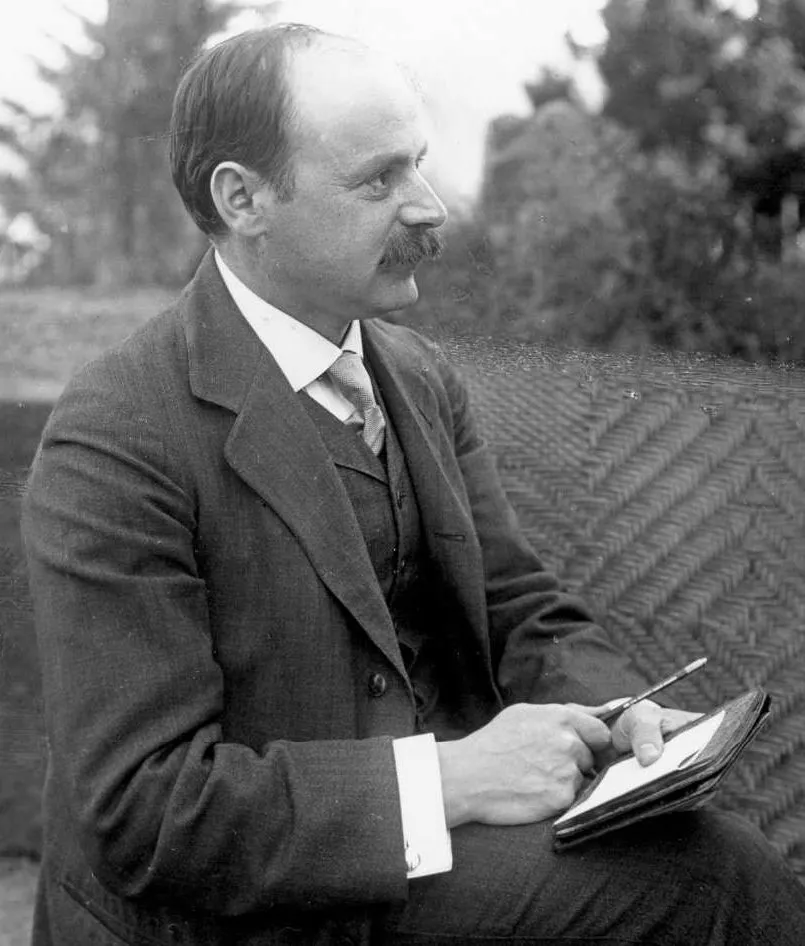
German astronomer and theoretical physicist Karl Schwarzschild earned immortality in the annals of science by deriving the first exact mathematical solution to Albert Einstein’s complex field equations of general relativity. In doing so, Schwarzschild uncovered the theoretical foundation for gravitational collapse and the existence of black holes.
The Schwarzschild Radius and Gravitational Singularity
Schwarzschild’s solution demonstrated that if a given mass is compressed into a sufficiently compact sphere, the curvature of spacetime around it becomes infinite. The critical boundary at which this occurs is universally known as the Schwarzschild radius ((r_s = 2GM/c^2)).
If matter is compressed within this gravitational radius, the escape velocity exceeds the speed of light, sealing the object within an event horizon from which no information can escape. At the center lies a gravitational singularity where classical general relativity breaks down into infinite density. For our Sun, the Schwarzschild radius is a mere 3 kilometers; for the Earth, it is roughly 9 millimeters.
Calculating General Relativity from the War Front
The historical backdrop of Schwarzschild’s breakthrough is astonishing. In late 1915, during the brutal fighting of World War I, Schwarzschild was serving as a lieutenant in the German army on the Russian front. Amid gunfire, artillery shelling, and bitter freezing cold, he obtained a copy of Einstein’s freshly published paper on general relativity.
While Einstein had assumed his non-linear tensor equations could only be approximated numerically, Schwarzschild succeeded within weeks in formulating an elegant, exact geometric solution for static, non-rotating spherical masses. He mailed the mathematical derivation from the trenches to Einstein, who presented it on Schwarzschild’s behalf to the Prussian Academy of Sciences.
A Tragic Loss and Eternal Legacy
Tragically, while stationed on the front lines, Schwarzschild contracted pemphigus, a painful autoimmune skin disease. He was invalided home and passed away in May 1916 at the age of just 42. In his honor, lunar crater Schwarzschild and asteroid 837 Schwarzschilda bear his name. Karl Schwarzschild’s courage and mathematical genius fundamentally shaped modern relativistic astrophysics, transforming black holes from abstract mathematical riddles into verifiable cosmic realities.