The International Space Station: Humanity's Orbiting Lab
An Overview of the International Space Station
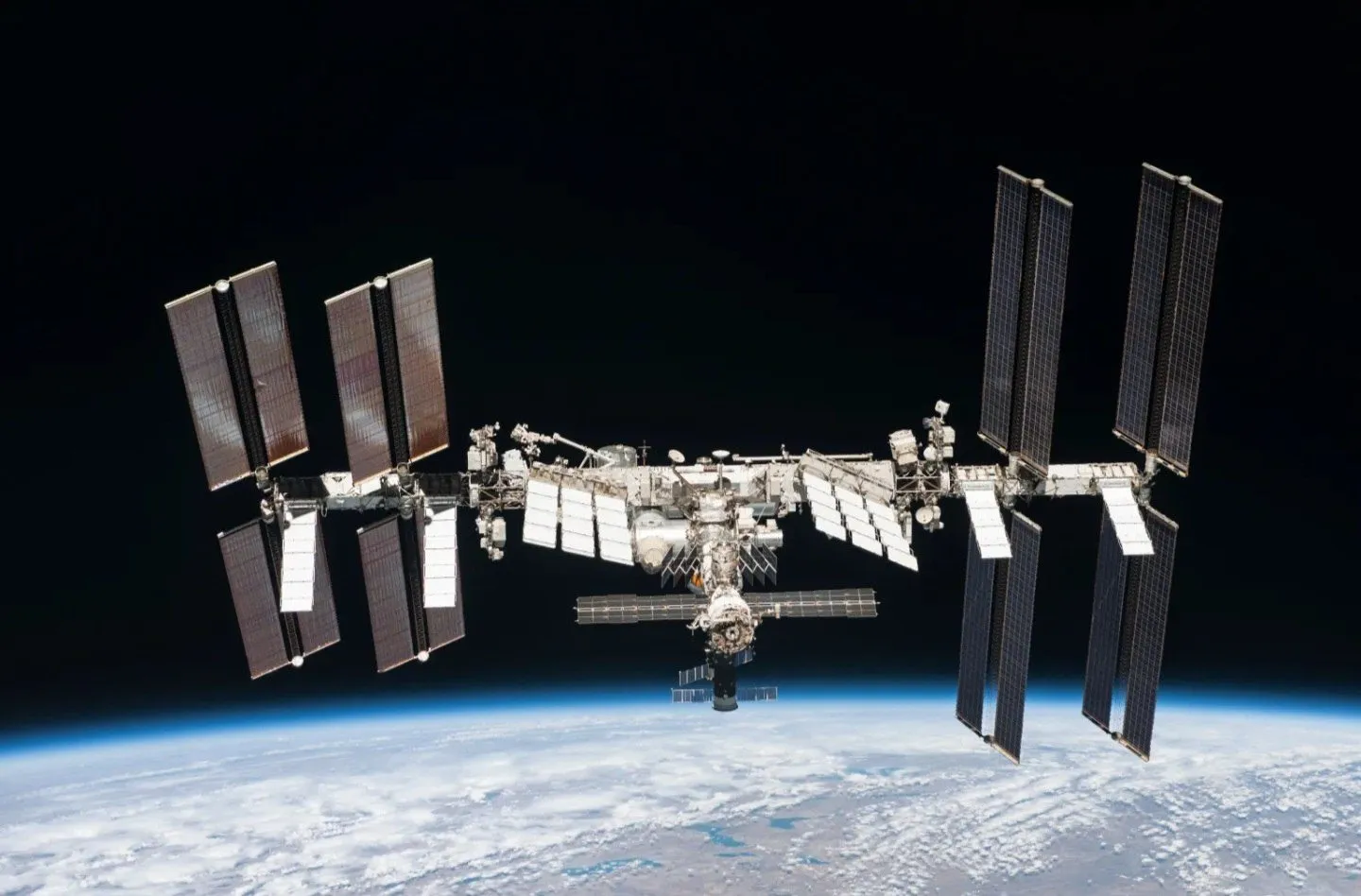
Look up at the clear night sky, and you may spot a bright, steady beacon of light swiftly traversing the constellations. That moving point is not an airplane or a shooting star—it is the International Space Station, commonly known as the ISS. Orbiting approximately 400 kilometers above our planet at an astonishing velocity of 28,000 kilometers per hour, it circles the Earth sixteen times every single day. The ISS stands as an extraordinary monument to human ingenuity, translating science fiction into orbital reality.
Early Orbital Laboratories: Spacelab
Human research in orbit did not begin with the ISS. Before its assembly, several crucial pioneering programs laid the groundwork—most notably Spacelab and the Russian Mir station. Developed collaboratively during the 1980s by the European Space Agency (ESA) and NASA, Spacelab was a reusable laboratory module carried inside the payload bay of the American Space Shuttle. Astronauts lived and performed scientific experiments in orbit for days at a time before returning safely to Earth.
Achievements and Shortcomings of Spacelab
The Spacelab program completed dozens of successful missions, facilitating groundbreaking research in biology, physics, solar science, and medicine. Yet Spacelab had an inherent limitation: it was tied directly to individual Space Shuttle flight schedules, operating only for short mission durations rather than serving as a permanent space station.
The Soviet Union’s Mir Space Station
The Soviet Union’s Mir was the world’s first modular, long-term space station. Rather than launching in a single flight, Mir was assembled incrementally in orbit. Its core module launched aboard a Proton rocket in 1986, with six subsequent research and living modules docking over the following decade. Each module featured specialized laboratory gear, life support, power generation, and docking ports. Mir served as an enduring microgravity research hub where cosmonauts conducted continuous long-duration flights. Russian astronaut Valeri Polyakov spent 437 consecutive days aboard Mir, setting a world record that remains unbroken to this day. However, aging hardware and limited modularity highlighted the need for a truly global, modernized successor.
Conceiving the International Space Station
Recognizing the limitations of prior stations, space agencies envisioned a permanent orbital habitat where researchers could reside continuously and perform uninterrupted scientific investigations. The ISS program was officially inaugurated in 1998, with continuous human occupancy beginning in November 2000. It represents humanity’s premier international cooperative endeavor beyond Earth.
A Unifying Global Partnership and Construction
Five leading space agencies co-engineered the ISS: NASA (United States), Roscosmos (Russia), ESA (Europe), JAXA (Japan), and CSA (Canada). In an unprecedented feat of orbital engineering, modules were launched separately and assembled in orbit over the course of thirteen years. Core modules were carried into space by American Space Shuttles and Russian Proton rockets, while regular supply and crew flights utilized Russian Soyuz and Progress vehicles, Europe’s Ariane 5, and Japan’s HTV cargo crafts.
Monumental Scale and Architecture
From end to end, the space station measures roughly 109 meters long and 73 meters wide—spanning an area comparable to an entire American football field. Eight massive pairs of solar panels generate up to 120 kilowatts of electricity; their reflective surfaces explain why the station appears so bright from Earth. Inside, the pressurized habitable volume equals that of a spacious six-bedroom apartment, complete with sleeping quarters, galleys, exercise equipment, and research modules. Constructed at an estimated cost of $150 billion, it is one of the most ambitious engineering undertakings in history, maintained with an annual operational budget of three to four billion dollars.
Endurance Records and Human Feats
Over 270 astronauts and cosmonauts from twenty different nations have lived and worked aboard the ISS. American astronaut Scott Kelly and Russian cosmonaut Mikhail Kornienko completed a landmark 340-day mission to study the long-term biological effects of microgravity, while veteran astronaut Sunita Williams has logged over 287 days during her missions.
Evolution of Orbital Transit and Commercial Crew
Transportation to and from the station has evolved significantly. Following the retirement of NASA’s Space Shuttle fleet in 2011, Russian Soyuz capsules served as the sole crew transport vehicle for nearly a decade. In 2020, SpaceX’s Crew Dragon initiated a new era of commercial crew flights, joined by vehicles like Boeing’s Starliner. The ISS features multiple docking adapters, accommodating cargo freighters bringing fresh water, food, and science experiments.
Life in Microgravity: Thrills and Demands
Daily existence on the station is both wondrous and physically taxing. In free-fall microgravity, objects and fluids drift freely, requiring astronauts to drink from sealed pouches and sleep inside tethered sleeping bags. To counter bone density loss and muscle atrophy, crew members must exercise vigorously for at least two hours every day using specialized treadmills and resistive exercise machines.
Pioneering Orbital Science
The scientific portfolio of the ISS is vast: developing novel pharmaceuticals, analyzing protein crystal growth, studying cellular mechanics, observing climate patterns, and testing closed-loop life support systems. Above all, the station serves as an indispensable testbed for future crewed journeys to the Moon and Mars.
The Future and Eventual Decommissioning
The ISS will not endure indefinitely. NASA and its international partners plan to transition operational focus toward commercial space stations by the early 2030s. Commercial ventures such as Axiom Space, Blue Origin, and SpaceX are developing private platforms. When its mission concludes, the ISS will be safely de-orbited over the remote South Pacific Ocean.
An Enduring Beacon of Unity and Discovery
Whatever the future holds, the International Space Station will be remembered as a triumphant symbol of peaceful global collaboration. Watching that radiant point of light glide across the night sky, we are reminded of what humanity can achieve when nations look past terrestrial borders and unite in the quest for discovery.