Quantum Gravity: Bridging General Relativity and Quantum Mechanics
The Two Pillars of Modern Physics
In the early twentieth century, the world of science was transformed by two revolutionary breakthroughs: Albert Einstein’s theory of relativity and the development of quantum mechanics. Together, these frameworks overturned classical Newtonian physics and redefined our understanding of nature.
Einstein’s Special Relativity and Time
In 1905, Albert Einstein introduced his special theory of relativity, demonstrating that time is not absolute but relative to velocity. Moving clocks run slower, and as an object approaches the speed of light, its mass increases while its length contracts along the direction of motion. Ten years later, in 1915, Einstein completed his masterpiece: the general theory of relativity, elevating our understanding of cosmic mechanics to an unprecedented height.
The Fabric of Spacetime
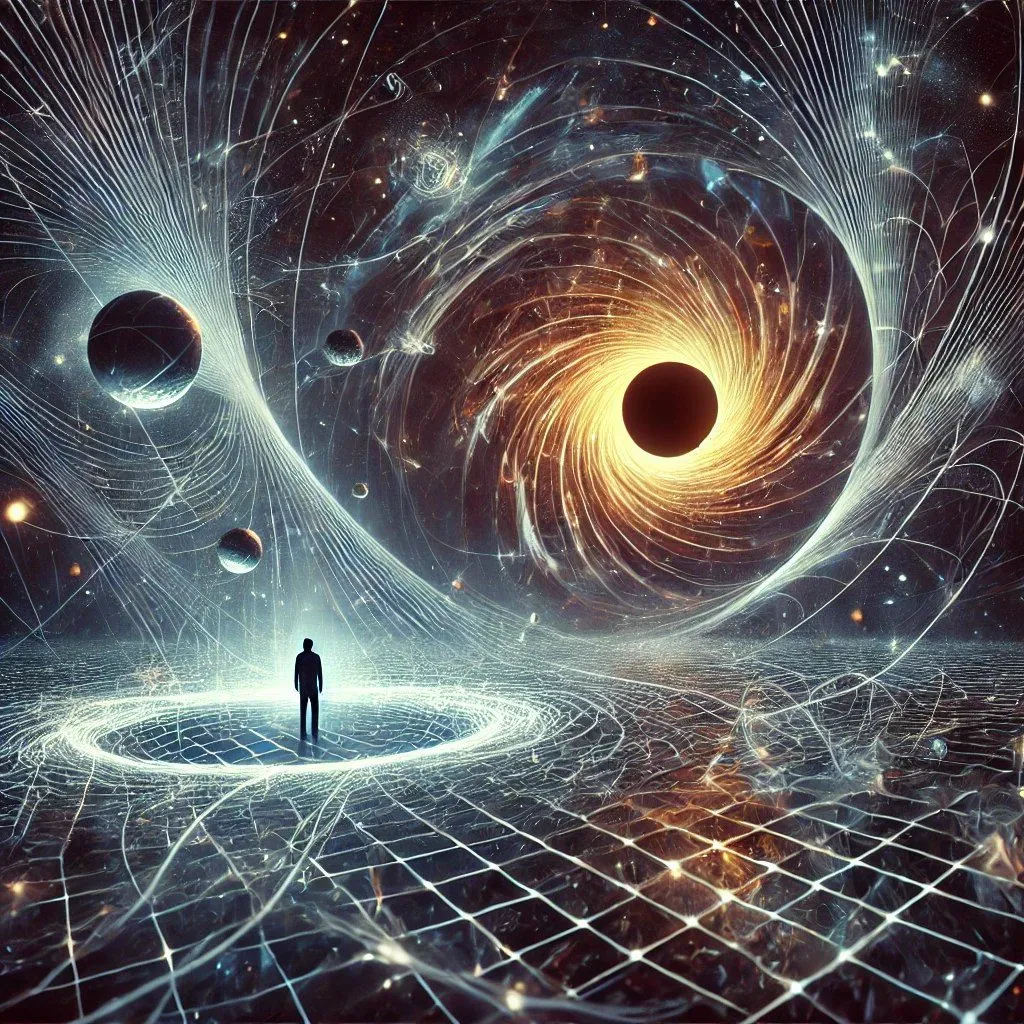
General relativity showed that space and time are inseparable aspects of a dynamic four-dimensional continuum known as spacetime. While human senses perceive space and time as distinct, the presence of mass and energy warps this fabric. We experience this curvature as the force of gravity.
The Geometric Interpretation of Gravitational Force
Imagine spacetime as a taut sheet of rubber. Placing a heavy lead ball in the middle causes the sheet to sag and curve. Smaller marbles rolled across the sheet will naturally follow the curve toward the heavy ball. Similarly, the Sun’s mass curves the surrounding spacetime, compelling Earth and the planets to orbit along smooth geometric paths (geodesics). The greater an object’s mass, the more steeply it warps spacetime, and the stronger its gravitational pull. Over the past century, general relativity has passed every empirical test with flying colors, accurately predicting the behavior of orbits, gravitational lensing, galaxies, and black holes.
The Rise of Quantum Mechanics and the Quanta
Simultaneously, quantum mechanics emerged to explain phenomena at atomic and subatomic scales. In 1900, Max Planck discovered that blackbody radiation is not emitted in a continuous stream, but in discrete energy packets he called “quanta”, quantified by Planck’s constant. Einstein expanded upon this to explain the photoelectric effect, showing that light consists of discrete energy particles called photons, even though it exhibits wave behavior.
The Strange Counterintuitive Subatomic Realm
Quantum mechanics governs the microscopic universe, revealing principles that defy classical intuition. Matter and radiation exhibit wave-particle duality, and Heisenberg’s uncertainty principle proves that one cannot simultaneously determine both the exact position and momentum of a particle.
Pioneers of the Quantum World
A generation of brilliant physicists formulated the mathematical foundations of quantum theory, including Werner Heisenberg, Erwin Schrödinger, Niels Bohr, Paul Dirac, Louis de Broglie, Wolfgang Pauli, Enrico Fermi, and Richard Feynman. When analyzing the behavior of subatomic particles, quantum mechanics is peerless. However, Einstein’s smooth, continuous geometric relativity cannot be applied to this jittery, probabilistic realm.
The Standard Model and the Missing Force
In the late twentieth century, physicists consolidated quantum mechanics into the Standard Model of particle physics, uniting three of the four fundamental forces of nature: electromagnetism, the weak nuclear force, and the strong nuclear force. Yet gravity remains conspicuously absent. Gravity, which guides falling apples, keeps planets in orbit, and collapses stars into black holes, resists standard quantum formulation, causing mathematical infinities when treated with conventional quantum field techniques.
The Quest for Quantum Gravity
General relativity and quantum mechanics are both exceptionally successful, yet they appear fundamentally incompatible. Nature, however, is unified; microscopic quantum particles and the vast cosmos exist in the exact same reality. Unifying these two pillars into a single coherent framework is the paramount goal of quantum gravity.
String Theory and Loop Quantum Gravity
Theoretical physicists have pursued two prominent candidates for quantum gravity: superstring theory and Loop Quantum Gravity (LQG). Each approaches the problem from a radically distinct mathematical philosophy.
String Theory and Eleven Dimensions
String theory proposes that the fundamental constituents of the universe are not zero-dimensional point particles, but vibrating one-dimensional strings roughly a Planck length ($1.6 \times 10^{-35}$ meters) long. Just as vibrating violin strings produce different musical notes, different vibration modes of these fundamental strings manifest as different elementary particles and forces. To achieve mathematical consistency, string theory requires extra spatial dimensions—specifically eleven spacetime dimensions in M-theory—compactified into intricate subatomic geometries beyond the reach of direct observation.
The Graviton and Force Unification
A compelling feature of string theory is that it naturally predicts a massless, spin-2 gauge boson corresponding precisely to the graviton, the hypothetical quantum mediator of gravity. String theory thus naturally incorporates gravity alongside quantum fields. However, string theory currently lacks experimental verification, as probing the Planck scale requires particle colliders operating at energies far beyond existing technologies.
Loop Quantum Gravity’s Geometric Approach
Loop Quantum Gravity (LQG) adopts a different philosophy. Unlike string theory, which assumes an existing background spacetime in which strings move, LQG is strictly “background independent”—honoring general relativity’s core lesson that spacetime is not an empty stage, but a physical actor.
Quantized Spacetime and Spin Networks
Pioneered by theoretical physicists including Abhay Ashtekar, Carlo Rovelli, and Lee Smolin, LQG models space and time as discrete quantum entities. Space is not smooth and continuous down to infinitely small scales; rather, it consists of indivisible “atoms” of volume and area at the Planck scale. These discrete quanta form one-dimensional loops woven into interconnected webs known as spin networks. As time evolves, these networks form higher-dimensional structures known as spin foam. Below the Planck length and Planck time ($10^{-43}$ seconds), space and time cease to exist.
Experimental Horizons and Gamma-Ray Bursts
Like string theory, LQG has not yet been directly validated in the laboratory. However, physicists are searching for astrophysical signatures using instruments like the Fermi Gamma-ray Space Telescope. By analyzing energetic gamma rays emitted from distant neutron star collisions and gamma-ray bursts, researchers test whether ultra-high-energy photons experience minute energy-dependent velocity dispersions across billions of light-years—a potential footprint of discrete spacetime foam.
The Endless Journey to Understand Gravity
Gravity is the weakest yet most universally pervasive force in nature. From Isaac Newton to Albert Einstein and today’s theoretical physicists, the quest to illuminate its ultimate quantum reality remains one of humanity’s grandest intellectual adventures.