How Plants Respond: The Science of Electrical Signals
The Silent Perception of the Plant Kingdom
Humans experience emotion and perception through an intricate central nervous system and brain. Plants possess neither neurons nor brains, yet they continuously sense and respond to their environment with remarkable precision. More than a century ago, renowned polymath Sir Jagadish Chandra Bose pioneered the study of plant electrophysiology, demonstrating with his sensitive crescograph that plants emit detectable electrical signals when subjected to touch, temperature shifts, and chemical stimuli.
Feeling versus Responding: A Vital Distinction
While popular folklore attributes subjective human feelings to flora, biological science distinguishes between conscious emotion and sensory responsiveness. Plants do not experience emotional suffering or joy; instead, they exhibit sophisticated cellular communication networks that coordinate growth, defense, and environmental adaptation.
The Three Channels of Plant Communication
Plants coordinate internal signals through three interrelated physiological systems:
1. Cellular Electrical Signaling
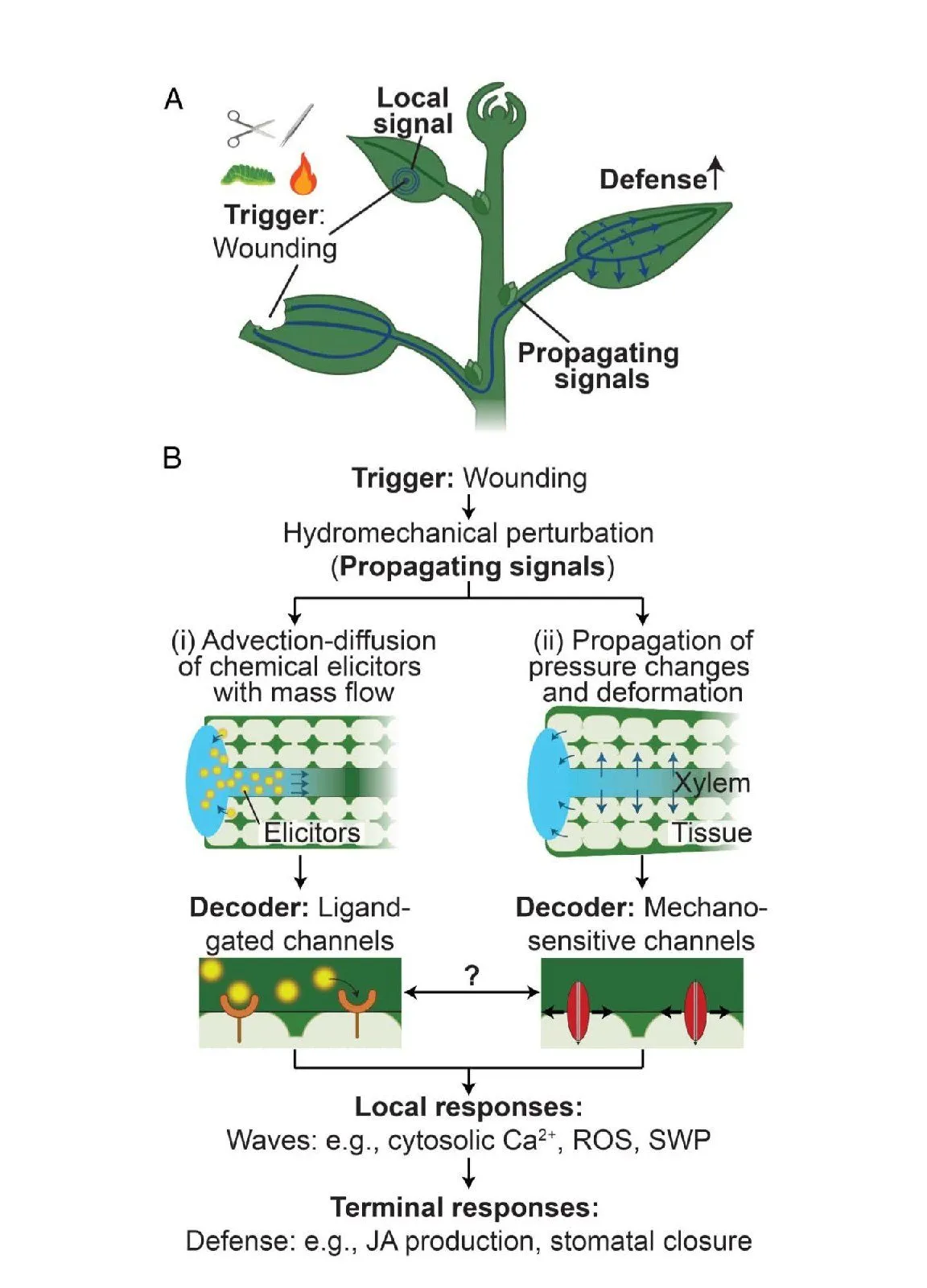
Like animal neurons, plant cells maintain membrane potential gradients using calcium, potassium, and chloride ions. Upon physical damage or insect attack, cells generate action potentials and variation potentials. Real-time fluorescent calcium imaging reveals that distress waves propagate from wounded leaves through the vascular xylem and phloem to distant roots within seconds, priming distant foliage for defense.
2. Phytohormones and Tropisms
Chemical messengers known as phytohormones direct developmental adaptations. Auxin distributes toward shaded stem tissues, stimulating cell elongation that bends stems toward sunlight—a directional response called phototropism. Concurrently, abscisic acid accumulates during drought to close stomata and conserve moisture, while ethylene regulates fruit ripening.
3. Genetic Programming and Decentralized Intelligence
Every plant cell operates as a localized information processor. Without a central brain, environmental signals switch developmental genes on or off, orchestrating seed germination, geotropism (root growth downward), and photoperiodic seasonal flowering in a distributed neural-like architecture.
Nastic Movements and Touch Reflexes
Direction-independent rapid responses, termed nastic movements, showcase breathtaking plant reflexes. Touching the leaves of the sensitive plant (Mimosa pudica) triggers an instantaneous ionic flux that empties water from petiole pulvinus cells, causing the leaflets to fold shut in seconds. Similarly, the carnivorous Venus flytrap rapidly shuts its bivalved leaves when an insect touches its trigger hairs twice within twenty seconds, capturing prey via high-speed electromechanical transduction.
Habituation and Ecological Unity
Remarkably, plants display forms of behavioral habituation. When Mimosa pudica is subjected to harmless, repeated drops from a small height, it quickly learns the stimulus poses no threat and ceases folding its leaves to conserve energy. As Sir Jagadish Chandra Bose eloquently maintained, life expresses itself through diverse forms: animal nerves and plant sap are united in nature’s grand ecological harmony.