Google's Willow Chip: Quantum Computing and the Multiverse
Google’s Exponential Quantum Milestone
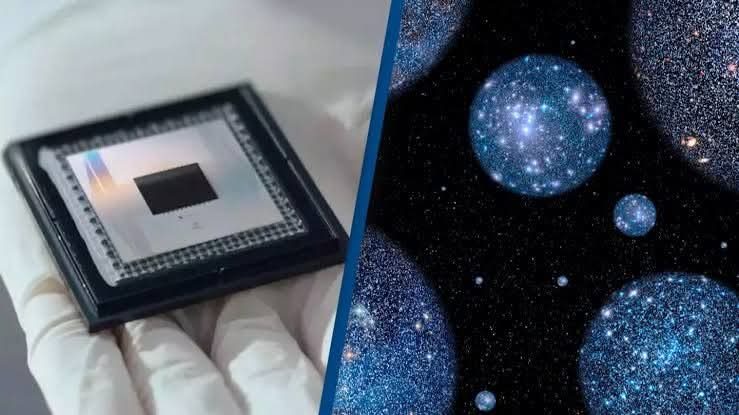
The global physics community was electrified by Google’s announcement of its latest quantum processor: Willow. In benchmark tests, the Willow chip resolved a hyper-complex mathematical problem in less than five minutes. For perspective, the world’s most capable classical supercomputer would require approximately 10 septillion years—a 1 followed by 24 zeros—to perform the same computation. That unfathomable timeframe exceeds the current age of our universe by trillions of times over. This feat not only underscores the explosive trajectory of quantum computing, but also reopens profound questions about the nature of physical reality.
The Multiverse Hypothesis and Quantum Reality
Willow’s exponential leap in computing speed has reignited debates surrounding the Many-Worlds Interpretation of quantum mechanics. Hartmut Neven, founder of Google’s Quantum AI lab, suggested that such computational throughput offers indirect support for the idea that quantum calculations unfold simultaneously across parallel universes. This viewpoint aligns closely with British theoretical physicist David Deutsch, who famously argued that a quantum processor achieves its staggering speed by delegating portions of its workload across countless parallel realities within a vast multiverse.
Scientific Skepticism and Classical Explanations
Not all physicists share the multiverse interpretation. Renowned astrophysicist and science writer Ethan Siegel points out that quantum phenomena such as superposition and entanglement can be mathematically understood without invoking an infinite ensemble of parallel universes. While acknowledging the Willow chip as a historic milestone in computer science, critics caution against conflating algorithmic performance with metaphysical proof of a multiverse.
A Breakthrough in Quantum Error Correction
Beyond raw calculation speed, the most crucial innovation in the Willow architecture lies in real-time quantum error correction. Historically, increasing the number of physical qubits in a quantum array escalated environmental noise and error rates—a phenomenon known as crosstalk. Willow overturned this barrier: as Google scaled the qubit count, the overall error rate decreased exponentially. This milestone is essential for building fault-tolerant quantum computers capable of simulating complex molecules, designing room-temperature superconductors, and transforming artificial intelligence.
Looking Toward Commercial and Scientific Frontiers
While fault-tolerant quantum computing remains in specialized laboratory settings, the breakthrough represented by Google’s Willow chip marks a decisive turning point. As quantum error correction matures, the line separating science fiction from computational reality continues to blur.