Dark Matter: Parallel Worlds or Invisible Particles?
Dark matter remains one of modern physics’ most captivating enigmas. Astronomers know it is out there because its gravitational influence is etched across the cosmos. Spiral galaxies rotate so rapidly that the gravity of visible stars and gas cannot keep them intact. Gravitational lensing around galaxy clusters bends background starlight far more than visible matter accounts for. Yet while dark matter constitutes roughly 27 percent of the cosmic energy budget, physicists have never detected what it is made of.
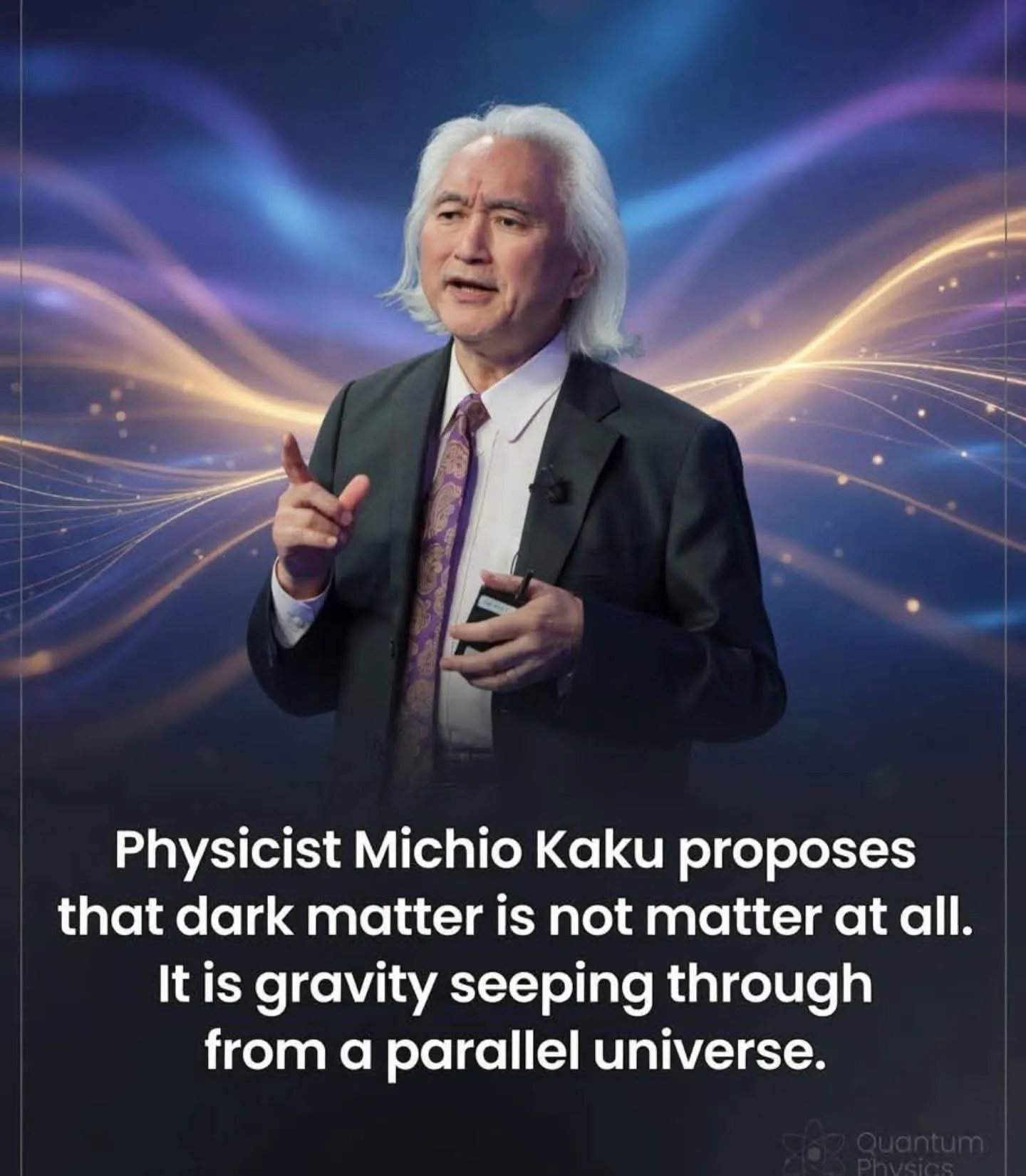
Theoretical physicist and author Michio Kaku offers a provocative hypothesis rooted in string theory and M-theory. Under these models, our universe is a three-dimensional membrane, or “brane,” floating within a higher-dimensional hyperspace. Parallel universes may hover millimeters away in higher-dimensional coordinates, completely beyond our sensory perception. Crucially, while electromagnetic and nuclear forces are confined to our brane, gravity may leak across dimensions.
If this occurs, what we identify as dark matter may not be exotic particles at all. Instead, it could be the gravitational footprint of ordinary matter residing in a neighboring parallel universe, exerting its pull across the dimensional divide. We feel its gravity without ever being able to see or touch its source—much like hearing footsteps on the other side of an impenetrable wall.
Kaku’s scenario sounds like speculative fiction, but conventional particle hypotheses face their own challenges. For decades, experimentalists have searched for candidate particles—WIMPs, axions, sterile neutrinos—using massive cryogenic detectors deep underground and space-based observatories, without a single confirmed detection.
While string theory remains mathematically unverified by collider experiments, open questions regarding dark matter compel physicists to consider bold alternatives.
Kaku’s hypothesis represents an imaginative possibility at the frontier of theoretical cosmology. The history of physics demonstrates that nature rarely conforms to simplistic expectations; sometimes ultimate reality proves far stranger than our initial intuition.