Genome Sequencing: The Reality of DNA Code and the Mystery of Life

Beyond the Media Hype: What Does “Unlocking Life” Mean?
In recent years, sensational news headlines frequently proclaim that scientists have “unlocked the mystery of life” for organisms ranging from jute and hilsa fish to the Black Bengal goat through high-throughput DNA analysis. In Bangladesh, national attention surged in 2010 when researchers successfully completed the draft genome sequence of the golden jute fiber plant.
While sequencing a genome is unquestionably a major technological triumph, equating raw sequencing with fully “solving life’s mysteries” reflects a popular misconception. To understand what genome sequencing actually achieves, we must examine the molecular reality of genetic information.
The DNA Blueprint: The Four-Letter Alphabet
A genome represents the complete collection of an organism’s genetic material encoded in deoxyribonucleic acid (DNA). Packaged within chromosomes inside the cell nucleus, DNA exists as an elegant double helix formed by alternating sugar-phosphate backbones connected by four nitrogenous bases:
- Adenine (A) — pairs exclusively with Thymine (T)
- Guanine (G) — pairs exclusively with Cytosine (C)
These four letters—A, T, G, and C—constitute the universal code of terrestrial life. The human genome contains approximately three billion base pairs distributed across twenty-three chromosome pairs.
Genes Versus the Genome: Needles in a Massive Haystack
A common misunderstanding is that the entire genome consists of functional genes. In reality, a gene is a specific nucleotide sequence that encodes a functional product—typically a messenger RNA that guides the synthesis of a specific structural protein or enzyme.
In complex multicellular organisms, protein-coding genes constitute an astonishingly small fraction of total DNA. In humans, only about $1.5\%$ of our three billion base pairs code for proteins—totaling roughly $20,000$ genes. The vast remainder consists of non-coding DNA, regulatory enhancers, introns, repetitive sequences, and ancient transposable elements. Identifying coding genes within billions of base pairs is truly like searching for needles within a vast haystack.
The True Nature of Genome Sequencing
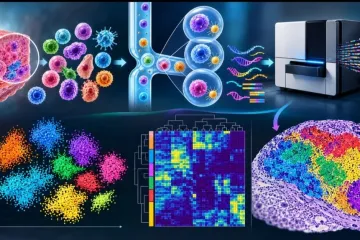
Genome sequencing is the technical process of determining the exact chemical order of base pairs (ATGC) throughout an organism’s DNA. Using modern automated Next-Generation Sequencing (NGS) platforms, massive computers assemble millions of short overlapping fragments into contiguous chromosomal scaffolds.
However, obtaining the raw sequence is merely like printing an encyclopedia written in an unknown language. Knowing the letter sequence does not automatically explain what each sentence means:
- Which sequences correspond to active genes versus inactive pseudogenes?
- How are genes turned on and off across different developmental stages and tissues?
- How do proteins fold into three-dimensional molecular machines and interact in cellular pathways?
The True Frontier: Functional Genomics
Answering these deep biological questions is the domain of functional genomics, transcriptomics, and proteomics. Determining how a specific genetic variant imparts disease resistance or climate resilience requires years of laborious gene knockout studies, biochemical assays, and field validations.
Thus, genome sequencing is not the final unraveling of life’s mystery, but rather the essential first blueprint that enables genuine biological discovery to begin.