The Tunguska Explosion: The 1908 Cosmic Mystery That Shook Siberia
The Morning the Sky Split Open
On the morning of June 30, 1908, in the remote taiga forests near the Podkamennaya Tunguska River in central Siberia, a peaceful summer dawn was shattered by a catastrophic cosmic detonation. Eyewitnesses hundreds of kilometers away reported seeing a bluish-white fireball, brighter than the midday sun, streak across the sky before exploding with apocalyptic fury.
The resulting atmospheric shockwave was so immense that it hurled people to the ground sixty kilometers away, shattered windows hundreds of miles distant, and registered on seismographs across London, Paris, and Washington. For several nights following the blast, nocturnal skies over northern Europe and Russia glowed so brightly that people could read newspapers at midnight without artificial light.
The Soviet Expeditions: A Landscape of Devastation
Preoccupied with political unrest and World War I, Tsarist Russia conducted no formal scientific inquiry. It was not until 1927, nearly two decades later, that Soviet mineralogist Leonid Kulik led the first scientific expedition into the frozen, swampy Tunguska wilderness.
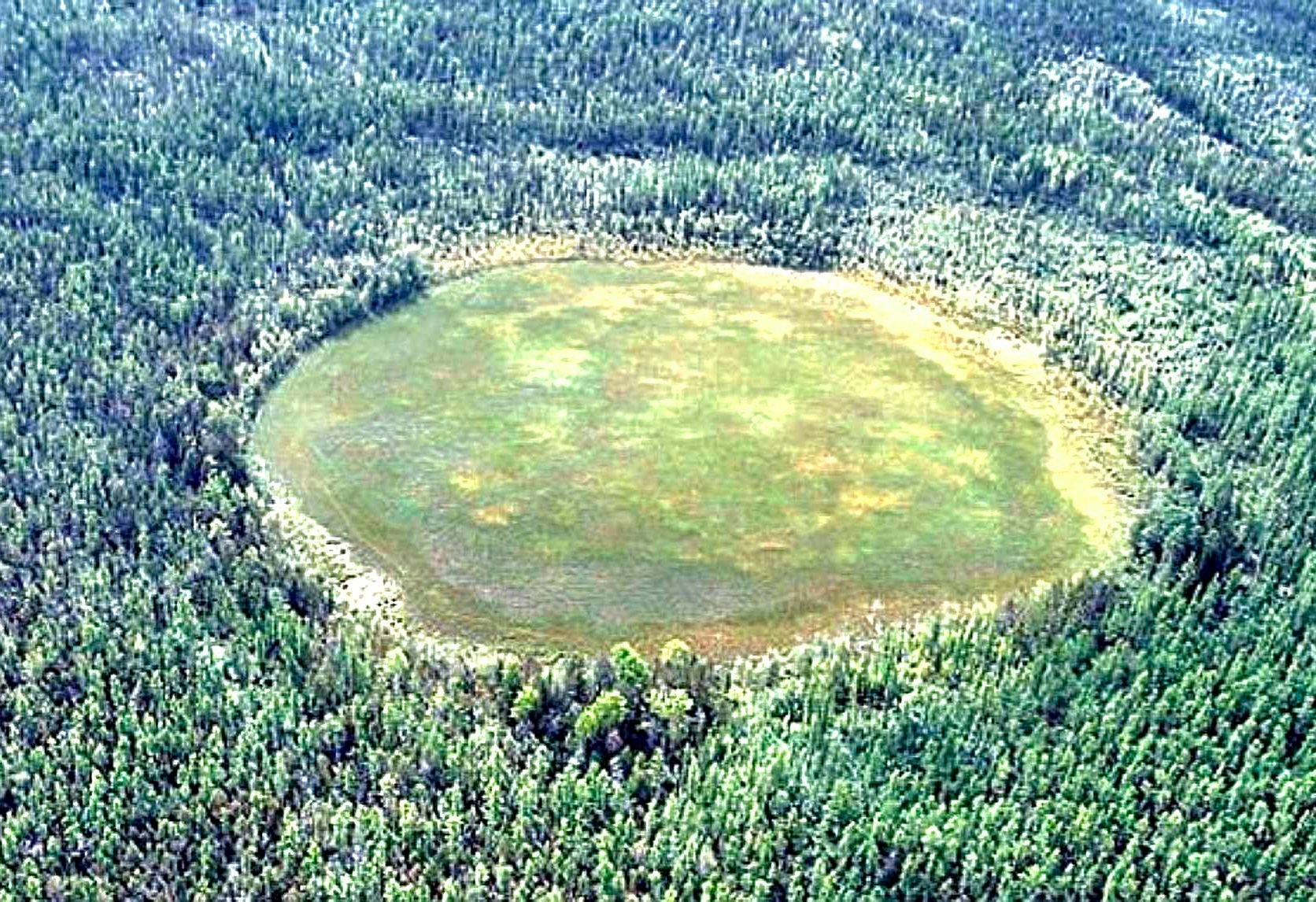
Kulik expected to find a colossal impact crater gouged into the earth by a massive metallic meteorite. Instead, the expedition was confronted by a bewildering scene of devastation:
- More than $2,000$ square kilometers ($770$ square miles) of dense taiga forest had been completely flattened.
- An estimated eighty million trees were scorched and blown flat in a radial, outward pattern resembling a gigantic butterfly.
- At the exact hypocenter, stands of trees remained standing completely upright, though their bark and branches had been entirely stripped away like scorched telephone poles.
- Critically, there was no impact crater anywhere to be found.
The Physics of an Atmospheric Airburst
Subsequent computational modeling and isotopic analyses solved the enigma of the missing crater: the Tunguska explosion was not a ground impact, but a high-altitude atmospheric airburst.
Astrophysicists calculate that a stony asteroid or fragment of a comet, measuring approximately $50$ to $100$ meters ($160$ to $330$ feet) in diameter, entered Earth’s atmosphere at a velocity of roughly $15$ to $30$ kilometers per second. Ram pressure compressed the atmospheric gases in front of the bolide, heating the object to thousands of degrees until the tremendous mechanical stress caused the projectile to violently disintegrate five to ten kilometers above the surface.
The energy yield of this detonation is estimated at ten to fifteen megatons of TNT—equivalent to nearly one thousand Hiroshima atomic bombs detonating simultaneously.
Planetary Defense and Near-Earth Objects
Had the Tunguska airburst occurred just four or five hours later, Earth’s daily rotation would have positioned major population centers like Saint Petersburg or Stockholm directly beneath the hypocenter, causing catastrophic loss of life.
Today, space agencies including NASA and ESA maintain continuous surveillance of Near-Earth Objects (NEOs) to track potentially hazardous asteroids. Missions like NASA’s DART (Double Asteroid Redirection Test) demonstrate humanity’s active capability to alter asteroid trajectories, ensuring that the ancient cosmic violence of the Tunguska explosion will not catch modern civilization unprepared.