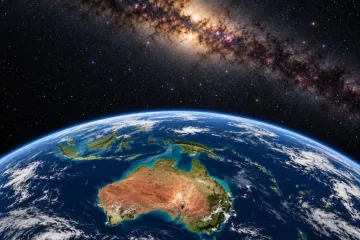
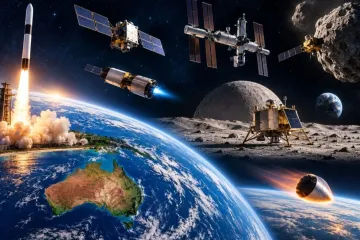
Earth from the Moon: A Surreal View of Our Cosmic Home
The Desolate Lunar Landscape and Two-Week Days
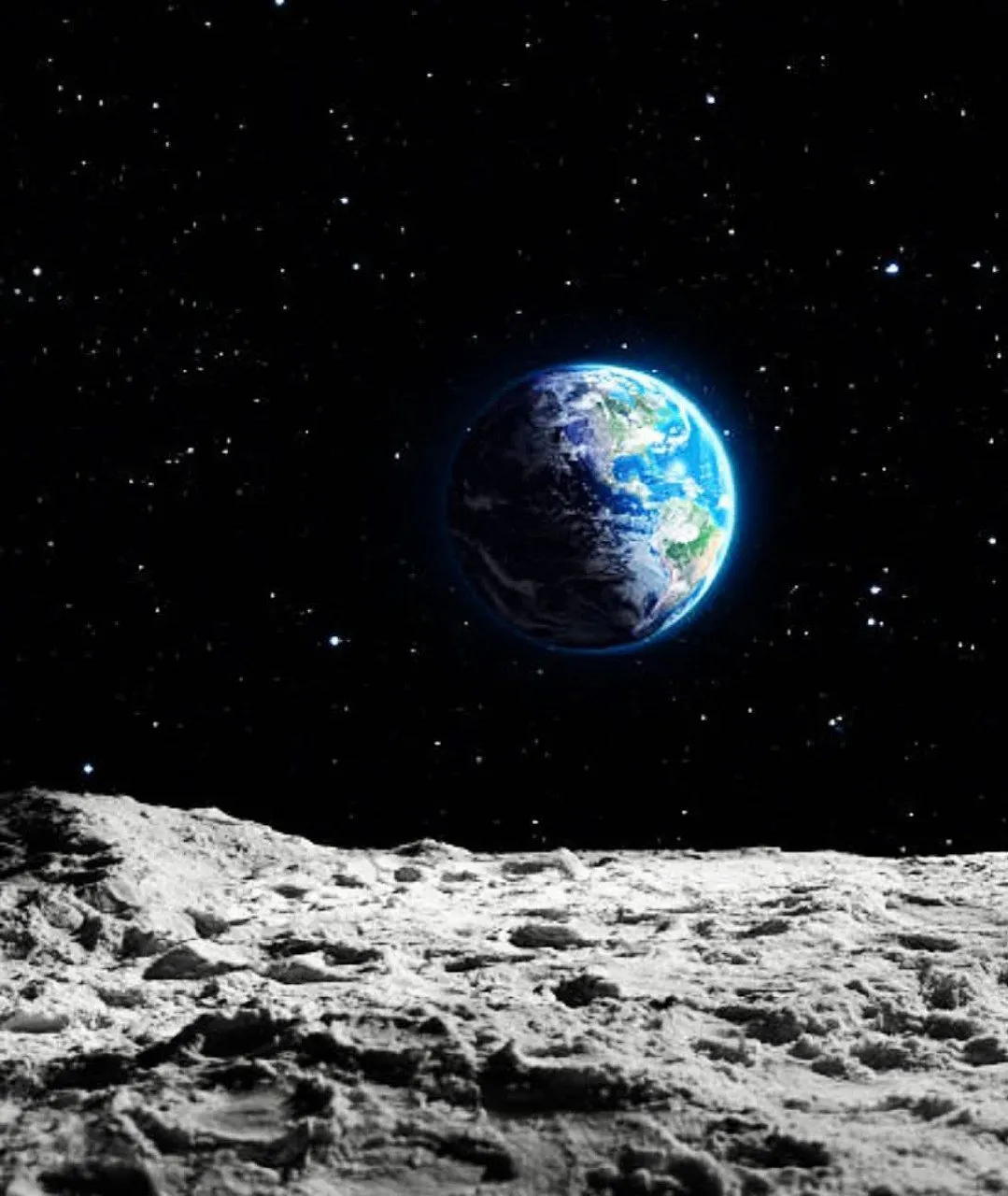
Imagine standing alone on the surface of the Moon. Around you stretches a silent, alien wilderness of powdery grey regolith, rugged craters, and ancient scars left by meteor impacts. Above you hangs an ink-black sky. Day and night on the Moon follow an entirely different rhythm than on Earth. Because the Moon takes nearly a month to complete a single rotation, lunar day and night each last roughly two continuous weeks. Wherever you stand, you are enveloped either in a fortnight of perpetual sunshine or a fortnight of freezing night.
An Atmosphere-Free Sky and Unblinking Stars
Countless stars pepper the lunar sky, but they do not twinkle. Without an atmosphere to scatter and refract starlight, every star shines with crisp, steady brilliance. During the daytime, the Sun blazes overhead, but devoid of atmospheric diffusion, it casts razor-sharp shadows across a blindingly bright white surface. The light carries an eerie, sterile clarity without the warm golden hues familiar to Earth.
The Radiant Blue-Green Earth Suspended in Space
As you lift your gaze toward the zenith, you are greeted by a breathtaking sight: a magnificent blue, green, and white sphere suspended motionless against the velvet darkness. It is our home planet, Earth, shining like a luminous celestial jewel.
The Immensity of Earth in the Moon’s Sky
From the near side of the Moon, Earth is permanently visible, hanging steadily overhead. While the Moon appears as a modest silver disc in our sky, Earth seen from the Moon looms nearly four times wider in diameter and shines with up to thirteen times greater surface area and luminous albedo. It dominates the black heavens with mesmerizing grandeur.
Tidal Locking and a Motionless Beacon
In the lunar sky, Earth never rises or sets. It appears permanently pinned in place as if mounted on an invisible pedestal. This occurs because the Moon is tidally locked to Earth: gravitational interactions over billions of years have synchronized the Moon’s rotation period with its orbital period. Consequently, the same lunar hemisphere always faces our planet, while the far side never catches a glimpse of Earth.
The Gentle Wobble of Libration
Although Earth remains virtually stationary in the lunar sky, it is not completely fixed. Due to the Moon’s elliptical orbit and slight axial tilt, the Moon experiences a gentle apparent wobble known as libration. To a lunar observer, Earth slowly drifts in a subtle, looping figure-eight motion over the course of each month, nodding and swaying gently against the background stars.
The Dynamic Panorama of a Living World
Even though Earth stays pinned in the sky, its appearance transforms continuously as it spins on its 24-hour axis. From thousands of miles away, the vitality of our world is vividly apparent. Deep blue oceans reflect radiant sunlight, swirling white cloud patterns drift across vast continents, and vibrant green rainforests emerge into daylight. As twilight envelops one hemisphere, spiderwebs of artificial golden light trace out bustling metropolitan cities, while the other hemisphere awakens to sparkling daytime vistas. Every twenty-four hours, the entire living planet unfolds before your eyes.
Our Fragile Oasis in the Cosmic Ocean
Gazing at Earth from the Moon shifts human consciousness completely. Earth is no longer merely “the ground”; it becomes a fragile, incandescent oasis suspended in the endless cosmic void. No other world in our solar system possesses such breathtaking hues of liquid water, swirling atmospheres, and thriving life. Viewing Earth from the Moon evokes profound humility, reminding us of our smallness, the uniqueness of our celestial home, and our shared responsibility to preserve it.