Whirlpools of Time: The Milky Way's Monster Black Hole and Star S62
The Supermassive Black Hole at the Galactic Center
At the very center of our Milky Way galaxy lurks a dormant cosmic leviathan: Sagittarius A* (Sgr A*). This supermassive black hole contains a mass equal to roughly 4 million suns compressed into a region smaller than the inner solar system. Located roughly 26,000 light-years from Earth, Sagittarius A* was confirmed through decades of meticulous infrared observations, earning astronomers Andrea Ghez and Reinhard Genzel the 2020 Nobel Prize in Physics.
The Astonishing Velocity of Star S62
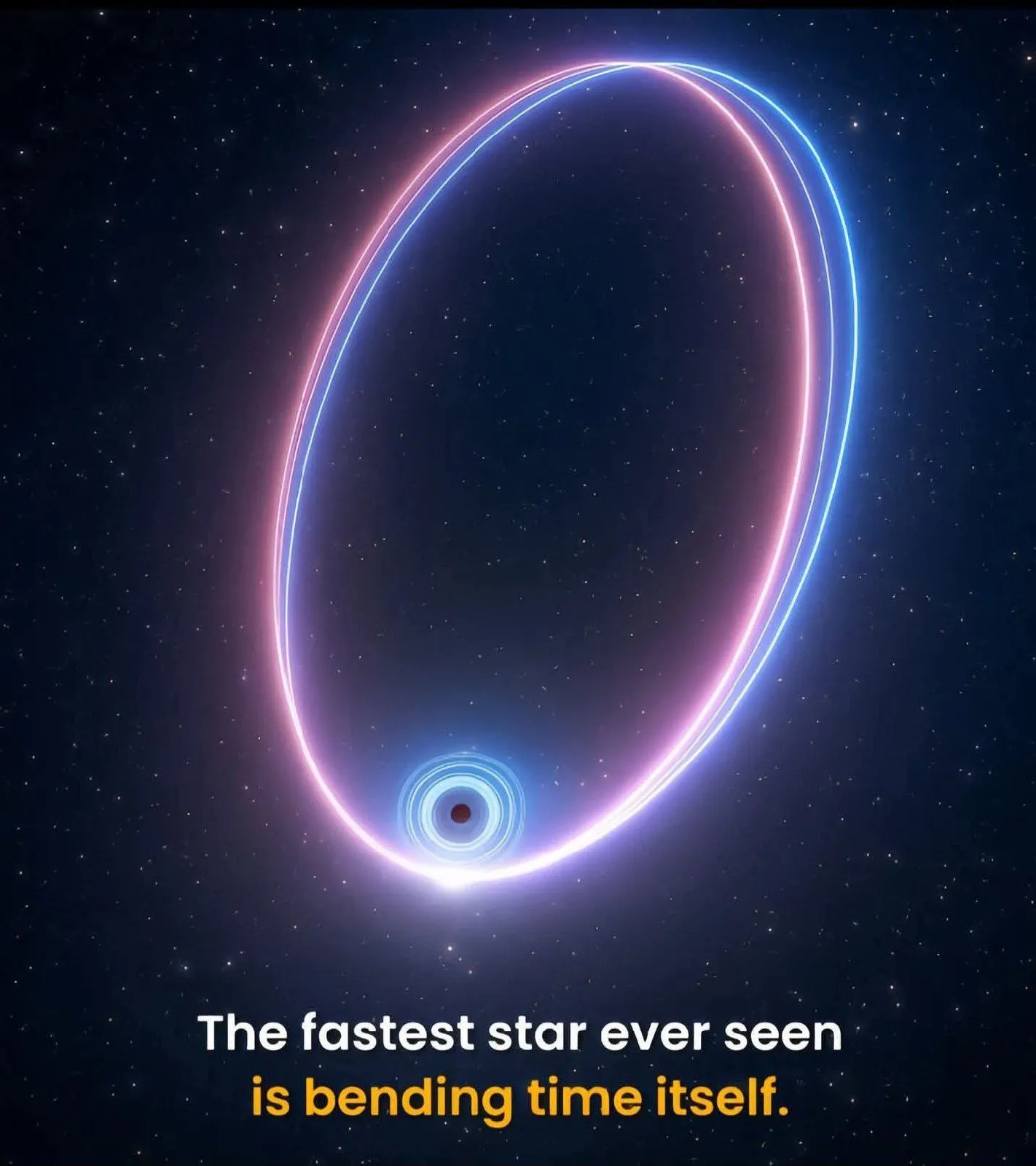
Orbiting dangerously close to this gravitational abyss is a hyper-velocity star named S62. Astronomers have identified S62 as one of the fastest moving stars in the entire cosmos. At periastron—its point of closest approach to the black hole—S62 hurtles through space at an astonishing 24,000 kilometers per second, reaching roughly 8 percent of the speed of light. Plunging through such extreme gravitational and kinetic regimes profoundly alters the passage of time for the star itself.
Time Dilation: When Clocks Slow Down
According to Einstein’s theories of relativity, as S62 sweeps through the intense gravitational well of Sagittarius A* at relativistic speeds, time slows down significantly. Because of this combined gravitational and kinematic time dilation, an hour passing on Star S62 corresponds to roughly one hour and forty minutes for observers watching from Earth.
Einstein’s Relativity and Spirograph Orbits
Star S62 completes a single orbit around Sagittarius A* every 9.9 years. Yet its orbital trajectory does not form a tidy closed ellipse. Instead, the orbital orientation precesses dramatically, shifting by approximately 10 degrees with every revolution in an intricate spirograph pattern. Isaac Newton’s classical mechanics cannot account for such extreme precession; only Einstein’s General Relativity accurately predicts the curved geometry of spacetime dictating this orbital dance.
Gravitational Redshift and Relativistic Astrophysics
Orbital precession was first famously observed on a minute scale in Mercury’s orbit around the Sun. But in the extreme environment around S62, the effect is magnified to an astonishing degree. In 2018, astronomers tracked another central star, S2, confirming the gravitational redshift of light climbing out of the black hole’s gravitational well. S62 pushes these empirical measurements into even more extreme relativistic domains.
Probing the Frontiers of Gravity
S62 serves as a natural astrophysical laboratory. Every time it swoops past periastron, astrophysicists gain invaluable opportunities to scrutinize how extreme gravity distorts space and dilates time at the galactic core. The universe has provided us a ringside seat to witness nature’s most radical physics unfold before our telescopes.