Primordial Black Holes and Cosmic Origins: Stephen Hawking's Revolutionary Theory

The Birth of the Universe and the Big Bang Theory
For decades, cosmologists have posited that our boundless universe originated from a colossal explosion known as the Big Bang. Before that singular instant, there was neither time, nor space, nor matter. Everything in existence suddenly burst forth into being in a single flash. This framework remains the prevailing paradigm in modern cosmology.
Stephen Hawking’s Legacy and Modern Astrophysics
Yet captivating new observations suggest this familiar narrative may not tell the whole story. A visionary theory first proposed by theoretical physicist Stephen Hawking in the 1970s has resurfaced at the center of astrophysics, promising to fundamentally rewrite how we understand the cosmic dawn.
Primordial Black Holes in the Early Cosmos
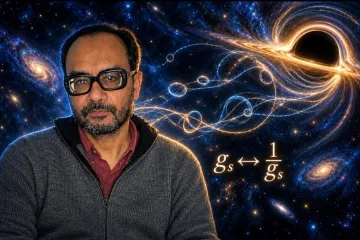
In the early 1970s, Hawking proposed that during the ultra-dense, turbulent opening moments of the Big Bang, localized density fluctuations collapsed directly into microscopic yet hyper-dense entities dubbed “primordial black holes.” These were microscopic bundles of extreme energy forged amidst the chaotic primordial plasma. Hawking subsequently demonstrated that black holes are not completely black; they slowly evaporate by shedding energy through a quantum process now celebrated as Hawking radiation.
Hawking Relics and the Enigma of Dark Matter
As primordial black holes evaporate, they discharge intense bursts of high-energy radiation. Cosmologists hypothesize that this immense energy injection played a pivotal role in catalyzing the earliest large-scale cosmic structures. Furthermore, as microscopic black holes evaporate down to the Planck scale, they may leave behind stable, subatomic remnants known as “Hawking relics.” Although invisible and undetectable through standard electromagnetic telescopes, these relics possess mass and gravitational pull. Leading theoretical physicists suggest these relics could explain the long-sought identity of dark matter—the invisible substance comprising roughly 85 percent of all matter in the universe.
Observational Clues and the AMS-02 Detector
Excitingly, recent observational methodologies have brought Hawking’s predictions closer to empirical proof than ever before. Research published in 2025 demonstrated that if lingering primordial black holes pass through our solar system, they should emit distinct radiation signatures detectable by orbiting instruments such as the Alpha Magnetic Spectrometer (AMS-02) aboard the International Space Station. Detecting this unique emission would provide humanity’s first direct confirmation of primordial black holes.
Re-evaluating Hawking Radiation and Dark Matter Lifespans
Simultaneously, parallel research has revealed that Hawking radiation for certain quantum black hole regimes may proceed at a substantially slower rate than classical approximations assumed. This implies that light-mass primordial black holes formed during the Big Bang could comfortably survive into the present epoch, making them exceptionally compelling candidates for cosmic dark matter.
Puzzling Discoveries by the James Webb Space Telescope
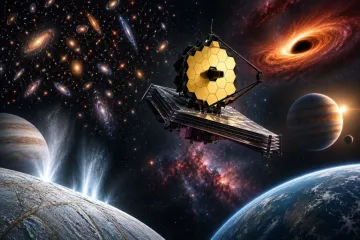
These theoretical breakthroughs are bolstered by unexpected discoveries from the James Webb Space Telescope (JWST). Deep-field JWST surveys have uncovered fully formed, supermassive black holes lurking in infant galaxies merely a few hundred million years after the Big Bang. Standard stellar collapse cannot explain how black holes grew so colossal so rapidly, prompting many astrophysicists to suspect they grew from seed primordial black holes seeded at the dawn of time.
KM3NeT Detector and Ultra-High-Energy Neutrino Detections
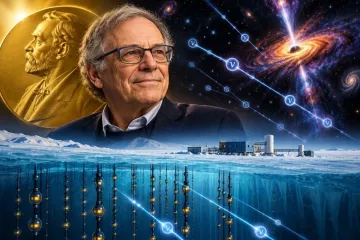
Perhaps the most thrilling observational clue has arrived from the abyssal depths of the Mediterranean Sea. The KM3NeT neutrino telescope recently detected an ultra-high-energy cosmic neutrino whose trajectory and energy profile match predictions for an evaporating primordial black hole. While further statistical verification is underway, such events offer tantalizing physical validation for Hawking’s quantum gravitational insights.
A Cosmic Transformation and the Rewriting of Genesis
Taken together, these revelations are driving a profound paradigm shift. It is possible that the Big Bang was not a singular explosive event springing from absolute nothingness, but a phase transition—perhaps the interior collapse of a black hole in a parent universe. If true, the opening chapters of our cosmic chronicle require bold revision. Stephen Hawking sketched the blueprint decades ago; only now do our instruments possess the sensitivity to decipher his profound cosmic vision.