Discovery of a Young Galaxy 12 Billion Light-Years Away Challenges Cosmic History

Peering into the Primordial Cosmos
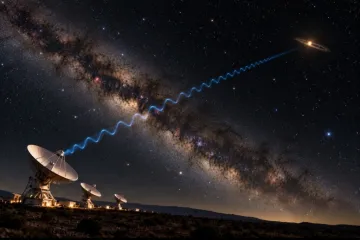
An international team of astrophysicists utilizing the Atacama Large Millimeter/submillimeter Array (ALMA) in Chile made an astonishing observation: the discovery of a young galaxy located more than twelve billion light-years from Earth. Designated SPT0418-47, the light captured by our radio observatories began its cosmic journey when the universe was barely $1.4$ billion years old—less than ten percent of its current age.
The discovery, published in the prestigious journal Nature, has challenged established models of galactic evolution, forcing astronomers to rethink how structures formed during the cosmic dawn.
The Power of ALMA and Gravitational Lensing
Perched at an altitude of $5,000$ meters on the Chajnantor Plateau in northern Chile, ALMA is an astronomical interferometer consisting of sixty-six high-precision parabolic antennas. By synchronizing millimeter and submillimeter radio waves, ALMA achieves angular resolution sharper than optical space telescopes.
To resolve SPT0418-47 across twelve billion light-years of expanding spacetime, the team leveraged a natural cosmic magnifying glass: gravitational lensing. Einstein’s general relativity dictates that massive foreground galaxy clusters warp the path of light traveling from background objects. The foreground galaxy’s gravitational field magnified and distorted SPT0418-47 into a near-perfect ring of radio emission—an Einstein ring—which researchers digitally reconstructed into an ultra-sharp portrait of the distant galaxy.
An Unexpectedly Orderly Spiral Disk in the Early Universe
Standard cosmological models of the early universe predicted that primordial galaxies were chaotic, turbulent environments. Following the Big Bang, rapid gas accretion, relentless galactic mergers, and intense supernova feedback were believed to keep young galaxies violently agitated, preventing the formation of stable structures.
Astonishingly, SPT0418-47 revealed the exact opposite:
- Stable Rotating Disk: Spectroscopic velocity maps confirmed that the galaxy possesses a cold, dynamically stable rotating disk, spinning smoothly much like our mature Milky Way.
- Central Bulge: The galaxy exhibits a prominent central stellar bulge—the first time a distinct galactic bulge has ever been detected in an infant galaxy so close to the Big Bang.
Implications for Cosmological Evolution
The discovery indicates that the complex physical mechanisms required to settle gas into organized, rotating spiral structures operated far more rapidly than previously thought. Rather than requiring billions of years of chaotic accretion to stabilize, galaxies in the early cosmos could achieve dynamic equilibrium in a fraction of that time.
While SPT0418-47 resembles a spiral galaxy in its kinematics, astronomers anticipate it evolved into an entirely different morphology today. Given its high star-formation rate, it likely merged with other structures over the ensuing twelve billion years, evolving into a colossal elliptical galaxy in the contemporary cosmos.
Conclusion
The discovery of a young galaxy like SPT0418-47 demonstrates that our cosmic nursery held surprises that theoretical models failed to anticipate. As next-generation observatories peer deeper into the dark ages of the cosmos, ancient light continues to illuminate the rich tapestry of galactic genesis.