Dark Energy and Dark Matter: The 95 Percent Unknown Universe
Cosmic Expansion and the Vanishing Consensus
Following the discovery of the expanding universe by Edwin Hubble in the 1920s, classical cosmology assumed that mutual gravitational attraction would inevitably slow cosmic expansion over time, eventually leading to recollapse in a “Big Crunch.”
However, late-twentieth-century astrophysics overturned this assumption. Astronomical observations revealed that cosmic expansion is not slowing down; rather, it is accelerating at an ever-increasing rate. The invisible forces orchestrating this acceleration and holding galaxies together are dark energy and dark matter.
Type Ia Supernovae and the Accelerating Universe
In 1998, two independent international astronomical teams—the High-Z Supernova Search Team and the Supernova Cosmology Project—measured distances to Type Ia supernovae, which serve as cosmological “standard candles.”
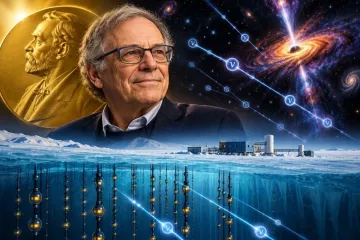
Led by Saul Perlmutter, Brian Schmidt, and Adam Riess, the observations revealed that distant supernovae were significantly dimmer than anticipated, proving that cosmic expansion began accelerating approximately five billion years ago. For this epochal discovery, the three astrophysicists were awarded the 2011 Nobel Prize in Physics.
Dark Energy: The Repulsive Energy of Empty Space
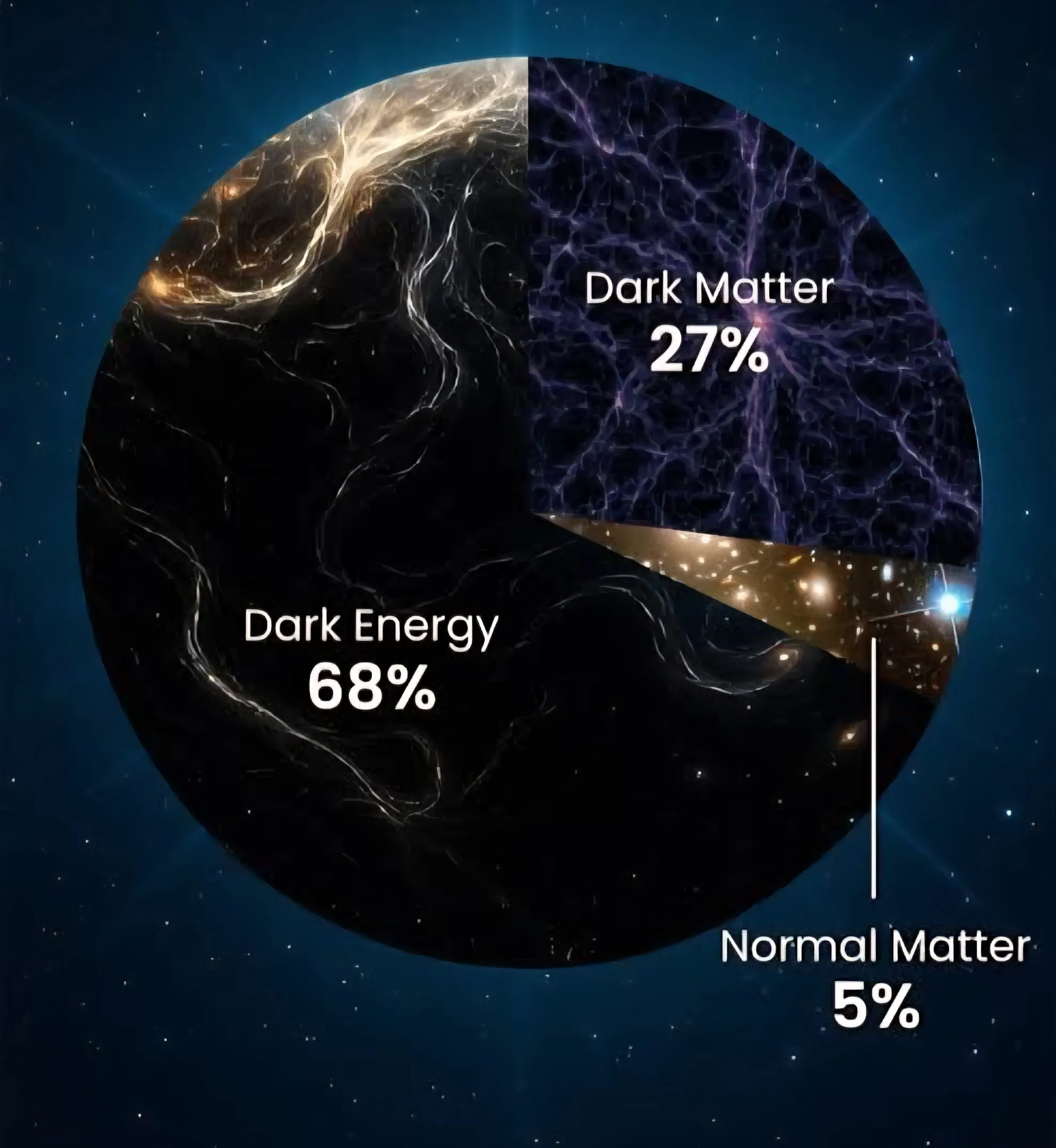
To account for cosmic acceleration, cosmologists introduced dark energy—a smooth, repulsive form of energy permeating all space uniformly. Calculations indicate that dark energy comprises approximately $68\%$ of the universe’s total energy budget.
Theoretical explanations include Einstein’s cosmological constant ($\Lambda$), representing the invariant vacuum energy of quantum spacetime, and dynamic scalar fields known as quintessence. Whatever its exact physical nature, dark energy works in direct opposition to gravity, driving galaxies ever further apart.
Dark Matter: The Invisible Gravitational Glue
Concurrently, observational astronomy verified that visible stars and gas account for only a fraction of galactic mass. In 1933, Swiss astronomer Fritz Zwicky noticed that galaxies within the Coma Cluster orbited too rapidly to remain bound by visible mass alone.
In the 1970s, Vera Rubin and Kent Ford confirmed flat galactic rotation curves in the Andromeda Galaxy and spiral systems, proving that vast halos of invisible dark matter envelope every galaxy. Dark matter comprises roughly $27\%$ of the universe. It emits, absorbs, and reflects no electromagnetic radiation, interacting almost exclusively via gravitation.
The Cosmic Budget: Humanity’s Humble 5 Percent
Combining cosmological data from the Planck satellite, cosmic microwave background surveys, and baryonic acoustic oscillations yields the definitive cosmic inventory:
- Dark Energy: $68\%$
- Dark Matter: $27\%$
- Ordinary Baryonic Matter: $5\%$
Every star, planet, galaxy, nebula, and living organism ever perceived constitutes merely five percent of the cosmos. The remaining $95\%$ consists of dark energy and dark matter, posing the greatest unresolved challenge in modern theoretical physics.