Black Holes: An Eternal Mystery of Cosmic Physics
The Genesis of Dark Stars
In 1783, English natural philosopher John Michell conceived a radical astronomical hypothesis: if a star were sufficiently dense and massive, its gravitational escape velocity would exceed the speed of light ($c$). Light emitted from its surface would be drawn back by gravity, rendering the object completely invisible. Michell coined the term “dark stars.”
Nearly two centuries later, in 1967, American theoretical physicist John Archibald Wheeler popularized the modern term for these gravitational enigmas: black holes.
Stellar Evolution and the Chandrasekhar Limit
Black holes are born from the deaths of massive stars. During a star’s main sequence lifetime, inward gravitational collapse is counterbalanced by outward radiative pressure generated by core thermonuclear fusion. When core hydrogen exhausts into helium, carbon, oxygen, and ultimately iron, fusion terminates.
In 1930, Indian-American astrophysicist Subrahmanyan Chandrasekhar calculated the maximum theoretical mass of an electron-degenerate white dwarf star—the celebrated Chandrasekhar limit of $1.44$ solar masses ($M_\odot$). Stellar remnants exceeding this threshold collapse catastrophically in a supernova detonation, creating either a neutron star or, if the core mass exceeds the Tolman-Oppenheimer-Volkoff limit (approx. $2.2–3.0\,M_\odot$), collapsing irreversibly into a black hole.
Spacetime Curvature and General Relativity
Einstein’s general relativity reveals that black holes are pure manifestations of extreme spacetime curvature. As Karl Schwarzschild proved in 1916, when a mass is compressed within its critical Schwarzschild radius ($r_s = 2GM/c^2$), spacetime curves infinitely inward.
The Anatomy of a Black Hole: Event Horizon and Singularity
A black hole features two defining theoretical boundaries:
- The Event Horizon: The one-way causal boundary of no return. Any matter, radiation, or information passing beyond this threshold can never escape to the outside universe.
- The Gravitational Singularity: The central core where matter is compressed to zero volume and infinite density, where known laws of classical physics and spacetime break down.
Imaging the Invisible: The Event Horizon Telescope
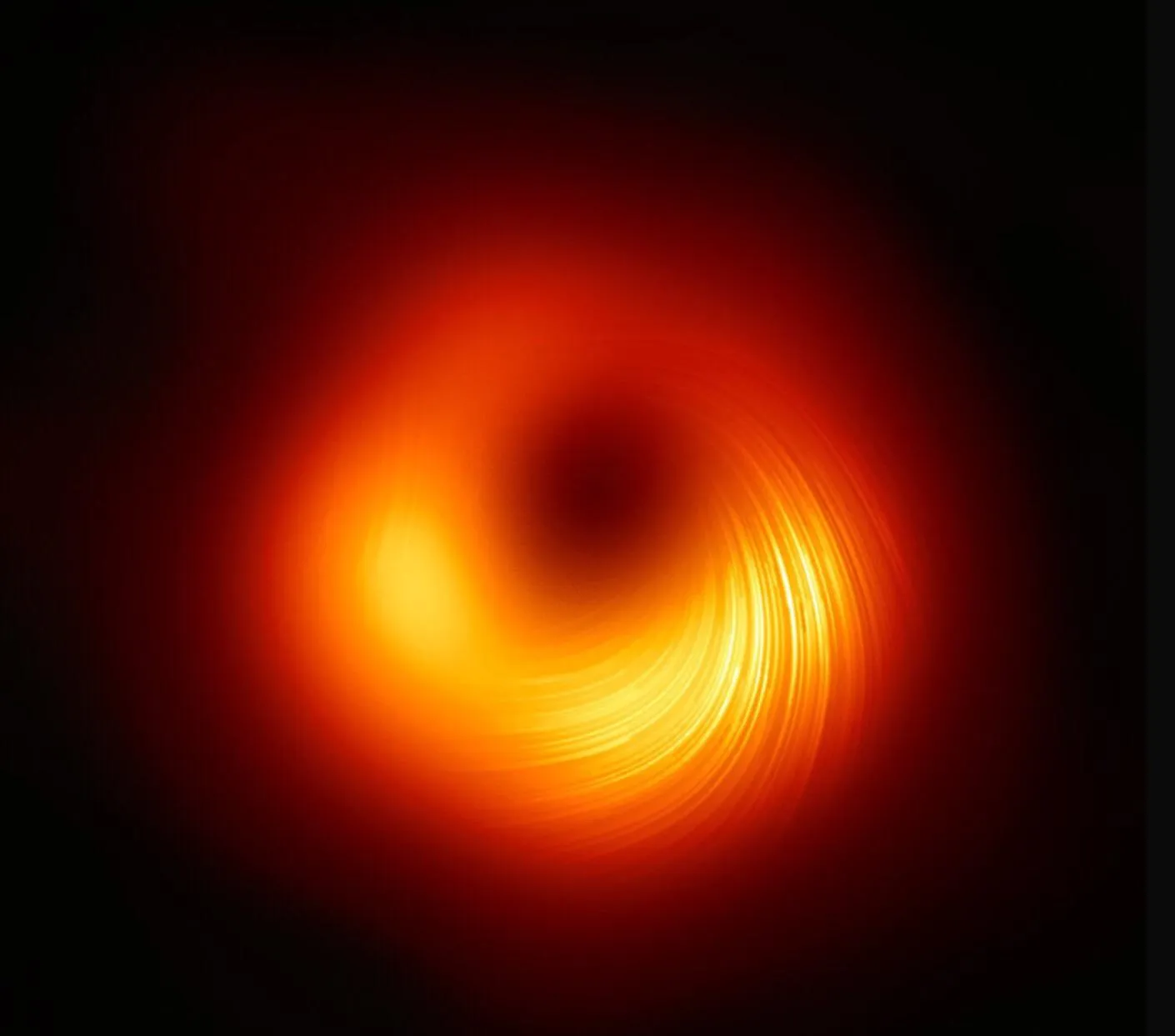
While light cannot escape the event horizon, glowing accretion disks of superheated gas surround active black holes. In April 2019, the global Event Horizon Telescope (EHT) collaboration released the first direct radio image of the supermassive black hole in galaxy Messier 87 (M87*), followed in 2022 by Sagittarius A* ($4.3$ million $M_\odot$) at the center of our Milky Way.
Hawking Radiation: Quantum Evaporation
In the 1970s, Stephen Hawking combined quantum field theory with general relativity to show that black holes are not eternal. Quantum vacuum fluctuations near the event horizon generate virtual particle pairs, allowing thermal Hawking radiation to escape. Over astronomical timescales, black holes slowly evaporate.
Black holes remain the ultimate cosmic testing ground where quantum mechanics and general relativity intersect, guiding theoretical physics toward a unified Theory of Quantum Gravity.