Wandering Black Hole: A Rare Stellar Feast Detected by Hubble
A Cosmic Cataclysm in Deep Space
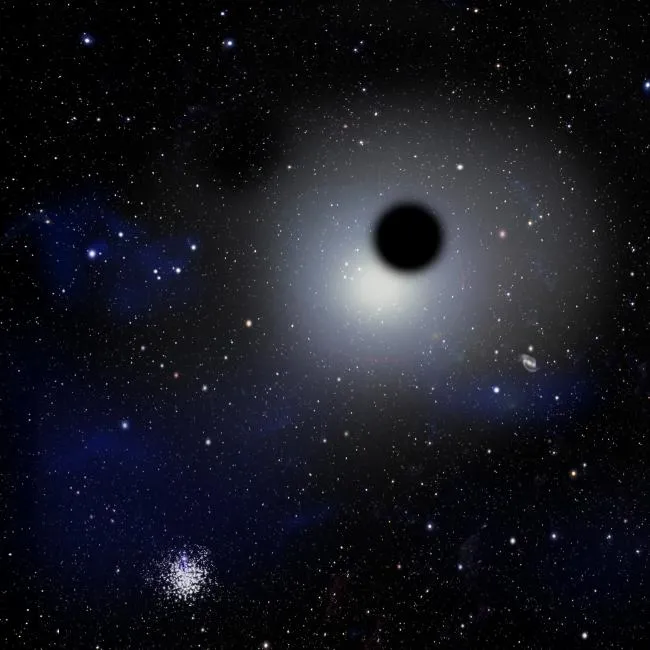
Approximately $600$ million light-years from Earth, an extraordinary astronomical event unfolded: an off-center intermediate-mass black hole ensnared and shredded an innocent star. This violent cataclysm represents a classic Tidal Disruption Event (TDE), designated by astrophysicists as AT2024tvd.
High-resolution spaceborne observations captured by NASA’s Hubble Space Telescope revealed that the perpetrator was not an ordinary galactic center resident, but a rogue wandering black hole prowling through the galactic outskirts.
Spaghettification: How Black Holes Devour Stars
First identified in August 2024 by the Zwicky Transient Facility (ZTF) in California, AT2024tvd generated an intense, transient flash of ultraviolet and optical luminosity. The radiation heralded the gruesome destruction of a passing star.
When a star ventures too close to a black hole, extreme differential gravitational tidal forces exceed the star’s internal self-gravity. In a violent process known as spaghettification, the stellar body is stretched vertically and compressed horizontally into a long, ribbon-like streamer of incandescent plasma before being drawn into an accretion disk.
Off-Center Discovery: 2,600 Light-Years from the Galactic Core
Supermassive black holes almost universally reside in the gravitational centers of host galaxies. However, collaborative follow-up observations conducted by Hubble, the Chandra X-ray Observatory, and the Very Large Array (VLA) pinpointed AT2024tvd at an unexpected location:
- The Tidal Disruption Event occurred approximately $2,600$ light-years off-center from the host galaxy’s galactic nucleus.
- The host galaxy already harbors a separate, quiescent supermassive black hole at its core containing roughly $100$ million solar masses.
This off-center orientation confirms that the snacking object is indeed a wandering black hole of approximately one million solar masses.
How Do Wandering Black Holes Form?
Astrophysical simulations suggest that wandering black holes originate through major galactic collisions. When two progenitor galaxies merge, their central supermassive black holes form a binary pair. If a gravitational merger or three-body interaction imparts an asymmetric gravitational-wave recoil kick, one black hole can be ejected or flung into a wide, eccentric wandering orbit throughout the newly formed galaxy.
Astrophysical Significance of AT2024tvd
The discovery of AT2024tvd provides direct empirical proof that dormant intermediate-mass and supermassive black holes drift through galaxies away from central nuclei, remaining entirely invisible until an unlucky star crosses their path. Events like AT2024tvd unlock invaluable insights into galactic merger dynamics and the census of black holes across cosmic time.