Spacetime and the Block Universe: Is Time Really Flowing?
Cosmic Fabric and Einstein’s Revolution
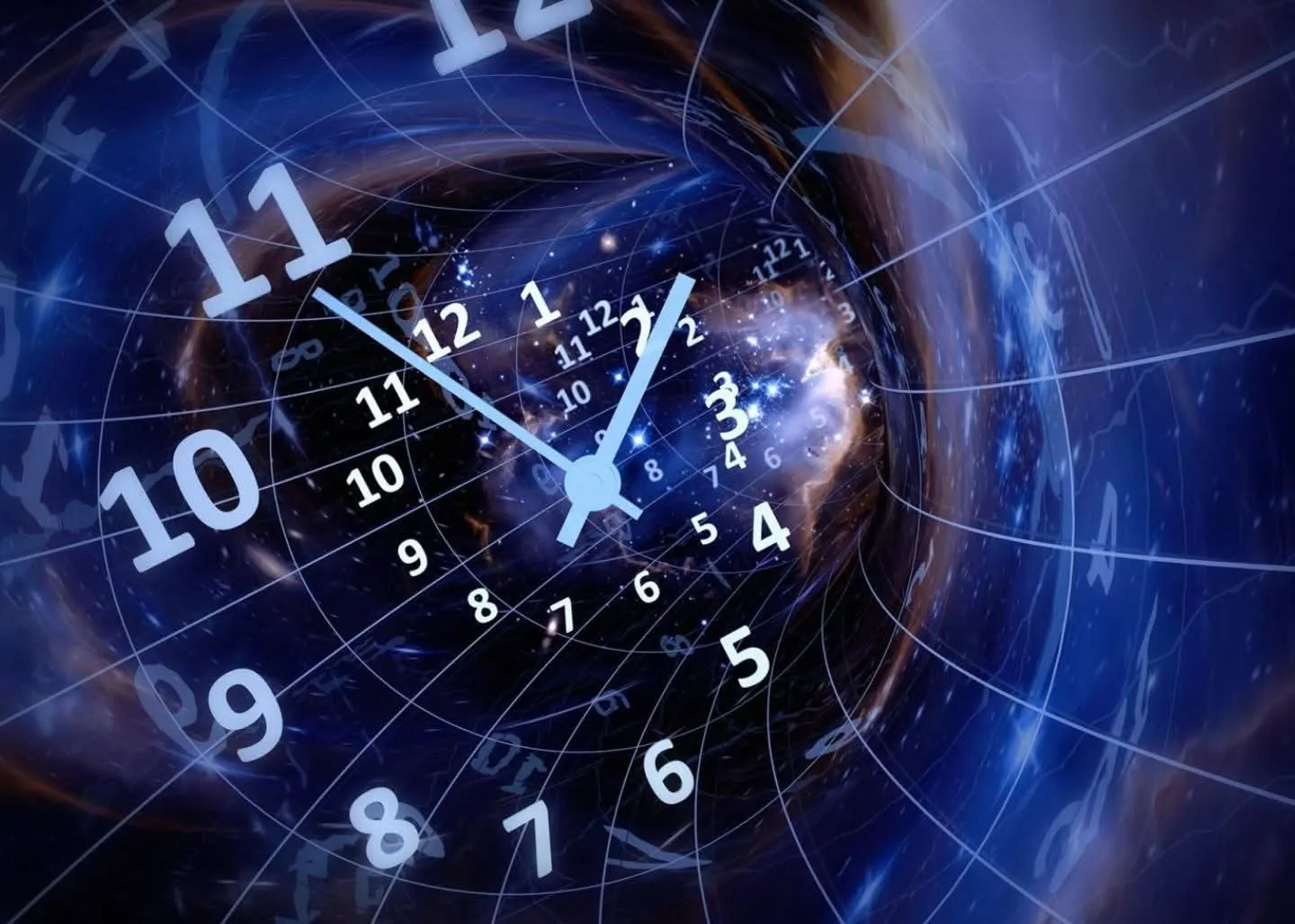
Human perception experiences time as an irreversible river flowing relentlessly from the past through the present into the future. However, modern physics tells a vastly different story. Albert Einstein demonstrated that space and time do not exist as independent, absolute entities. Instead, they are woven into a unified four-dimensional continuum known as spacetime.
Mass and energy warp this cosmic fabric, and we perceive that curvature as gravity. In Einstein’s relativistic cosmos, the progression of time is relative to the observer’s motion and gravitational environment, shattering the Newtonian ideal of a universal cosmic clock.
Reality or Illusion: The Philosophy of Eternalism
Does the passage of time represent an objective physical process, or is it an artifact of human sensory perception? In the philosophy of time, the doctrine of eternalism posits that the past, present, and future exist simultaneously and with equal ontological validity. Under this view, what we label “now” is merely a subjective coordinate within a vast four-dimensional spacetime landscape, akin to describing a location as “here.”
The Block Universe Theory: A Static Reality
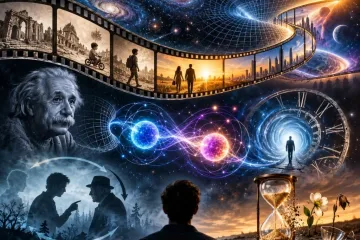
In theoretical physics, this conceptualization is formalized as the block universe theory. In a block universe, the history of the cosmos is treated as an unchanging four-dimensional block where every event that has ever occurred or ever will occur is permanently encoded. Time does not flow; instead, all temporal moments exist concurrently.
Just as all frames on a reel of film exist simultaneously regardless of which single frame a projector displays at any given second, past, present, and future events are permanently etched into the block universe. From a four-dimensional perspective, your birth, childhood, present moment, and distant future are all equally real.
Consciousness and the Illusion of Temporal Passage
If the universe is static, why do our minds perceive a persistent flow of time? Cognitive scientists and physicists suggest that temporal flow may be an emergent illusion created by human consciousness and biological memory. Just as ocean waves appear to travel across the surface while the underlying water molecules primarily oscillate in place, our neurological architecture constructs a narrative of moving time from stationary spacetime coordinates.
Modern Physics and Loop Quantum Gravity
Pioneering approaches in quantum gravity seek to resolve the nature of spacetime at fundamental Planck scales. In Loop Quantum Gravity (LQG), spacetime is not a smooth, continuous background, but is composed of discrete, quantized loops of gravitational field. At this sub-microscopic level, fundamental equations contain no explicit time variable, suggesting that both space and time emerge from deeper, timeless quantum entanglement networks.
The Arrow of Time and the Cosmic Mystery
Why then does thermodynamics exhibit a distinct arrow of time pointing toward increasing entropy? Why can we remember the past but not the future? The answer lies rooted in the low-entropy boundary condition of the Big Bang, where cosmic expansion initiated thermodynamic asymmetry.
Whether spacetime is a fundamental fabric or an emergent construct, the block universe challenges our deepest intuitions about existence, mortality, and reality, proving that the boundary between past, present, and future remains a stubbornly persistent illusion.