Wave-Particle Duality: Is Light a Particle or a Wave?
Newton vs. Huygens: Particle or Wave?
During the seventeenth century, Sir Isaac Newton conducted foundational experiments on the nature of light. Observing the dispersion of sunlight through glass prisms and the sharp shadows cast by obstacles, Newton concluded that light consists of streams of microscopic corpuscles traveling in straight lines.
Although his Dutch contemporary Christiaan Huygens championed the alternative view that light travels as waves through an ether medium, Newton’s immense authority dominated physics for more than a century, cementing the particle hypothesis.
Thomas Young and the Double-Slit Experiment
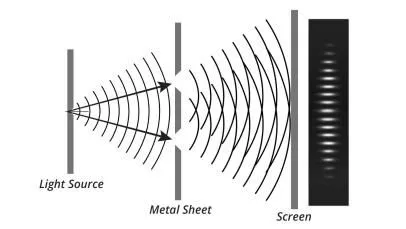
The first decisive challenge to the corpuscular theory arrived in 1801. English polymath Thomas Young devised an elegantly simple yet transformative investigation: the double-slit experiment.
Young directed sunlight through two closely spaced parallel slits onto a viewing screen. If light consisted purely of classical particles traveling in straight trajectories, two sharp bright bands would appear behind the slits. Instead, Young observed an alternating sequence of bright and dark fringes across the screen.
This phenomenon—an interference pattern—occurs when wave crests and troughs emanating from both slits overlap and interfere with one another. Constructive interference amplifies brightness, while destructive interference creates darkness. Young’s findings provided incontrovertible evidence of light’s wave nature.
Einstein and the Quantum Photoelectric Effect
For a century, light was definitively regarded as a continuous electromagnetic wave. But in 1905, Albert Einstein turned classical physics on its head. To explain the photoelectric effect—the emission of electrons from a metallic surface when illuminated by light—Einstein proposed that light consists of discrete energy packets, later named “photons.”
Wave theory failed to explain why light below a certain threshold frequency could never eject electrons regardless of intensity. Einstein demonstrated that incoming light behaves as discrete particle collisions, where individual photon packets transfer energy directly to individual electrons. It was for this revolutionary insight, not his theory of relativity, that Einstein was awarded the 1921 Nobel Prize in Physics.
The Enigma of Wave-Particle Duality
These contradictory findings left physics with a profound paradox: how could light exhibit wave interference while simultaneously interacting as localized particles? Modern physics embraced the concept of wave-particle duality.
Light possesses both wave and particle characteristics, but our observation method dictates which aspect manifests:
- In propagation, propagation pathways, and diffraction, light behaves as a continuous wave.
- During emission, absorption, and detection at a boundary, light acts as localized discrete quanta.
Electrons and the Quantum Observer Effect
In 1924, Louis de Broglie hypothesized that if light waves possess particle properties, material particles such as electrons should similarly exhibit wave properties. When physicists fired electrons through double slits, the detector screen revealed the exact same interference fringes observed with light waves.
Even more startling was firing electrons one by one at intervals. Over time, an interference pattern still emerged, demonstrating that each individual electron interferes with its own wave function. However, when researchers placed detectors at the slits to determine which slit the electron passed through, the interference pattern vanished instantly, replaced by two classical particle bands.
This celebrated “observer effect” illustrates that the act of quantum measurement collapses the electron’s probability wave function into a definite particle state.
Conclusion
The reality of wave-particle duality opened the doorway to quantum mechanics, revolutionizing our understanding of matter and radiation. As Nobel laureate Richard Feynman famously remarked, quantum mechanics exposes a universe fundamentally governed by probabilities rather than classical certainty.