The Discovery of X-Rays: Wilhelm Röntgen's Historical Breakthrough
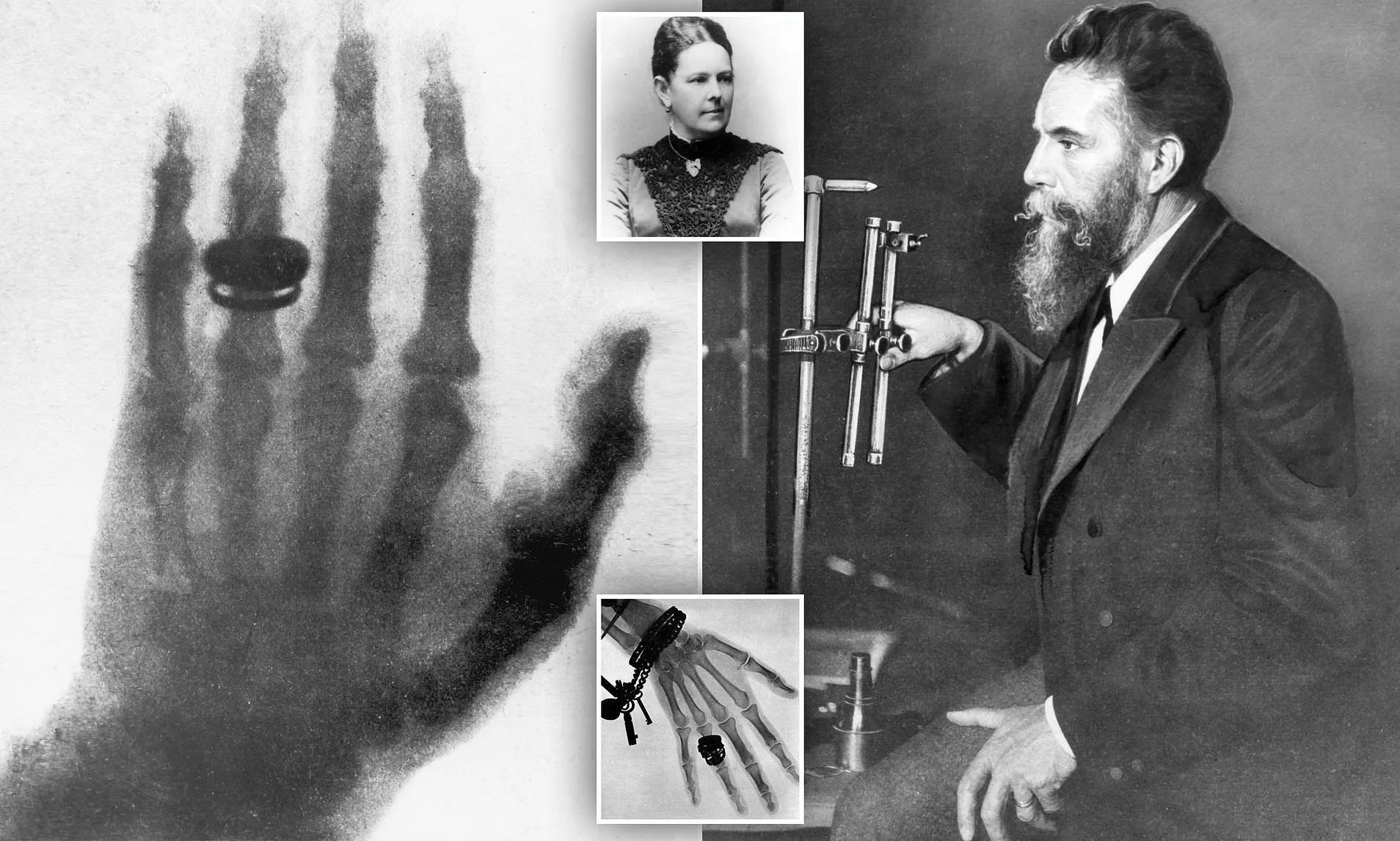
On the freezing evening of November 8, 1895, at the University of Würzburg in Germany, physics professor Wilhelm Conrad Röntgen was working alone in his darkened laboratory. On his workbench stood a Lenard-Hittorf cathode ray tube, passing high-voltage electrical discharges through an evacuated glass bulb.
Röntgen had carefully enveloped the tube in thick black cardboard to block all visible light emissions. As he energized the apparatus, a faint, shimmering glow caught his eye from a nearby bench—a fluorescent paper screen coated with barium platinocyanide had begun to luminesce, marking the historic moment that led to the discovery of X-rays.
An Uncanny Laboratory Phenomenon
The screen glowed brightly even though the gas-discharge tube was completely shielded by opaque cardboard. Surprised, Röntgen moved the fluorescent screen further away, yet the mysterious luminescence persisted across distances exceeding two meters.
Röntgen realized that the discharge tube was generating an entirely unknown form of invisible penetrating radiation capable of traversing opaque materials and exciting phosphorescent chemical compounds from afar.
Bertha’s Hand and the First Medical Radiograph
Over the following weeks, Röntgen isolated himself in his laboratory to study the penetrating power of these novel rays. He placed various objects between the tube and the photographic plates—books, pieces of wood, sheets of rubber, and thin foils of metal. Dense metals, particularly lead, blocked the rays completely, whereas lighter substances proved transparent.
In late December 1895, Röntgen conducted his most historic experiment. He invited his wife, Anna Bertha Ludwig, to place her hand over a photographic plate while exposing it to the mysterious beam for fifteen minutes. When developed, the plate revealed a startling silhouette: the internal skeleton of Bertha’s hand and fingers stood out in sharp contrast, with her gold wedding ring clearly visible, while skin and soft tissue appeared faint and translucent. Upon seeing her internal bones, Bertha famously gasped, “I have seen my death!”
Revolutionizing Modern Medicine
Röntgen christened this mysterious radiation “X-rays,” using the mathematical symbol “X” to denote an unknown variable. In late December 1895, he submitted his findings in a landmark paper titled “On a New Kind of Rays.” Within weeks, news of the discovery of X-rays swept the global scientific community and medical circles.
The medical potential was immediately apparent. For the first time in human history, physicians could visualize internal biological structures non-invasively, allowing doctors to:
- Precisely diagnose and align bone fractures.
- Locate embedded foreign bodies, such as bullets and shrapnel.
- Detect pulmonary infections, tuberculosis cavities, and internal pathologies.
Recognition and World Radiography Day
In recognition of this monumental contribution to science and healthcare, Wilhelm Conrad Röntgen was awarded the inaugural Nobel Prize in Physics in 1901. Demonstrating remarkable altruism, Röntgen refused to patent his discovery, donating his prize money to the University of Würzburg so that humanity could freely benefit from X-ray technology.
Today, the legacy of the discovery of X-rays thrives across modern hospitals through advanced radiography, computed tomography (CT), and fluoroscopy. Every year on November 8, World Radiography Day celebrates Röntgen’s breakthrough, honoring the relentless curiosity that transformed medical diagnostics and continues to save millions of lives worldwide.