The First Three Minutes of the Universe: Big Bang Nucleosynthesis and the Higgs Boson
The Primordial Crucible: From Singularity to Matter
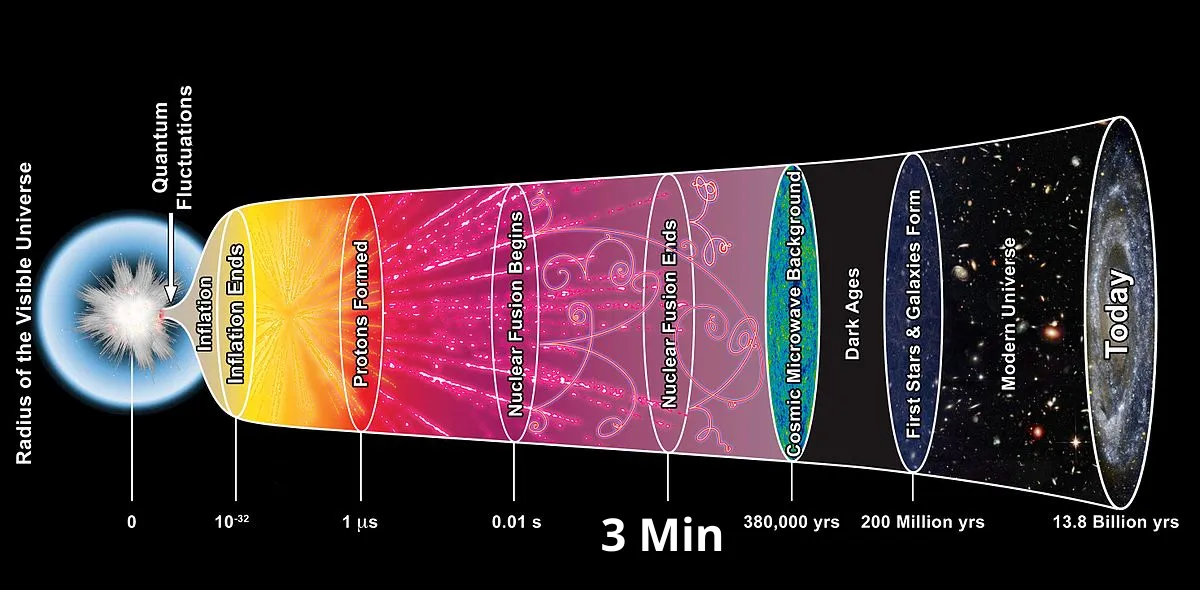
Approximately $13.8$ billion years ago, the known universe erupted into existence from a state of near-infinite temperature and density during the Big Bang. While the cosmic timeline spans billions of years, theoretical physicists recognize that the foundational architecture of all matter was forged during the first three minutes of cosmic history.
In those crucial initial moments, temperature plummeted from trillions of degrees, allowing raw, undifferentiated energy to condense into the primary subatomic building blocks of the physical cosmos.
The Primordial Timeline: Quarks to Nuclei
The rapid unfolding of events within the first few minutes is one of the most astonishing chapters in astrophysics:
- The Planck and Quark Epochs ($10^{-43}$ to $10^{-6}$ seconds): The universe was an ultra-dense quark-gluon plasma. As cosmic expansion cooled the universe, quarks and antiquarks engaged in rapid annihilation, leaving a tiny excess of matter over antimatter. Quarks bound together to form protons and neutrons.
- Big Bang Nucleosynthesis (10 seconds to 3 minutes): When temperatures dropped to roughly one billion degrees Kelvin, protons and neutrons fused without being instantly torn apart by high-energy photons. In this brief nuclear window, the universe formed the light nuclei that dominate the cosmos: approximately $75\%$ Hydrogen-1, $25\%$ Helium-4, and trace amounts of Deuterium and Lithium-7.
Without this critical three-minute phase of nucleosynthesis, the universe would have remained a sterile expanse of free protons, devoid of the composite atomic nuclei required to form subsequent generations of stars, planets, and life.
The Origin of Mass: The Higgs Field and Boson
Albert Einstein’s landmark mass-energy equivalence equation ($E=mc^2$) demonstrated that mass and energy are interchangeable. However, an essential question long troubled particle physicists: Why do fundamental particles possess mass in the first place?
In 1964, theoretical physicist Peter Higgs and collaborators proposed the existence of an invisible quantum field permeating all space: the Higgs field. As particles traverse this cosmic field, they interact with it, acquiring inertia and mass. The quantum excitation of this field is the Higgs boson, famously popularized as the “God Particle”. Without the Higgs mechanism, fundamental particles like quarks and electrons would travel at the speed of light without mass, making stable atoms impossible.
Recreating the Dawn of Time at CERN
To directly verify these theoretical models of the primordial universe, physicists at the European Organization for Nuclear Research (CERN) built the Large Hadron Collider (LHC). Located in a twenty-seven-kilometer circular tunnel one hundred meters beneath the Franco-Swiss border, the LHC accelerates counter-rotating beams of protons to $99.999999\%$ the speed of light before smashing them together.
These ultra-relativistic collisions generate temperatures exceeding four trillion degrees Celsius, momentarily replicating the extreme conditions that existed fractions of a microsecond after the Big Bang. On July 4, 2012, CERN confirmed the discovery of the Higgs boson with a mass of $125$ GeV, completing the Standard Model of particle physics.
Unlocking the Cosmic Genesis
From the microscopic realm of particle accelerators beneath Geneva to the grandest macroscopic structures of cosmic superclusters, modern physics continues to illuminate the first three minutes of genesis—revealing how a fleeting spark of primordial energy became the universe we inhabit today.