The Wallace Line: Nature’s Invisible Biodiversity Wall
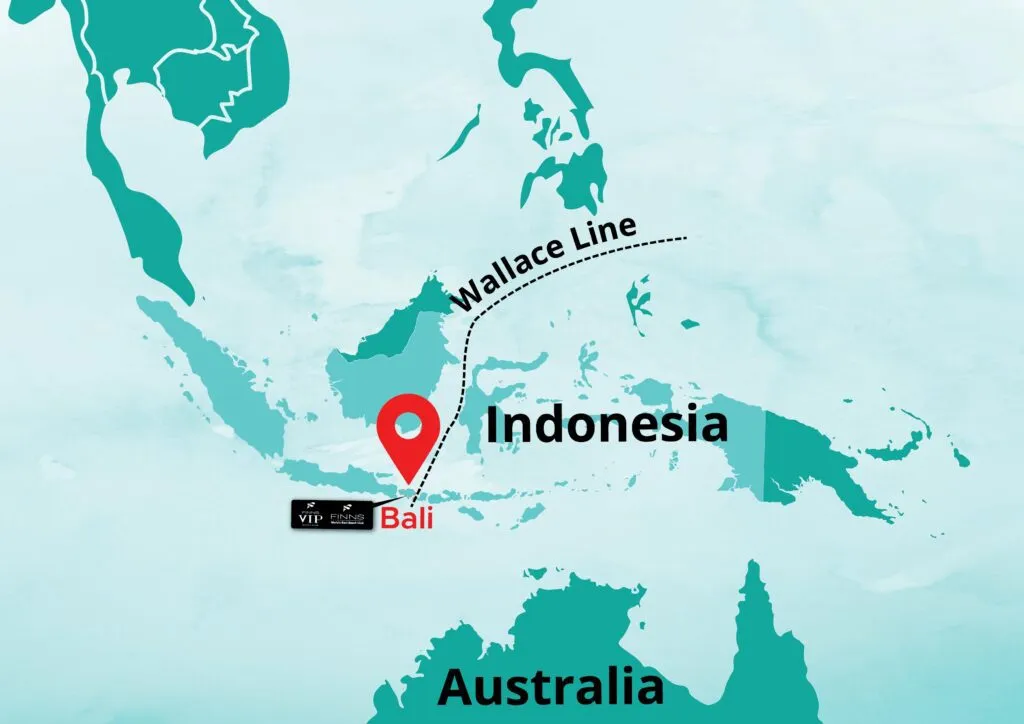
Nature’s Invisible Boundary
Deep within the Indonesian archipelago, across the azure waters of the Lombok Strait, lies one of the most astonishing boundaries in evolutionary biology: the Wallace Line.
First identified in 1859 by visionary British naturalist Alfred Russel Wallace during his eight-year exploration of the Malay Archipelago, this invisible divide represents an insurmountable biological barrier separating Asian and Australasian fauna.
Neighboring Islands, Distinct Ecological Worlds
Though Bali and Lombok sit barely twenty miles apart, their natural worlds are separated by millions of years of evolutionary divergence:
- West of the Line (Sundaland – Borneo, Sumatra, Java, Bali): Home to quintessential Asian mammals including orangutans, wild elephants, rhinoceroses, leopards, and tigers.
- East of the Line (Wallacea and Australasia – Lombok, Sulawesi, New Guinea): Asian placental mammals abruptly disappear. In their place thrive marsupials like the tree-dwelling cuscus, cockatoos, megapodes, and honeyeaters closely related to Australian wildlife.
Plate Tectonics and Deep Oceanic Trenches
Alfred Russel Wallace realized that this sudden ecological cleavage stemmed from ancient geological forces. Asia and Australia reside upon separate tectonic plates.
During the Ice Ages, vast quantities of water froze into continental glaciers, dropping global sea levels by over a hundred meters. This exposed shallow continental shelves, uniting Borneo, Java, and Sumatra with mainland Asia via the Sunda Shelf, and New Guinea with Australia via the Sahul Shelf. However, the deep ocean trench of the Lombok Strait never drained, forming an impassable aquatic barrier for terrestrial mammals.
Plant life mirrors this division: tropical dipterocarp rainforests dominate the west, giving way to eucalyptus and acacia woodlands in the east.
A Classic Cornerstone of Biogeography
Today, evolutionary scientists regard the Wallace Line as the foundational example of biogeography. It proves that geographic barriers and plate tectonics dictate the distribution and diversification of life.
Biodiversity is not arbitrary; it is the living tapestry woven by millions of years of continental drift and environmental adaptation.
Other Major Biogeographical Boundaries
Similar physical divides across the globe have carved the planet into distinct biological provinces:
- The Himalayas: Separating the Palearctic wildlife of Central Asia from the Indomalayan tropical fauna.
- The Sahara Desert: Dividing Mediterranean ecosystems from Sub-Saharan African habitats.
- The Isthmus of Panama: Forming a volcanic land bridge that triggered the Great American Biotic Interchange three million years ago.
- The Galápagos Archipelago: Volcanic isolation fostering specialized endemic species that inspired Charles Darwin’s theory of natural selection.
Conclusion
The Wallace Line reveals the profound unity between Earth’s geological dynamics and organic evolution. It stands as an enduring testament to how deep ocean chasms can quietly divide the living kingdoms of two continents.