Science in Bangladesh: Research, Innovation & New Horizons
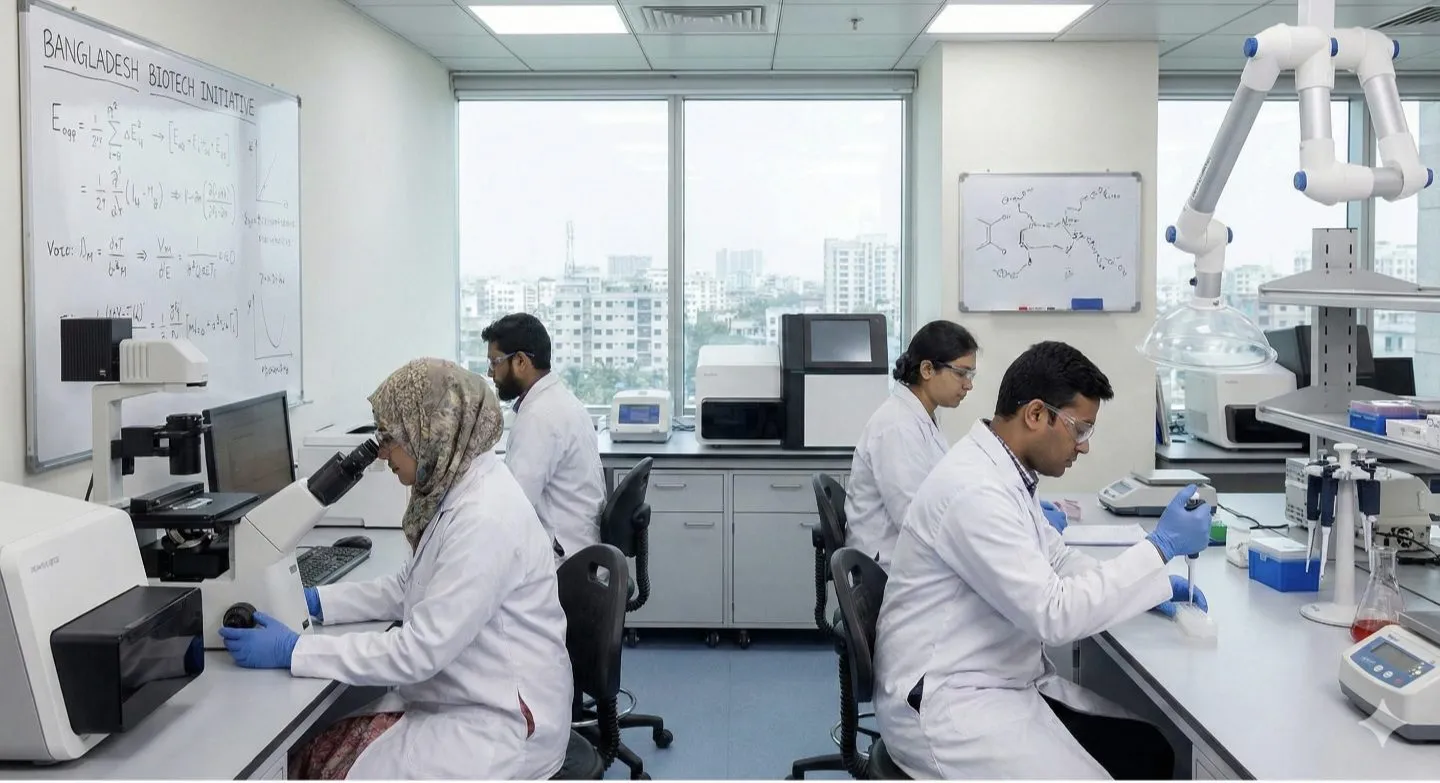
For decades, the journey of science in Bangladesh advanced through resource constraints, infrastructure hurdles, and historical neglect. Yet through grit and intellectual devotion, the nation’s scientists persevered. Today, the quiet progress of science in Bangladesh is constructing a modern, knowledge-driven society, inaugurating an inspiring new era.
Scientific research in Bangladesh is no longer confined within laboratory walls; it has integrated into global research networks, emerging as the foundational engine of the country’s sustainable future.
Biotechnology and Genome Sequencing Milestones
The global recognition of Bangladeshi genomics surged in 2010 when an international team led by Dr. Maqsudul Alam successfully sequenced the complete genome of jute. This breakthrough placed Bangladesh firmly on the world genomics map, demonstrating that cutting-edge molecular biology could be conducted domestically.
Building on this foundation, researchers at the University of Dhaka developed robust local sequencing capacity. Professor Haseena Khan spearheaded the genomic sequencing of the national fish, Hilsa (Tenualosa ilisha), unlocking vital genetic markers for conservation and breeding. Concurrently, Dr. Senjuti Saha and the Child Health Research Foundation (CHRF) earned worldwide acclaim for high-throughput genomic surveillance of pediatric infectious pathogens, antimicrobial resistance, and SARS-CoV-2.
Revolutionizing Agricultural Science and Crop Breeding
Agricultural research represents one of Bangladesh’s greatest success stories. Facing rapid population density and climate vulnerability, the nation transformed into a global leader in stress-tolerant crop breeding. The Bangladesh Rice Research Institute (BRRI) has developed dozens of high-yielding, climate-resilient varieties:
- Salinity-tolerant strains (e.g., BRRI dhan 47, 52, 65) enabling coastal farmers to cultivate previously barren delta soil.
- Flood-submergence tolerant varieties (such as “scuba rice” BRRI dhan 51 and 52) capable of surviving under water for over two weeks.
- Drought-resistant, zinc-enriched, and short-duration varieties (BRRI dhan 57, 84, 100, 112) stabilizing year-round crop yields.
Collaborating with the International Rice Research Institute (IRRI), Bangladeshi researchers utilize marker-assisted selection and genomic editing to secure future food supplies.
Panchabrihi: A Breakthrough in Multi-Harvest Rice
In Kulaura, Moulvibazar, noted geneticist Dr. Abed Chaudhury spearheaded private agricultural research leading to “Panchabrihi”—a remarkable perennial rice variety capable of yielding five consecutive harvests from a single planting within a single year. Unlike conventional low-yield ratoon crops, Panchabrihi produces high grain yields, offering dramatic reductions in agricultural labor, irrigation, and tilling costs.
Defeating Wheat Blast and Precision Pathology
When the devastating wheat blast fungus struck Bangladesh in 2016, Professor Tofazzal Islam of Bangabandhu Sheikh Mujibur Rahman Agricultural University led an international consortium using field-pathogenomics to rapidly pinpoint the outbreak’s South American origin. His research developed CRISPR-based diagnostic tests and molecular breeding pipelines that protected wheat cultivation across South Asia.
Biomedical Innovation, Plasma Physics, and Climate Adaptation
In global health, Professor Firdausi Qadri’s pioneering vaccine research at icddr,b against cholera, enterotoxigenic *E. coli*, and typhoid earned prestigious international honors, saving countless lives across developing nations.
In climate science, the late Professor Saleemul Huq played a monumental leadership role in the IPCC, guiding international climate finance and deltaic adaptation policies. In theoretical physics, Professor A. A. Mamun of Jahangirnagar University is globally celebrated for his prolific research in dusty and quantum plasma astrophysics, inspiring a new generation of Bangladeshi physicists.
Youth Engagement and Emerging Frontiers
The catalyst for future advancement resides in Bangladesh’s youth. Triumphs in international Mathematical, Physics, and Olympiad in Informatics competitions, alongside vibrant university robotics clubs and data science hubs, signal a thriving culture of curiosity.
With increasing investments in artificial intelligence, software engineering, and biomedical research, science in Bangladesh is driving national resilience, turning domestic challenges into world-class scientific breakthroughs.