The Uncertainty Principle: Heisenberg’s Quantum Limit
The Quantum Enigma
In 1927, young German physicist Werner Heisenberg was grappling with the paradoxical behavior of the subatomic realm. Electrons appeared to act simultaneously as localized particles and spreading waves. This wave-particle duality presented a profound puzzle: treating an electron as a wave blurred its physical position, while pinning it down as a localized particle rendered its velocity indeterminate.
Heisenberg’s Foundational Realization
Heisenberg realized that this indeterminacy was not an artifact of faulty laboratory equipment or clumsy experimental technique; rather, it was a fundamental, structural property of nature itself. From this profound insight arose Heisenberg’s famous Uncertainty Principle.
The principle dictates that in the quantum domain of atoms and elementary particles, certain pairs of complementary physical quantities cannot be simultaneously measured with arbitrary precision. The most iconic example is the relationship between position and momentum:
- Position: Pinpointing precisely where a particle is located in space.
- Momentum: Determining the particle’s mass, speed, and directional trajectory.
The Physics of Quantum Uncertainty
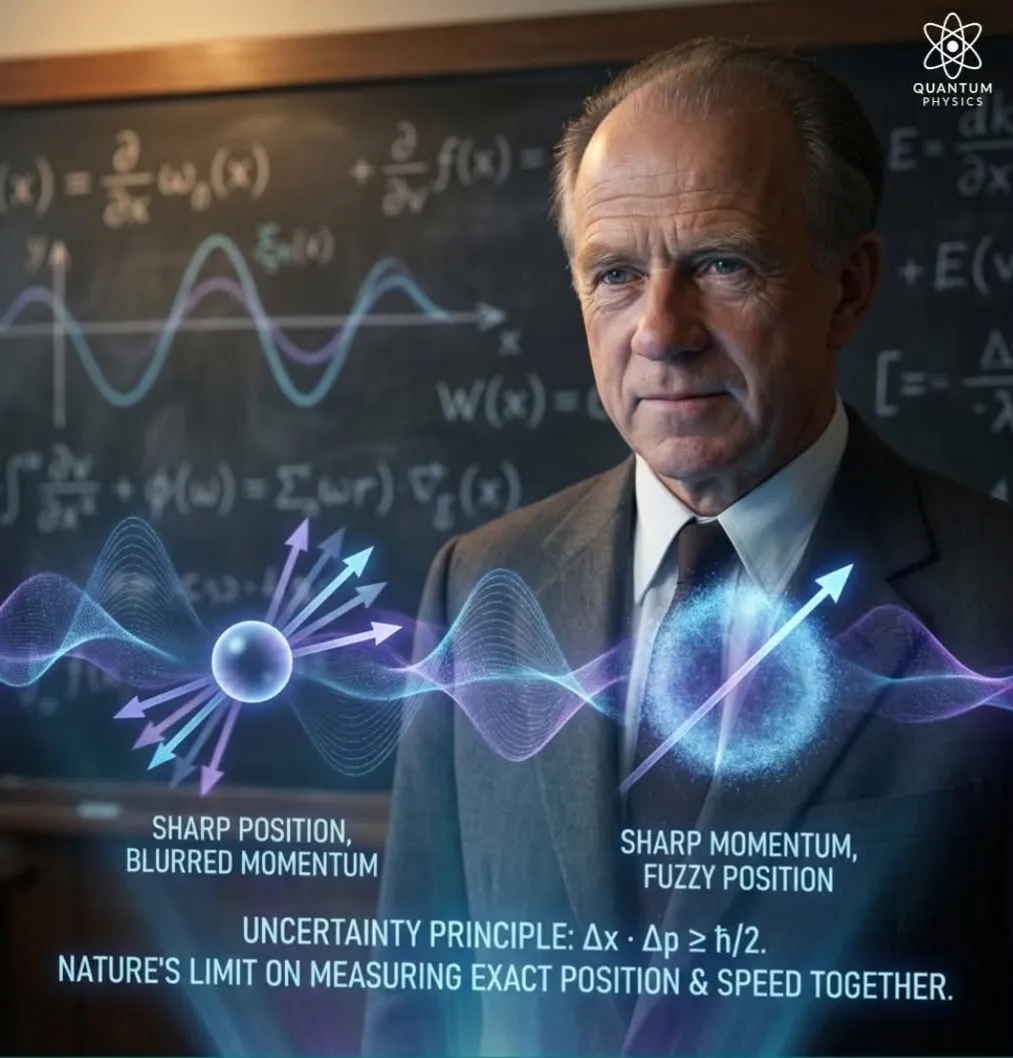
If you measure a subatomic particle’s position with extreme precision, its momentum becomes fundamentally indeterminate. Conversely, if you measure its momentum with absolute accuracy, its spatial location blurs into a wavepacket across space. Mathematically expressed as Δx · Δp ≥ ℏ/2, this relation reflects the intrinsic wave nature of matter.
A pure monochromatic wave has a precise wavelength (and therefore a defined momentum via de Broglie’s relation), but extends indefinitely through space. To confine a wave into a localized packet (a defined position), one must superimpose countless waves of differing wavelengths, thereby dispersing its momentum.
In our macroscopic everyday world, this uncertainty is unnoticeable. Because Planck’s reduced constant (ℏ) is exceedingly tiny, the quantum uncertainty for vehicles, buildings, or human bodies is utterly negligible. In the subatomic realm, however, it governs all physical interactions.
Nature’s Intrinsic Boundaries
The formulation of the Uncertainty Principle shattered the deterministic clockwork universe envisioned by classical Newtonian physics. It demonstrated that nature possesses built-in epistemological boundaries, proving that probabilistic uncertainty lies at the very heart of physical reality.