Quantum W-State: Japanese Physicists Master Robust Entanglement
Mastering Multi-Particle Quantum Connections
Quantum entanglement—which Albert Einstein famously dubbed “spooky action at a distance”—occurs when particles share a unified quantum state such that measuring the properties of one instantaneously determines the state of another, regardless of spatial separation. While pairs of entangled photons are routinely manipulated in laboratory settings, scaling entanglement across three or more particles presents immense experimental challenges.
In a historic achievement, experimental physicists from Kyoto University and Hiroshima University in Japan succeeded in performing direct, simultaneous entangled measurements on a three-photon quantum W-state, opening exciting new horizons for quantum information networks.
GHZ States vs. the Resilient W-State
When entangling three or more qubits, two primary non-equivalent families emerge: Greenberger-Horne-Zeilinger (GHZ) states and W-states.
- The GHZ State ($|GHZ\rangle = \frac{1}{\sqrt{2}}(|000\rangle + |111\rangle)$): Maximally entangled across all three particles, but exceptionally fragile. If even one photon is lost or measured, the entanglement among the remaining particles is instantly and completely destroyed.
- The W-State ($|W\rangle = \frac{1}{\sqrt{3}}(|100\rangle + |010\rangle + |001\rangle)$): Characterized by distributed bipartite entanglement. If one qubit is lost, traced out, or measured, the remaining two qubits retain substantial bipartite entanglement. This robustness makes the W-state an ideal resource for loss-tolerant quantum communications.
The Japanese Experimental Breakthrough
Despite its theoretical advantages, directly verifying a quantum W-state as a single holistic system had remained out of reach. Previous methods required piecemeal state tomography, which destroyed the fragile quantum coherence during measurement.
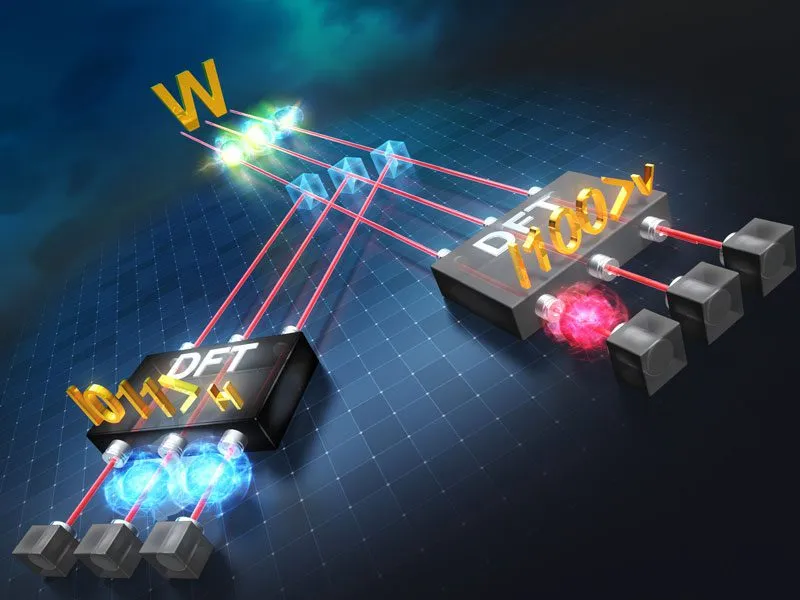
The Japanese research consortium engineered an intricate multiport optical circuit utilizing beam splitters, waveplates, and high-efficiency single-photon detectors. This specialized architecture allowed all three entangled photons to interfere simultaneously, executing a collective “entangled measurement” that identified the entire W-state signature in a single shot.
Implications for Quantum Communications and Computing
This experimental capability addresses a crucial bottleneck in building quantum repeaters and secure quantum key distribution (QKD) networks across transcontinental optical fibers. Because real-world fiber networks inevitably suffer photon absorption losses, protocols built on robust W-state architectures can maintain communications integrity even when transmission channels experience partial losses.
Conclusion
From theoretical thought experiments in the 1930s to table-top optical reality in Japan, mastering the quantum W-state marks another major stride toward fault-tolerant quantum computers and secure global quantum telecommunications networks.