Quantum Tunneling: From Harry Potter's Wall to Solar Fusion
Walking Through Solid Walls: Fiction vs. Quantum Fact
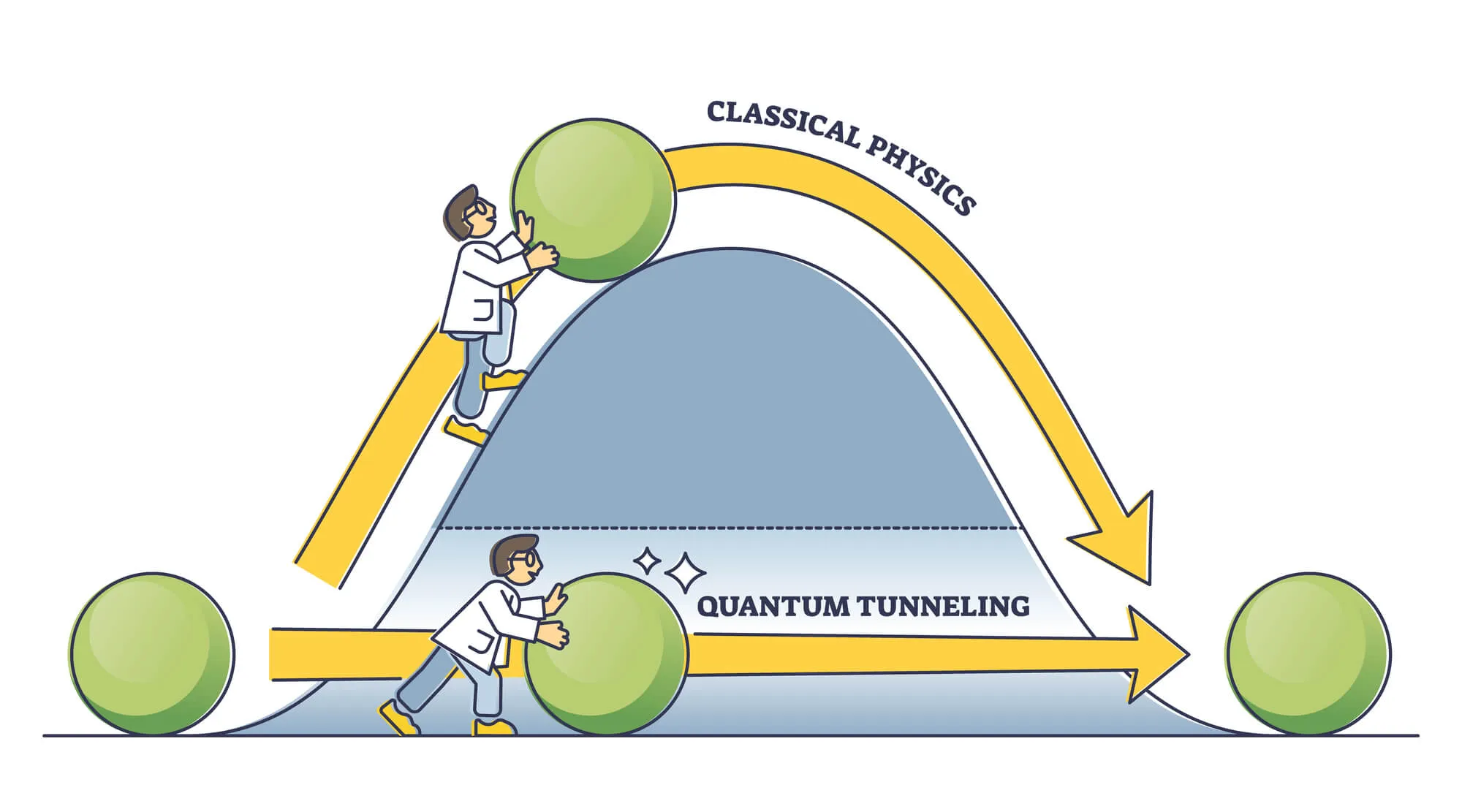
In the popular fantasy saga Harry Potter, young wizards access Platform $9\frac{3}{4}$ at London’s King’s Cross Station by dashing straight through a solid brick barrier. In our macroscopic world, common sense dictates that solid barriers are impassable: throw a tennis ball against a brick wall, and it will bounce back every single time.
In the microscopic realm of quantum physics, however, an entirely different set of rules applies. Subatomic particles can, under the right conditions, pass directly through seemingly insurmountable energy barriers. This astonishing phenomenon is known as quantum tunneling.
Wave-Particle Duality and the Non-Zero Wave Function
The foundation of tunneling lies in wave-particle duality and the Heisenberg Uncertainty Principle. Microscopic entities such as electrons and protons are not hard, localized spheres; they are described by Schrödinger’s spatial wave function ($\psi$), representing probability amplitudes.
When an electron approaches an electrostatic barrier that it lacks the classical kinetic energy to surmount, its wave function does not stop abruptly at the boundary. Instead, it penetrates the barrier, decaying exponentially as an evanescent wave across the barrier’s thickness. If the barrier is sufficiently thin, the wave function emerges on the far side with a non-zero amplitude—meaning there is a finite probability the particle will materialize on the other side without having crossed over the top.
Everyday Technological Applications
While human-scale tunneling is statistically near zero, subatomic quantum tunneling occurs constantly and is harnessed across modern electronics:
- Tunnel Diodes: High-speed semiconductor switching devices operating via electron tunneling through p-n junctions.
- Scanning Tunneling Microscopes (STM): Instruments that measure electron tunneling current between a fine metallic probe tip and a sample surface, allowing scientists to image individual atoms.
- Flash Memory and Qubits: Solid-state memory drives use quantum tunneling to trap and release electrons in floating gate transistors, while superconducting qubits rely on Josephson junction tunneling.
The Cosmic Engine: How Tunneling Powers the Sun
Perhaps the most profound consequence of quantum tunneling is the existence of life on Earth. The Sun generates energy by fusing positively charged hydrogen nuclei (protons) into helium within its superheated core.
Because all protons carry positive electrical charge, they repel each other through powerful electrostatic forces (the Coulomb barrier). Solar core temperatures (~15 million °C) provide protons with an average kinetic energy that is a thousand times too weak to overcome this electrostatic repulsion classically. Without quantum mechanics, the Sun could never ignite.
Thanks to quantum wave nature, protons regularly tunnel through the Coulomb barrier. Although the tunneling probability for an individual collision is minuscule (roughly one in $10^{28}$), the staggering density of protons in the core ensures that sextillions of fusion events occur every second, maintaining steady solar radiation.
Conclusion
Without quantum tunneling, the Sun would remain a cold, dark sphere, and terrestrial biology could never have evolved. What appears as magic in fiction is, in truth, the quiet quantum reality that illuminates the cosmos.