Does the Infinite Multiverse Have a Venn Diagram? Science's Bold New Idea
Venn Diagrams and the Cosmic Geometry
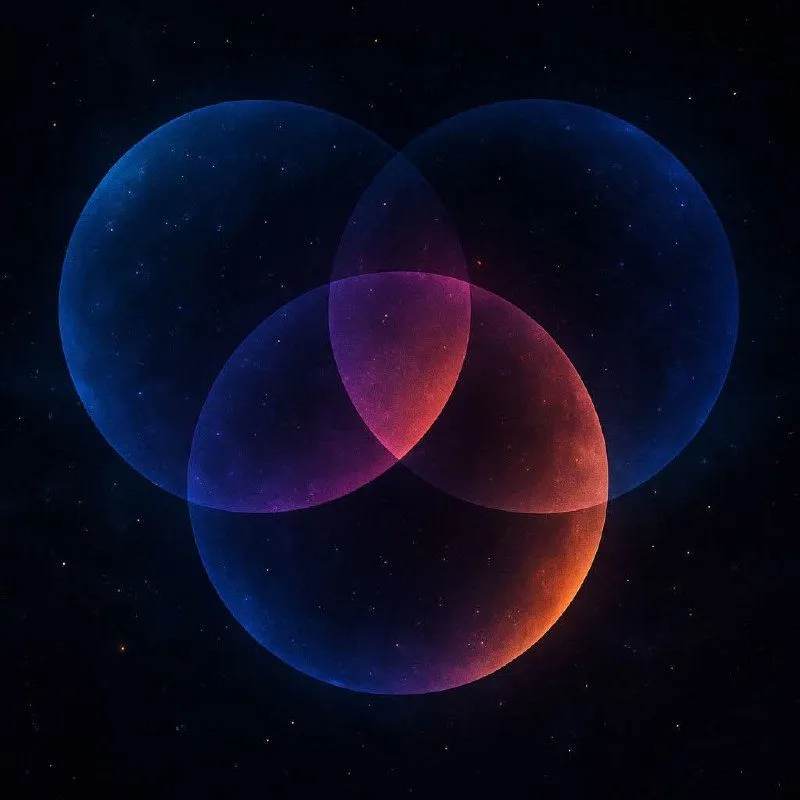
In elementary mathematics, a Venn diagram illustrates how distinct sets or circles can partially intersect. Though they represent separate identities, their boundaries overlap in a shared domain. What if we applied this simple conceptual framework to the fabric of reality itself?
The Multiverse and Bubble Universes
Could other universes exist beyond our observable horizon, and could one of them physically intersect with our own? Once relegated to science fiction, this question is now seriously examined in modern theoretical cosmology. Many cosmologists hypothesize that primordial cosmic inflation generated innumerable “bubble universes” within an expansive inflating cosmos known as the multiverse. Theoretical physicists now contemplate whether these expanding bubbles might graze or intersect one another, mirroring the overlapping geometry of a Venn diagram.
Potential Consequences of Universal Overlap
If another universe were to graze our own, what signatures would it leave? It might perturb the geometric structure of spacetime or produce subtle astronomical anomalies that standard cosmological models cannot easily explain.
JWST and the Mystery of Early Massive Galaxies
Consider the recent revelations from the James Webb Space Telescope (JWST). Peering into the dawn of the cosmos, JWST has detected mature, surprisingly massive galaxies existing merely hundreds of millions of years after the Big Bang. Standard galactic evolution models predicted that assembling such massive cosmic structures should require billions of years. It looks almost as if early cosmic evolution was fast-forwarded by an unseen mechanism.
Hubble Tension: The Cosmic Expansion Discrepancy
Alongside early galaxies lies another profound dilemma: the Hubble tension. The Hubble constant quantifies the expansion rate of the universe, yet two premier measurement methods produce conflicting values. The precision mapping of the Cosmic Microwave Background (CMB) from the early universe (~13.8 billion years ago) yields an expansion rate of approximately 67 km/s/Mpc. Conversely, measurements using local Cepheid variable stars and Type Ia supernovae indicate roughly 73 km/s/Mpc.
A 9% Discrepancy and Cosmological Crisis
This nearly 9 percent divergence is too large to dismiss as experimental noise. It signals that either our theoretical framework of cosmic expansion is incomplete, or unknown physics is at play. Hypotheses range from early dark energy to new relativistic particles—or perhaps even external gravitational influences.
Shadows of an Adjacent Universe
A few daring theoretical cosmologists propose an even bolder idea: could the discrepancy reflect the subtle gravitational shadow of an adjacent universe intersecting our cosmic bubble? Just as the Big Bang was once met with skepticism before becoming the bedrock of modern cosmology, multi-bubble interactions might one day find observational support.
From Science Fiction to Future Science
Multiverse collisions and bubble Venn diagrams may sound speculative today, but theoretical physics frequently transforms seemingly wild concepts into rigorous models of cosmic reality.
The Infinite Quest for Understanding
Our observable realm may simply be one petal in an immense cosmic Venn diagram, with external influences imprinting subtle clues on our expanding cosmos.