Turning Mercury into Gold: The Fusion Reality
Mercury into gold! For thousands of years, humans have dreamed of turning base metals into precious gold. Medieval alchemists conducted countless experiments in pursuit of that dream, yet none succeeded.
Now, an American startup called Marathon Fusion has brought that ancient dream back into the spotlight. The company claims it has succeeded in creating gold from mercury using nuclear fusion technology.
But how does one turn mercury into gold? And how credible is the startup’s claim?
The Secret of Making Gold
Mercury and gold are two distinct chemical elements, but their atomic structures are remarkably close.
A mercury nucleus contains 80 protons, while a gold nucleus has 79. In other words, reducing the number of protons in a mercury nucleus by just one would turn it into gold.
Ordinary chemical reactions cannot achieve this. It requires altering the structure of the atomic nucleus itself—a process known as nuclear transmutation.
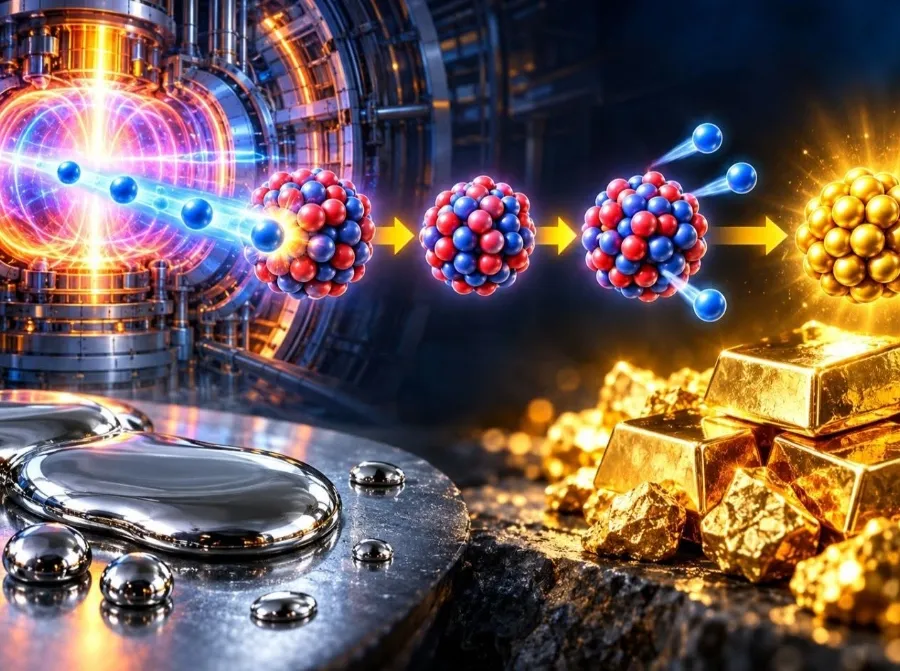
In Marathon Fusion’s proposed method, high-energy neutrons produced by nuclear fusion enter the nucleus of mercury-198. This temporarily creates an unstable nucleus of mercury-199. When two neutrons are subsequently expelled, it becomes mercury-197.
Mercury-197 is a radioactive isotope. Through radioactive decay, it gradually transforms into gold-197 as a proton converts into a neutron. Thus, mercury becomes gold!
Gold-197 is the only stable isotope of gold.
A History of Creating Gold
Producing gold through nuclear reactions is not entirely new.
In 1980, researchers at the Lawrence Berkeley Laboratory in the United States produced a minuscule amount of gold from bismuth.
In 2025, CERN announced that gold nuclei had been produced from lead nuclei inside the Large Hadron Collider.
Experiments conducted between 2015 and 2018 generated around 86 billion gold nuclei at CERN. Yet in total, that amounted to merely 29 picograms of gold, and those nuclei were extremely short-lived.
These experiments had already proven that converting one element into another through nuclear reactions is entirely possible.
Marathon Fusion’s Claim
Marathon Fusion claims its method can produce stable gold far more efficiently than previous experiments.
In research published in 2025, the company estimated that a large future fusion power plant could yield up to two tons of gold per year.
In other words, a single facility could generate clean electricity while producing gold as a byproduct.
However, this two-ton estimate remains a theoretical forecast. The practical technology to produce gold at such a scale does not yet exist.
How Strong Is the Evidence?
This is where claims diverge from established scientific fact.
While the transmutation of elements is proven physics, Marathon Fusion’s recent experimental results have not yet been independently verified by peer-reviewed research or outside laboratories.
Critical questions remain unanswered: exactly how much gold was produced, how pure was it, and how much energy and money were consumed in the process?
Furthermore, nuclear reactions can produce radioactive isotopes alongside stable gold. Any gold produced this way may require extensive additional processing before it can be safely handled or used commercially.
Whether this process can ever become commercially viable remains deeply uncertain.
From Alchemy to Modern Science
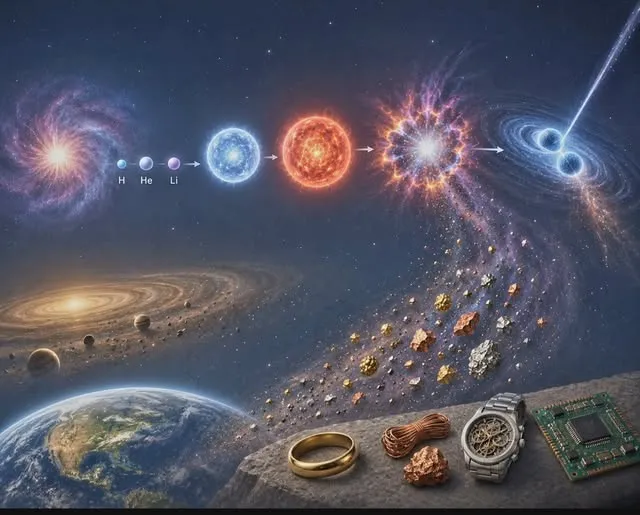
Medieval alchemists hoped to transform base metals through chemical reactions, not knowing that an element’s identity is defined solely by the number of protons in its nucleus.
Today, nuclear physics has demonstrated that changing that proton count genuinely transforms one element into another.
Yet producing microscopic traces of gold in an experiment is very different from manufacturing it profitably on a commercial scale. The first is established science; the second remains an open question for future research.
Still, who knows? Perhaps one day, alongside gold mines dug into the Earth, humanity will build factories that synthesize gold from atoms.