J. J. Thomson and the Discovery of the Electron
Sir J. J. Thomson stands as a towering pioneer of modern physics. In the late nineteenth century, when classical chemistry dogma regarded the atom as the indivisible bedrock of matter, Thomson dared to suggest that the atom contained smaller constituent particles within.
Born on December 18, 1856, in Manchester, England, Joseph John Thomson directed Cambridge University’s Cavendish Laboratory, where his brilliant experimental designs reshaped the course of scientific history.
Cathode Rays and the Historic 1897 Experiment
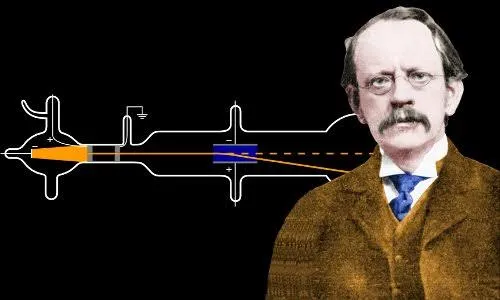
Thomson’s breakthrough centered on cathode rays—luminous electrical discharges produced within sealed glass vacuum tubes. By applying calibrated electric and magnetic fields, Thomson discovered that cathode rays bent in response to both forces.
Through precise quantitative measurements, he determined that cathode rays were not ether waves, but streams of negatively charged subatomic particles. Calculating their charge-to-mass ratio (e/m), he proved these “corpuscles” were over a thousand times lighter than a hydrogen atom. In 1897, Thomson introduced the world to the electron, irrevocably splitting the atom.
The Plum Pudding Atomic Model
To explain atomic neutrality, Thomson proposed the “Plum Pudding Model” in 1904. He pictured the atom as a sphere of positive electrification with negatively charged electrons embedded throughout like raisins in a pudding.
While later replaced by the nuclear model of his student Ernest Rutherford, Thomson’s proposal was the first scientific model to conceptualize internal atomic architecture.
Mentorship and Nobel Glory
Thomson received the 1906 Nobel Prize in Physics for his discovery of the electron and conduction of electricity in gases. Beyond his personal research, he was an unmatched academic mentor, guiding future Nobel laureates including Ernest Rutherford, Charles Barkla, and Francis William Aston.
Conclusion
Modern electronics, telecommunications, computing, and quantum physics trace their heritage back to Thomson’s laboratory table. Sir J. J. Thomson ignited the subatomic revolution that continues to power our technological world.