Is a Warp Drive Possible? Physics of Faster-Than-Light
In science fiction classics like Star Trek, the starship USS Enterprise cruises across deep space at velocities exceeding light, traversing interstellar gulfs in the blink of an eye. The fictional propulsion system making this possible is known as the warp drive. But does real-world general relativity permit faster-than-light (superluminal) travel?
Relativity and the Cosmic Speed Limit
Albert Einstein’s Special Theory of Relativity dictates that the speed of light in a vacuum (approximately 300,000 kilometers per second) represents the ultimate cosmic speed limit. No physical object possessing mass can accelerate to or exceed this boundary, as relativistic mass increases toward infinity, requiring infinite energy.
Humanity’s fastest deep space probe, Voyager 2, cruises at approximately 15.4 km/s. At that rate, traveling to our nearest stellar neighbor, Proxima Centauri (4.2 light-years away), would require over 70,000 years—illustrating the immense challenge of interstellar transit.
The Alcubierre Metric: Warping Spacetime
In 1994, Mexican theoretical physicist Miguel Alcubierre discovered an ingenious mathematical solution to Einstein’s field equations of General Relativity. Alcubierre demonstrated that a spacecraft could theoretically achieve effective faster-than-light transit without violating local relativity.
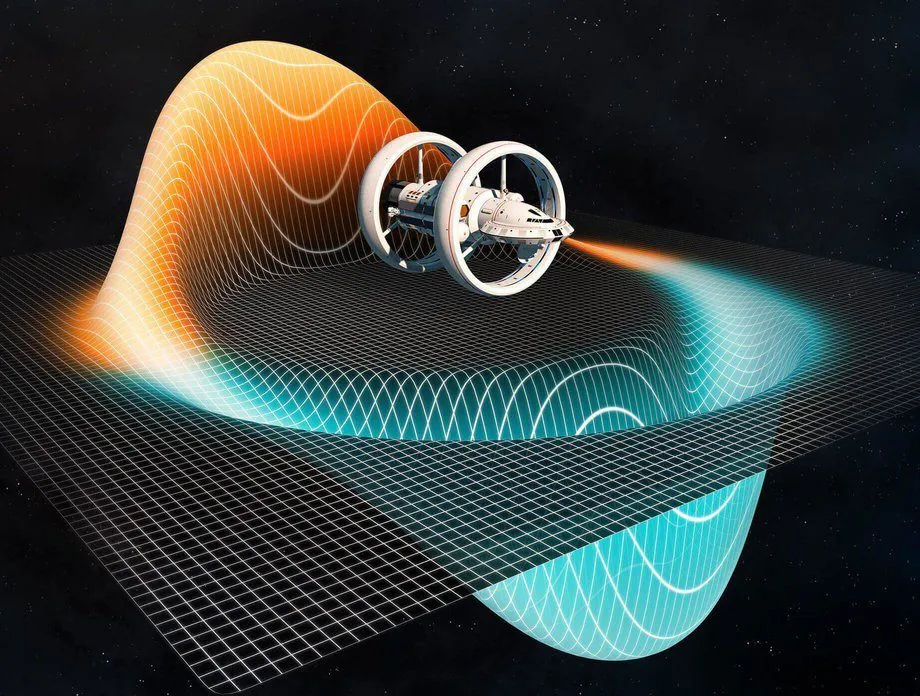
Instead of accelerating the spacecraft through space, an Alcubierre warp drive distorts spacetime around the vessel. The drive contracts the spacetime fabric in front of the ship while expanding spacetime behind it, creating a localized “warp bubble.” The spacecraft remains at rest inside this bubble, floating within flat spacetime, while the bubble itself moves through space.
The Carpet Analogy
Consider a cup resting across a large carpet. To reach the cup, you can walk across the floor, or you can bunch up the rug and pull the cup directly toward yourself. The Alcubierre metric pulls the destination toward the traveler. Crucially, while physical matter cannot travel through space faster than light, spacetime itself has no such speed limit—as demonstrated during the cosmic inflation of the early universe.
Overcoming the Negative Energy Barrier
The primary theoretical obstacle in Alcubierre’s original metric was the requirement for exotic matter possessing negative mass-energy density to stabilize the warp bubble. Producing astronomical quantities of negative energy appeared physically impossible.
However, recent breakthroughs have altered this landscape. In 2021, physicists Alexey Bobrick and Gianni Martire formulated a generalized model demonstrating that warp bubbles can be constructed using conventional positive energy configurations.
Recent Applied Physics Breakthroughs
Research led by groups such as Applied Physics has modeled physical, constant-velocity sub-luminal warp shells that obey classical relativistic energy conditions. By refining geometry and mass distributions, physicists are demonstrating that warp fields are mathematically plausible within standard physics.
Conclusion
Mainstream physics no longer dismisses the warp drive as pure impossibility. While enormous engineering, energetic, and material hurdles remain, the concept has matured from Hollywood science fiction into a legitimate, active field of theoretical gravitational research.