Book Review: Philip Ball's 'How Life Works' and the New Horizons of Biology
The Mysterious Inner World of the Living Cell
To grasp the essence of life, biologists peer deep into the intricate micro-universe of the cell. They observe the silent choreography of chromosomes, the relentless metabolic engines of mitochondria, the information sequences of DNA and RNA, and the architectural craftsmanship of ribosomes. Inside every microscopic cell, an invisible drama unfolds every millisecond. Yet what is life, truly? Is it merely a clockwork assembly of molecular gears, or something vastly more subtle, dynamic, and profound?
Philip Ball’s Redefinition of Biological Reality
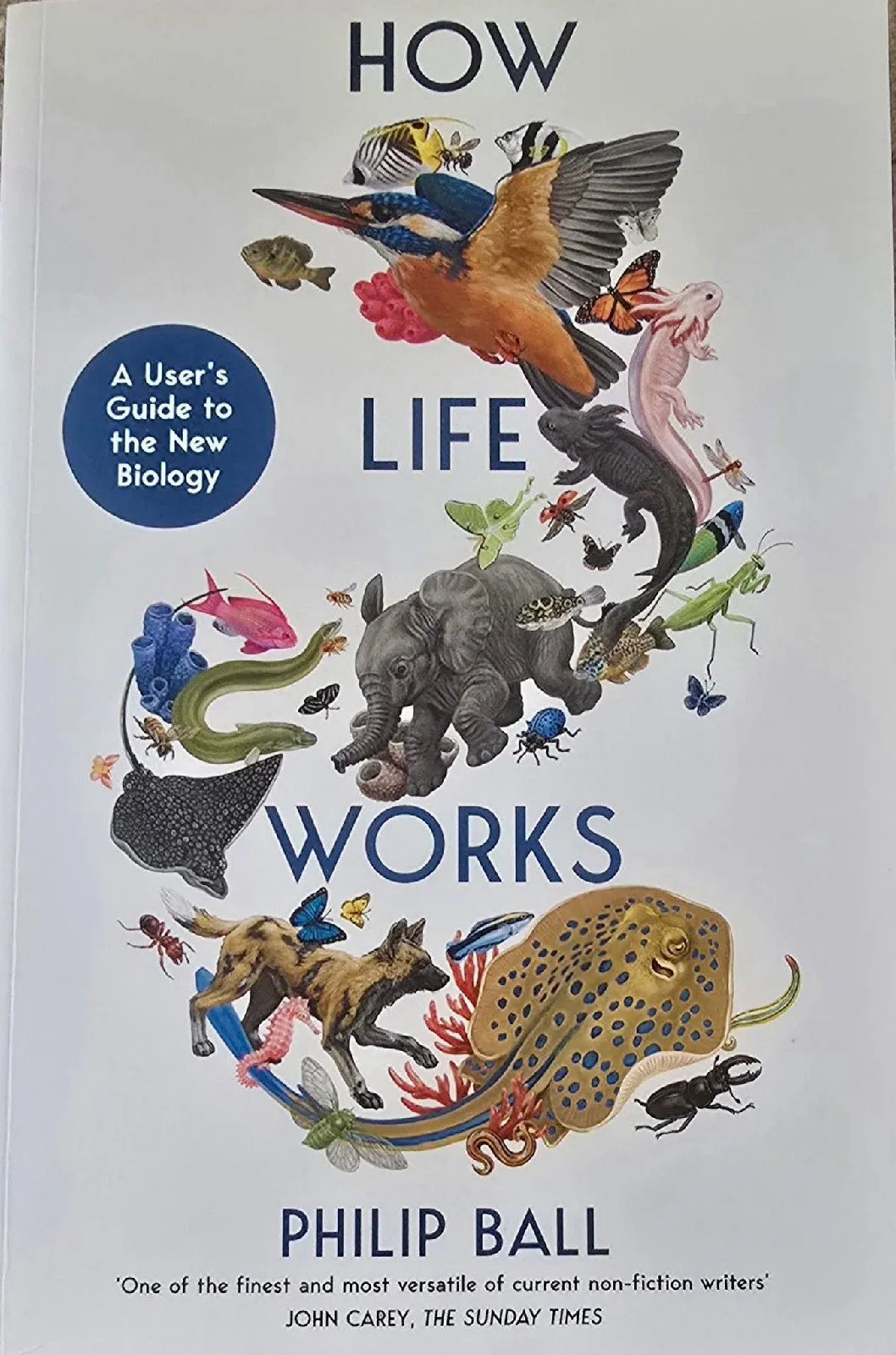
Renowned science writer Philip Ball tackles this foundational question in his acclaimed book, How Life Works: A User’s Guide to the New Biology. Far from reading like a dry textbook, Ball’s work is a luminous, thought-provoking narrative that unpacks the genuine principles orchestrating biological systems.
Beyond the Genetic Blueprint
A central thesis of the book is dismantling the popular metaphor of DNA as a rigid computer program or master blueprint. Ball demonstrates that DNA does not rigidly control the cell from the top down. Instead, life is an emergent, cooperative, multi-layered process. Inside cells, stochastic molecular chaos and precision order coexist in dynamic tension. Life does not operate like an engineered machine; it thrives on flexibility, degeneracy, and contextual adaptability.
The Continuous Flux of Living Systems
Ball emphasizes that the true nature of life is process and flow. Living organisms are never static equilibria; they are dissipative structures maintaining self-organization through continuous material and energetic turnover, constantly reinventing new possibilities from within.
Systems Biology and Emergent Complexity
For decades, popular science reduced biology to selfish genes and linear causal pathways. Ball illuminates modern systems biology, showing that form and function arise from recursive interactions among regulatory gene networks, biochemical cascades, cellular mechanical stresses, and environmental signaling. Life operates simultaneously across multiple scales of hierarchy.
The Frontier of Modern Cellular Biophysics
How Life Works explores cutting-edge biological frontiers: intrinsically disordered proteins, biomolecular condensates formed by phase separation, and sophisticated epigenetic signaling. Ball conveys with lucid prose how countless cellular processes harmonize together—not unlike a symphonic orchestra playing without a single autocratic conductor.
Where Science Meets Philosophical Artistry
Ball’s narrative voice avoids academic pedantry, weaving storytelling, historical context, and rigorous science. He invites the reader to marvel at the living world as an astonishing masterpiece of nature, where astonishing complexity emerges from elegant, versatile principles.
Why You Should Read ‘How Life Works’
How Life Works is essential reading for anyone curious about the modern revolution transforming life sciences. Philip Ball delivers an exhilarating, mind-expanding intellectual feast that reveals biology not as a solved mechanical puzzle, but as a vibrant, ever-evolving wonder.