DNA Data Storage: Revolutionizing Information Technology with Biology
Nature’s Ultimate Storage Architecture
Deoxyribonucleic acid (DNA) is nature’s supreme information storage medium. Packed within the microscopic chromosomes of living cells, DNA stores the developmental blueprints of all terrestrial organisms. Its iconic double helix structure is composed of a sugar-phosphate backbone and four nitrogenous nucleotide bases: Adenine (A), Thymine (T), Guanine (G), and Cytosine (C), paired complementarily (A with T, and C with G).
The human genome comprises approximately three billion base pairs of genetic data. If printed sequentially on standard paper, the stack would reach 170 meters tall—higher than the Statue of Liberty. With trillions of cells in the human body, nature demonstrates an unmatched capacity to store immense volumes of data within sub-microscopic dimensions.
Bridging Silicon and Genetics
Faced with exponential growth in digital data generation—which is rapidly outstripping global supplies of silicon and magnetic storage media—computer scientists and bioengineers are actively developing DNA data storage.
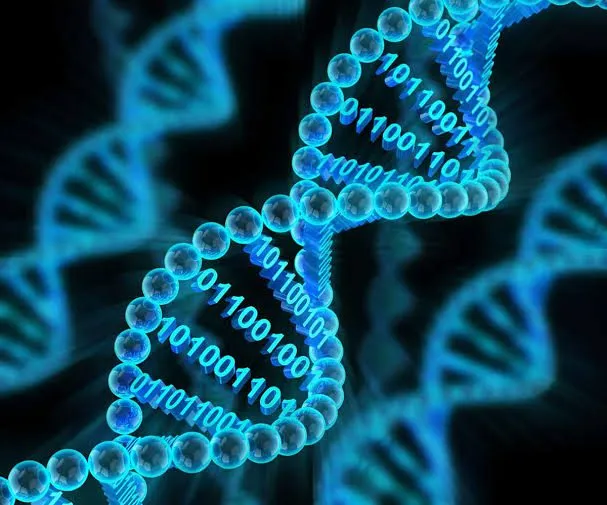
Digital computing operates on binary code consisting of zeros and ones ($0$ and $1$). In synthetic biology, this binary sequence is mapped onto the four nucleotide bases of DNA:
- $00
ightarrow ext{A}$ (Adenine) - $01
ightarrow ext{C}$ (Cytosine) - $10
ightarrow ext{G}$ (Guanine) - $11
ightarrow ext{T}$ (Thymine)
Through automated chemical synthesis, these encoded sequences are manufactured into artificial DNA strands, storing text documents, high-definition videos, and complete operating systems within biological molecules.
Historical Milestones in Molecular Storage
In 2012, bioengineers at the European Bioinformatics Institute (EBI) encoded 739 kilobytes of digital files into synthetic DNA, including Shakespearean sonnets and Martin Luther King Jr.’s “I Have a Dream” audio speech. In 2016, researchers from Microsoft and the University of Washington expanded this capacity to 200 megabytes, archiving the Universal Declaration of Human Rights and music videos.
Recent breakthroughs have developed DNA microchips holding a hundred times more density than earlier architectures, while artificial intelligence models have accelerated DNA sequencing readouts by a factor of 3,200. Encapsulating synthetic DNA in silica glass nanoparticles shields it from environmental degradation, ensuring readability for thousands of years without data corruption.
Reading and Retrieval Challenges
Retrieving stored information requires high-throughput Next-Generation Sequencing (NGS) to determine the exact base sequence, which software decodes back into digital binary files. While sequencing speeds have increased exponentially, real-time read and write latencies remain too slow for active operational memory, making DNA ideally suited for long-term archival storage.
Conclusion
With theoretical densities capable of storing the entire global internet within a few grams of matter, DNA data storage unites biology and computer science to create an enduring archival solution for human civilization.