The Chandrasekhar Limit: White Dwarfs and Cosmic Collapse
A Sea Voyage and a Revolutionary Idea
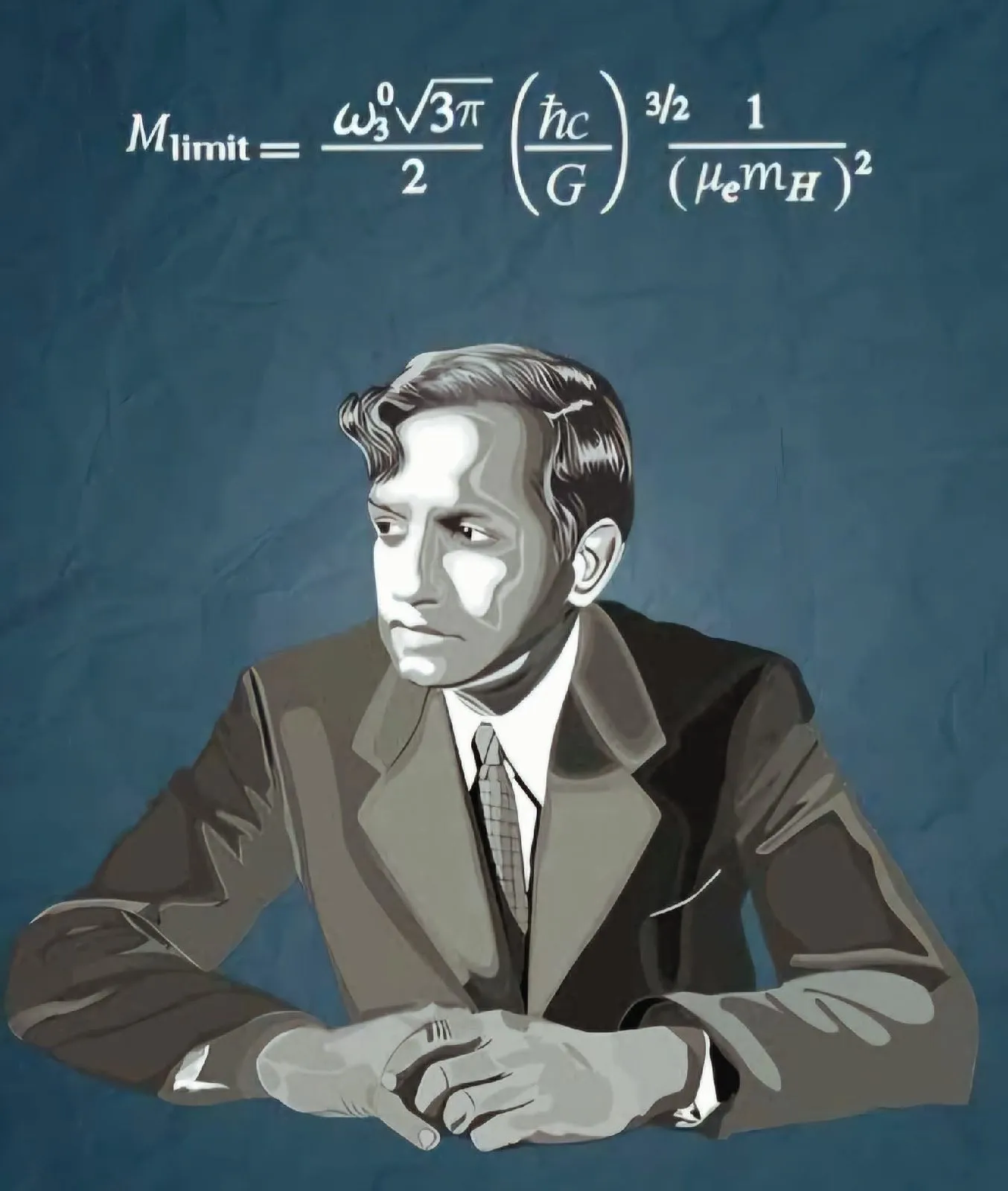
In the summer of 1930, a nineteen-year-old Indian youth boarded a steamship sailing from Madras to England. His name was Subrahmanyan Chandrasekhar, and he was bound for the University of Cambridge for advanced studies in theoretical physics. To pass the solitary weeks at sea, he took out pencil and paper to calculate the internal equilibrium of dying stars. On that ocean voyage, he conceived one of the greatest milestones in astrophysics: the Chandrasekhar limit.
The Prevailing View of White Dwarfs
At the time, the astronomical establishment believed that once stars exhausted their nuclear fuel, they all ended their lifecycles in the same quiet state—shrinking into cold, dense remnants known as white dwarfs. Eminent British astrophysicist Sir Arthur Eddington and his contemporaries held that regardless of initial mass, every dying star gracefully cooled into a stable white dwarf supported indefinitely against gravitational collapse.
Merging Quantum Mechanics with Special Relativity
On his journey, the young Chandrasekhar unified Albert Einstein’s special relativity with the newly emergent principles of quantum mechanics. In a white dwarf, collapse is halted by “electron degeneracy pressure”—a quantum effect arising from the Pauli exclusion principle that prevents electrons from occupying the same state. Chandrasekhar realized that in massive stars, these tightly packed electrons move at speeds approaching the speed of light. Under relativistic conditions, the electron pressure grows more softly than gravitational pull, failing to prevent continued collapse.
1.44 Solar Masses: The Chandrasekhar Limit
Chandrasekhar calculated an exact mathematical boundary: if a dying star’s core exceeds approximately 1.44 times the mass of the Sun, electron degeneracy pressure cannot resist the crushing force of gravity. This threshold became universally celebrated as the Chandrasekhar limit. Its implication was startling: massive stars could never settle into quiet white dwarf retirement. Instead, they must suffer catastrophic gravitational collapse, forging exotic remnants like neutron stars or collapsing entirely into black holes.
Eddington’s Rejection and Intellectual Solitude
In 1935, Chandrasekhar presented his findings before the Royal Astronomical Society in London. Shockingly, his mentor Sir Arthur Eddington publicly mocked the paper, dismissing the idea of infinite gravitational collapse as physically absurd. Eddington’s overwhelming scientific authority cast a long shadow over Chandrasekhar’s work, leaving the young physicist isolated. Yet, confident in the rigor of his mathematics, Chandrasekhar refused to abandon his equations.
Belated Vindication and the Nobel Prize
Decades later, observational astronomy confirmed Chandrasekhar’s visionary predictions with the discoveries of pulsars, neutron stars, and stellar-mass black holes. In 1983—fifty-three years after his solitary sea voyage—Subrahmanyan Chandrasekhar was awarded the Nobel Prize in Physics. The Chandrasekhar limit stands today as a timeless monument to intellectual courage and mathematical truth.