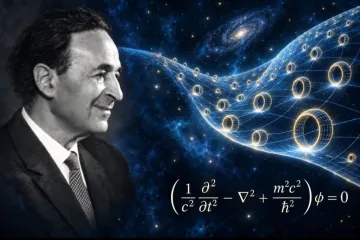
Quantum Entanglement: Einstein's Spooky Action Explained

Einstein’s Disbelief and the Quantum Conundrum
Imagine possessing two enchanted coins. You keep one on your desk and send the other to a distant galaxy billions of light-years away. You flip your coin, and it lands on heads. At that exact microsecond, without any physical signal passing between them, the distant coin instantly lands on tails. In our everyday macroscopic world, such synchronized behavior seems impossible. Yet within the subatomic realm, this very phenomenon unfolds routinely. Physicists call it quantum entanglement. Albert Einstein found the concept so deeply unsettling that he famously dismissed it as spooky action at a distance.
What Is Quantum Entanglement?
Quantum entanglement occurs when two or more particles become intertwined in such a way that their physical states cannot be described independently. Measuring the property of one particle—such as its spin or polarization—instantaneously dictates the state of its entangled partner, regardless of whether they are separated by millimeters or across opposite ends of the observable universe.
The EPR Paradox and Hidden Variables
In 1935, Einstein, along with Boris Podolsky and Nathan Rosen, published the celebrated EPR paradox paper. Einstein argued that nothing in the universe could travel faster than light, meaning instantaneous communication violated local causality. He contended that quantum mechanics was incomplete and suggested that particles must possess predetermined “hidden variables” that dictate their outcomes before measurement, much like a pair of matching shoes placed in separate boxes.
Bell’s Theorem and Experimental Proof
The controversy remained unresolved until 1964, when Northern Irish physicist John Stewart Bell devised a rigorous mathematical theorem known as Bell’s inequality. Bell formulated an experimental test to determine whether nature relies on local hidden variables or obeys pure quantum weirdness. In the decades that followed, pioneering experiments led by Alain Aspect and others conclusively proved Einstein wrong: local hidden variables do not exist. Quantum entanglement is an undeniable reality of the physical universe, operating beyond classical intuitions of space and locality.
The Vanguard of the Quantum Revolution
What began as a philosophical dispute over the foundations of reality has become the engine of next-generation technologies. Quantum entanglement forms the bedrock of quantum computing, promising exponential processing speeds capable of revolutionizing medicine, cryptography, and materials science. It also underpins quantum key distribution (QKD), enabling theoretically unhackable secure communications. In 2022, Alain Aspect, John Clauser, and Anton Zeilinger were awarded the Nobel Prize in Physics for their groundbreaking tests of entanglement. Einstein’s spooky action has evolved into humanity’s most transformative technological frontier.