Big Bang vs Black Bounce: Bouncing Cosmology Explained
Rethinking the Dawn of the Cosmos
For nearly a century, cosmological orthodoxy has held that our universe originated roughly 13.8 billion years ago in the Big Bang—an explosive expansion that birthed space, time, matter, and energy from an infinitely dense singularity. Yet cutting-edge theoretical physics suggests this might not be the full story. Instead of exploding out of nothingness, our cosmos may have been born deep within the interior of a colossal black hole situated in an older parent universe.
Galactic Spin Patterns and Cosmic Asymmetry
While the concept sounds like science fiction, recent observational analyses lend intriguing support. Investigations led by astronomer Lior Shamir at Kansas State University revealed unexpected alignments in the rotational directions of distant galaxies. Statistical analyses indicate a slight preference for galaxies spinning in a clockwise direction. Rather than random coincidence, this preferential orientation could imply a preferred cosmic axis inherited from the angular momentum of a rotating progenitor black hole.
Nikodem Popławski and Bouncing Cosmology
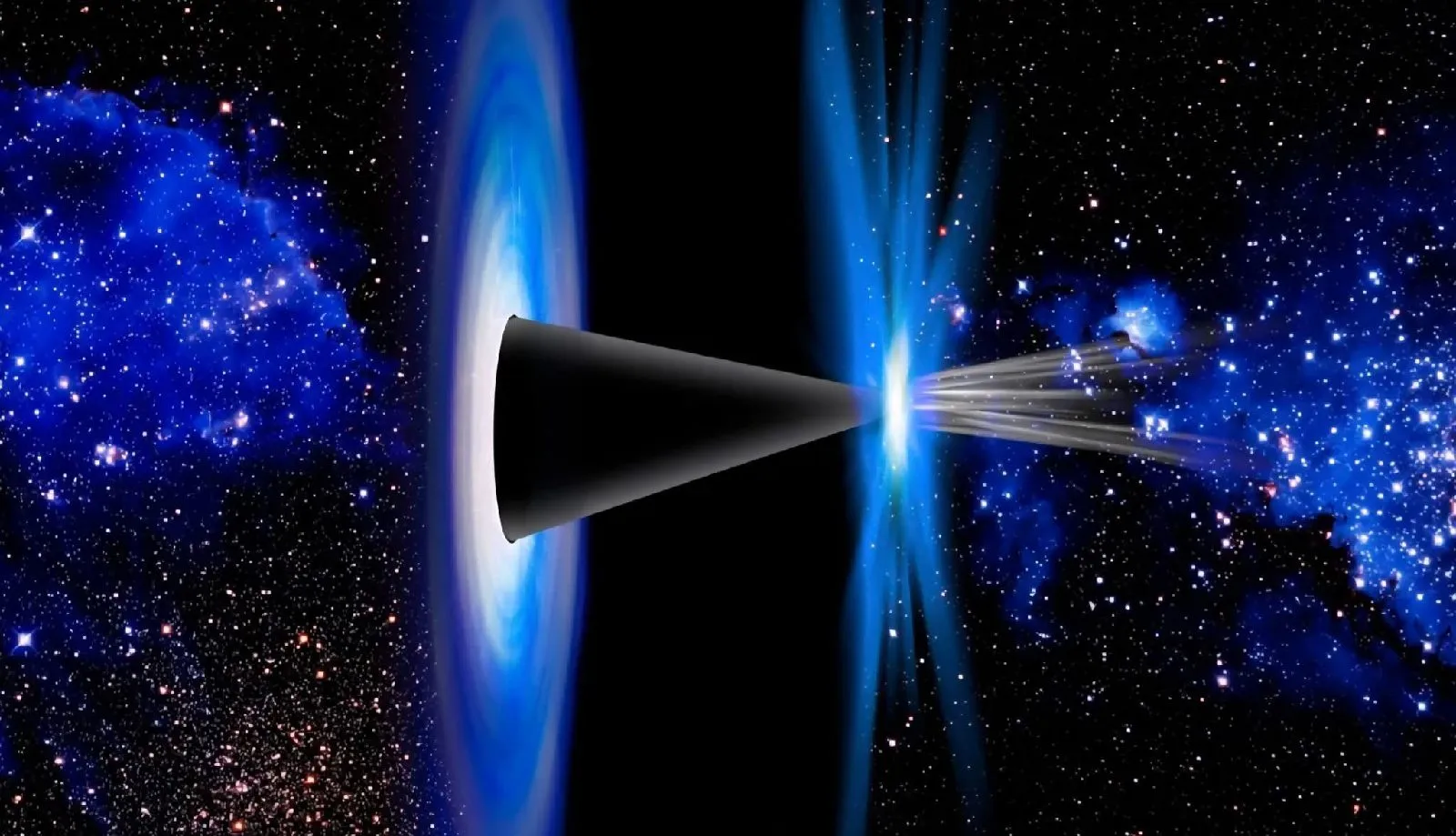
Polish-American theoretical physicist Nikodem Popławski has championed this cosmological model for over a decade. He proposes that every black hole acts as a cosmic womb for a nascent universe. Under standard Einstein-Cartan-Sciama-Kibble gravity—which accounts for the intrinsic quantum spin of matter—gravitational collapse halts before reaching a physical singularity. The extreme density of fermions induces repulsive torsion, causing collapsing matter to rebound violently outward. Popławski terms this paradigm bouncing cosmology, wherein the death of a massive star in one realm triggers the birth of a blossoming universe inside.
The Event Horizon as a Temporal Boundary
In this framework, our entire observable universe corresponds to the expanding interior of a black hole existing in a higher-order cosmos. The black hole’s event horizon acts as a one-way temporal gateway, decoupling our internal space from the past of the parent universe. This geometric asymmetry offers a compelling physical origin for the thermodynamic arrow of time, explaining why entropy continuously increases within our cosmos.
Re-evaluating the Big Bang Paradigm
If bouncing cosmology proves accurate, the Big Bang was not an absolute beginning, but a localized transition—a “Big Bounce” taking place on the inside of a collapsing event horizon. This perspective replaces the lonely concept of a singular, isolated universe with a vast, fertile multiverse where black holes perpetually propagate new baby universes across cosmic epochs.
Testing the Hypothesis with Next-Generation Telescopes
The black bounce model currently remains in the theoretical domain, awaiting conclusive observational validation. Data gathered by space observatories like the James Webb Space Telescope (JWST) and cosmic microwave background polarization probes may provide critical empirical tests. Did our universe erupt from a point of infinite density, or did it awaken within the protective gravitational cradle of another realm?