Avoiding Space Collisions: Chandrayaan-2 and NASA LRO

Orbital Congestion Beyond Earth
While vehicular traffic accidents are common on terrestrial roads, the vastness of space might seem immune to traffic hazards. However, as nations and commercial entities launch increasing numbers of satellites, orbital paths around Earth and the Moon are becoming steadily more crowded. In modern space exploration, orbital conjunctions—near-miss events between high-speed spacecraft—present critical operational hazards that require constant vigilance.
The Close Encounter at the Lunar North Pole
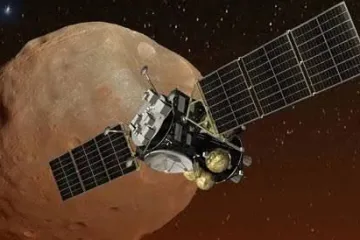
In late October 2021, the Indian Space Research Organisation (ISRO) revealed that its Chandrayaan-2 Orbiter (CH2O) came perilously close to colliding with NASA’s Lunar Reconnaissance Orbiter (LRO). Both robotic probes were traversing polar orbits above the Moon’s north pole when trajectory modeling identified a dangerously high collision probability if both spacecraft maintained their projected courses.
Executing a Collision Avoidance Maneuver (CAM)
Spacecraft in orbital motion travel at extraordinary velocities; in lunar orbit, velocities approach 1.6 kilometers per second. Even a microscopic spatial overlap at these speeds would cause instantaneous mutual destruction, generating thousands of dangerous orbital debris fragments. In close coordination with NASA’s flight dynamics team, ISRO engineers executed a precision Collision Avoidance Maneuver (CAM).
By firing the orbiter’s onboard auxiliary thrusters, mission controllers delivered a calibrated propulsive burn that slightly adjusted Chandrayaan-2’s orbital period and altitude. This subtle velocity shift created safe spatial separation during the subsequent orbital crossing, successfully averting disaster without compromising the orbiter’s ongoing scientific observation program.
The Growing Necessity of Space Situational Awareness
Collision avoidance maneuvers are routine for Earth-orbiting satellites and the International Space Station, which execute dozens of evasive maneuvers annually to evade space debris and defunct rocket bodies. However, conjunctions in deep space and lunar orbit highlight an emerging reality: as lunar exploration accelerates with international programs like Artemis, space agencies must establish robust space situational awareness (SSA) networks and universal coordination protocols to ensure orbital safety around the Moon.