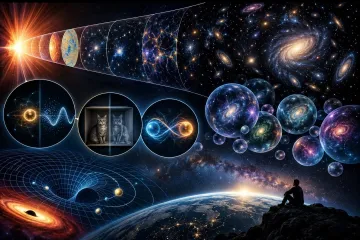
The Arrow of Time: Entropy, Relativity, and Cosmic Order
The Relentless Cosmic River
In our daily experience, time feels absolute and unyielding. It flows like an unceasing river from the unalterable past, through the fleeting present, and toward the undetermined future. We remember yesterday, but cannot remember tomorrow; broken teacups never spontaneously reassemble; and living organisms inexorably age. Physicists designate this fundamental asymmetry as the arrow of time. Yet examining the fundamental equations of classical and quantum physics reveals a startling secret: virtually all fundamental physical laws are completely time-symmetric!
The Birth of Time: Big Bang and Spacetime Geometry
According to standard modern cosmology, time as we know it originated 13.8 billion years ago with the Big Bang. Space and time did not precede the universe; rather, spacetime itself came into being at the initial cosmic expansion. In general relativity, time is not an independent background ticking away universally, but the fourth coordinate woven inextricably into a four-dimensional manifold known as spacetime.
Einstein’s Relativity: Time Is Dynamic and Observer-Dependent
Albert Einstein dismantled the Newtonian illusion of universal, constant time:
- Special Relativity (Velocity Time Dilation): The faster an observer travels relative to another, the slower time ticks on their clock. As relative velocity approaches the speed of light ((c)), time dilation approaches infinity.
- General Relativity (Gravitational Time Dilation): Stronger gravitational fields warp spacetime more intensely, causing clocks closer to massive gravitational bodies to run measurably slower than clocks situated in weaker gravity.
This is no theoretical abstraction. Global Positioning System (GPS) satellites orbiting Earth experience both velocity dilation (running 7 microseconds slower daily) and gravitational dilation (running 45 microseconds faster daily). Without daily calibration of this net 38-microsecond relativistic offset, GPS navigation would accumulate positional errors of several kilometers every single day!
Thermodynamics and the Origin of the Arrow
If microscopic particle collisions are reversible, where does the macroscopic arrow of time come from? The answer lies in the Second Law of Thermodynamics and the concept of entropy ((S))—the statistical measure of microscopic disorder.
The universe began in a state of extraordinarily low entropy at the Big Bang. Under statistical mechanics (formulated by Ludwig Boltzmann), natural systems spontaneously transition from rare, low-entropy configurations toward overwhelmingly probable, high-entropy disordered states. The forward march of the arrow of time is directly propelled by this relentless statistical increase in cosmic entropy.
Quantum Foam and Loop Quantum Gravity
In the pursuit of a unified theory of quantum gravity, theoretical physicists question whether time is even continuous. In Loop Quantum Gravity (LQG), spacetime is quantized into discrete, indivisible packets at the Planck scale. The smallest indivisible quantum of time is the Planck time ((approx 5.4 imes 10^{-44}) seconds). At this infinitesimal threshold, continuous time ceases to exist, dissolving into dynamic spin foams of quantum geometry.
The Block Universe: Is the Passage of Time an Illusion?
Taking relativity to its logical philosophical conclusion gives rise to the Block Universe theory (Eternalism). In a four-dimensional spacetime block, the past, present, and future all coexist simultaneously as physical realities. As Albert Einstein famously consoled the family of his lifelong friend Michele Besso: “People like us, who believe in physics, know that the distinction between past, present, and future is only a stubbornly persistent illusion.” While our consciousness experiences time as a moving spotlight, the deep architecture of time remains one of the universe’s most mesmerizing frontiers.