Einstein's Blunder: The Cosmological Constant and Dark Energy
The Quest for a Static Cosmos
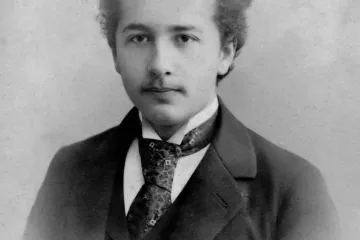
When Albert Einstein formulated his revolutionary General Theory of Relativity in 1915, he rewrote humanity’s understanding of gravity, showing that massive objects warp the four-dimensional fabric of spacetime. However, when Einstein applied his gravitational field equations to the cosmos as a whole, he encountered an unsettling dilemma: his equations indicated that the universe could not remain stationary. Under the mutual gravitational attraction of matter, all cosmic structures should inevitably collapse inward.
At the time, the prevailing astronomical consensus held that the universe was eternal, uniform, and completely static. To prevent his dynamic equations from predicting gravitational collapse, Einstein introduced an ad-hoc mathematical patch in 1917: the cosmological constant, symbolized by the Greek letter Lambda ($\Lambda$).
This constant represented a hypothetical repulsive energy inherent to empty space, exerting negative pressure that exactly counterbalanced gravitational attraction to maintain a perfectly stable, unchanging universe.
Hubble’s Discovery and the “Biggest Blunder”
Einstein’s static model was short-lived. In 1929, American astronomer Edwin Hubble, working at the Mount Wilson Observatory, observed that distant galaxies are racing away from Earth in all directions. Hubble discovered that the farther a galaxy is, the faster it recedes—proving conclusively that the universe is actively expanding.
Theoretical physicist Georges Lemaître and mathematician Alexander Friedmann had already demonstrated that Einstein’s unadjusted equations naturally predicted an expanding cosmos. Faced with undeniable observational proof, Einstein discarded Lambda, famously lamenting to physicist George Gamow that introducing the cosmological constant was the “biggest blunder” of his career.
The 1998 Revolution: Acceleration and Dark Energy
For nearly seven decades, astronomers assumed the expansion of the universe was gradually slowing under the gravitational braking of all cosmic matter. In 1998, two competing teams of astrophysicists measuring distant Type Ia supernovae made a shocking discovery: the cosmic expansion is not decelerating at all, but rather accelerating exponentially.
To account for this accelerating expansion, cosmologists resurrected Einstein’s discarded term. What Einstein had called his greatest mistake proved to be a stroke of inadvertent genius: the cosmological constant accurately describes dark energy—the mysterious repulsive force that permeates all of space and constitutes approximately $68\%$ of the total mass-energy budget of the universe.
Triumph of General Relativity
While Einstein doubted his own instincts regarding dynamic cosmic evolution, his original relativistic equations have continually passed every observational test with flying colors. A century after he predicted the existence of gravitational waves—tiny ripples propagating through spacetime caused by violent cosmic collisions—the Laser Interferometer Gravitational-Wave Observatory (LIGO) directly detected them in 2015 from colliding black holes.
From gravitational waves to cosmic expansion, Einstein’s blunder transformed modern cosmology, reminding us that even the missteps of a genius can open new frontiers in our quest to comprehend the cosmos.