Quantum Computers: The Upcoming Revolution in Future Computing
The Dawn of the Quantum Computing Era
For decades, popular science labeled quantum computers as the “computers of tomorrow.” Today, that future has arrived at the laboratory doorstep. Just as electricity, the semiconductor transistor, and the global internet fundamentally transformed human civilization, quantum computing is poised to ignite the next great technological paradigm shift.
Leading technology conglomerates and premier national research laboratories have successfully engineered functioning quantum processors, engaging in an intense technological race to construct scalable, fault-tolerant machines capable of completing calculations in seconds that would demand millennia from conventional classical supercomputers.
How Do Quantum Computers Work?
Classical computing processors process information using binary bits—voltage states representing either a zero ($0$) or a one ($1$), analogous to binary on/off switches. Quantum computing replaces classical bits with quantum bits, or “qubits.”
Qubits derive computational power from two fundamental quantum phenomena:
- Superposition: A qubit can exist simultaneously as a linear combination of both $|0
angle$ and $|1
angle$. An array of $N$ superposed qubits can evaluate $2^N$ states simultaneously. - Quantum Entanglement: Entangled qubits share correlated quantum states such that operations performed on one instantaneously affect its partners regardless of physical separation, allowing complex state spaces to be computed in parallel.
Global Industry Competitors and Milestones
Global technology leaders have achieved landmark engineering milestones:
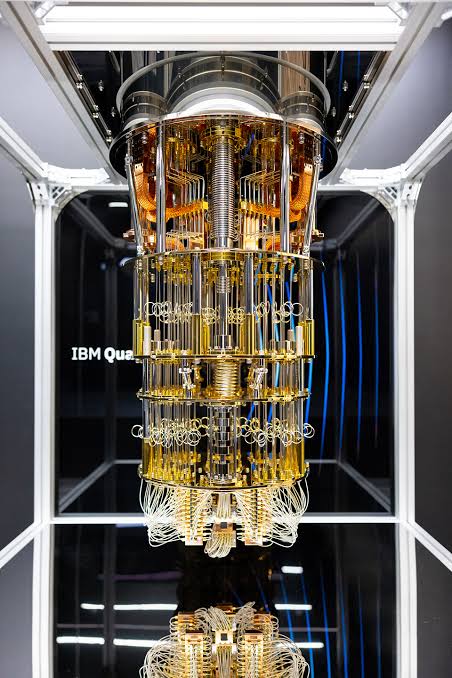
- IBM: Launched the commercial IBM Quantum System One in 2019, followed by the 433-qubit Osprey processor in 2022 and the 1,121-qubit Condor chip in 2023, while developing the Starling fault-tolerant modular architecture.
- Google Quantum AI: Announced quantum computational supremacy in 2019 using its 53-qubit Sycamore superconducting processor, completing a sampling benchmark in 200 seconds that would have occupied a classical supercomputer for thousands of years.
- Microsoft: Focused on topological qubits, engineering Majorana zero modes to construct hardware with built-in physical protection against environmental noise.
- Global Initiatives: Canadian quantum pioneer D-Wave (quantum annealing), China’s photonic Jiuzhang and superconducting Zuchongzhi processors, and academic consortia across Japan and Europe have demonstrated world-class platforms.
Transformative Industrial Applications
The practical applications of quantum computers span vital global sectors:
- Molecular Pharmacology and Medicine: Simulating intricate molecular electron interactions and protein folding pathways to rapidly discover targeted therapeutics for oncology, Alzheimer’s disease, and emerging viral pathogens.
- Financial Risk Modeling: Financial institutions (such as JPMorgan Chase and Morgan Stanley) utilize quantum algorithms for high-speed portfolio optimization, arbitrage detection, and market risk simulations.
- Cybersecurity and Cryptography: While Shor’s algorithm theoretically threatens RSA and elliptic-curve cryptography, post-quantum cryptography (PQC) and Quantum Key Distribution (QKD) are establishing unbreakable communication channels.
- Climate Modeling and Materials Science: Designing room-temperature superconductors, efficient nitrogen-fixation catalysts for fertilizers, and high-capacity battery chemistries.
Technical Hurdles: Decoherence and Error Correction
Despite rapid progress, critical engineering challenges remain. Qubits are extraordinarily sensitive to thermal fluctuations, electromagnetic radiation, and vibrational noise, which cause quantum states to collapse through “decoherence.” Consequently, superconducting processors must operate inside dilution refrigerators near absolute zero (15 millikelvin).
Furthermore, scaling systems requires fault-tolerant quantum error correction (QEC), where thousands of physical qubits are linked to form a single protected logical qubit.
Conclusion
The journey toward fully commercialized quantum computers represents one of the most ambitious engineering undertakings in human history. Once mature, quantum computation will unlock previously insoluble problems across science, energy, and medicine, reshaping humanity’s technological horizon.