Capturing the Abyss: The First Direct Image of a Black Hole
A Century-Long Journey of Verification
In May 1919, British astrophysicist Sir Arthur Eddington led an expedition to the island of Príncipe to photograph stars during a total solar eclipse. By proving that the Sun’s gravitational field bent the path of starlight, Eddington provided the first empirical confirmation of Albert Einstein’s General Theory of Relativity. Exactly one century later, in April 2019, an international consortium of astronomers achieved an even more extraordinary milestone: capturing the first black hole image in human history.
For decades, black holes existed primarily as mathematical solutions to Einstein’s equations—objects of such extreme gravitational density that nothing, not even light, could escape from within their event horizons.
An Earth-Sized Virtual Telescope
Imaging a black hole directly poses a staggering technical challenge. Because black holes are completely dark and situated at astronomical distances, observing their silhouette requires an angular resolution equivalent to reading a newspaper in New York from a café in Paris.
To overcome this diffraction barrier, astronomers established the Event Horizon Telescope (EHT)—a global network of millimeter-wave radio observatories synchronized using atomic hydrogen maser clocks. Employing the technique of Very Long Baseline Interferometry (VLBI), the EHT linked telescopes in Hawaii, Chile, Arizona, the Spanish Sierra Nevada, and the South Pole to synthesize a virtual radio telescope with an effective aperture equal to the entire diameter of Planet Earth.
The Shadow of M87*
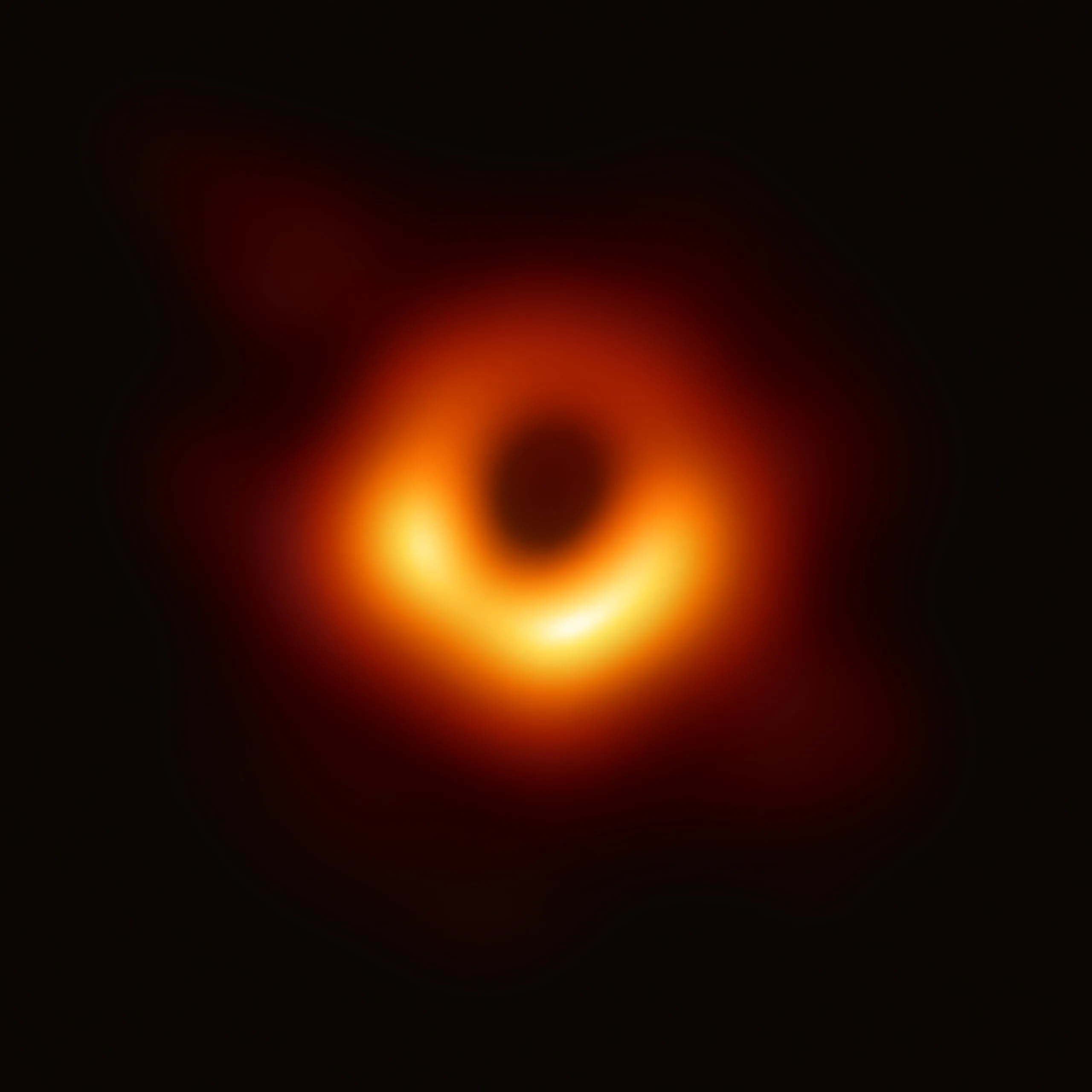
On April 10, 2019, the EHT collaboration unveiled the historic photograph of the supermassive black hole at the center of the giant elliptical galaxy Messier 87 (M87*), located approximately $55$ million light-years away in the constellation Virgo.
With an estimated mass equal to $6.5$ billion solar masses, M87* presented a spectacular astronomical vista:
- The Photon Ring: A glowing, asymmetric ring of superheated relativistic plasma swirling around the singularity at near-light speeds.
- The Event Horizon Shadow: A central dark void representing the gravitational shadow of the event horizon, where light has been swallowed forever.
- Doppler Beaming: The crescent appears brighter on one side because relativistic plasma traveling toward Earth is Doppler-boosted in brightness.
Einstein Vindicated Once Again
The observed dimensions and geometry of the dark shadow matched the precise mathematical predictions of general relativity to unprecedented accuracy. The EHT’s breakthrough confirmed that Einstein’s gravitational equations hold true even under the most extreme relativistic conditions in the cosmos.
By capturing the first black hole image, astrophysics transitioned from theoretical speculation to direct observational imaging of the most enigmatic objects in the universe.