What Is a White Hole? The Cosmic Opposite of Black Holes
The Theoretical Antithesis of Black Holes
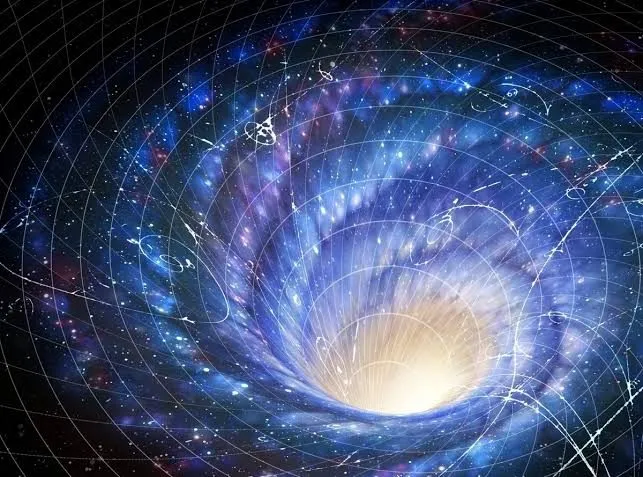
In theoretical physics, a white hole is envisioned as the time-reversed twin of a black hole—possessing an identical gravitational architecture yet displaying exact opposite physical behavior. A black hole possesses an inescapable gravitational pull from which nothing, not even light, can escape once past the event horizon. At its heart lies a gravitational singularity, where the curvature of spacetime diverges toward infinity and standard classical physics breaks down.
The Quantum Transition from Black to White Hole
While black holes continuously swallow surrounding matter and radiation, a white hole does the exact reverse: nothing can enter past its boundary, and it relentlessly expels matter and radiant energy into the cosmos. Italian theoretical physicist Carlo Rovelli, a primary pioneer of Loop Quantum Gravity (LQG), argues that white holes are not mere mathematical curiosities, but the natural evolutionary terminus of dying black holes.
According to LQG, spacetime is quantized into discrete Planck-scale loops, which prevents gravitational collapse from reaching an infinite physical singularity. When a dying star compresses toward this minimum quantum threshold, quantum bounce dynamics take over. The extreme gravitational pressure rebounds, causing the black hole to “bounce” inside out over cosmic timescales, erupting as a white hole.
Carlo Rovelli’s Vision of White Holes
In his acclaimed popular science work White Holes, Carlo Rovelli takes readers on an imaginative yet mathematically grounded journey across the event horizon. Rovelli unpacks how an observer might witness the collapse and subsequent quantum rebound, explaining how extreme relativistic time dilation makes an event lasting fractions of a second at the core appear as billions of years to an outside observer.
Theoretical Possibility and Empirical Search
Although white holes are valid solutions to the field equations of Einstein’s general relativity, no empirical observation has yet confirmed their existence in our universe. Whether white holes drift quietly through deep space or remain purely within the realm of theoretical physics is an open question waiting for next-generation astrophysics to answer.