A Colossal Spacetime Vortex: The Spinning Black Hole at Our Galaxy's Core
Introducing Sagittarius A*
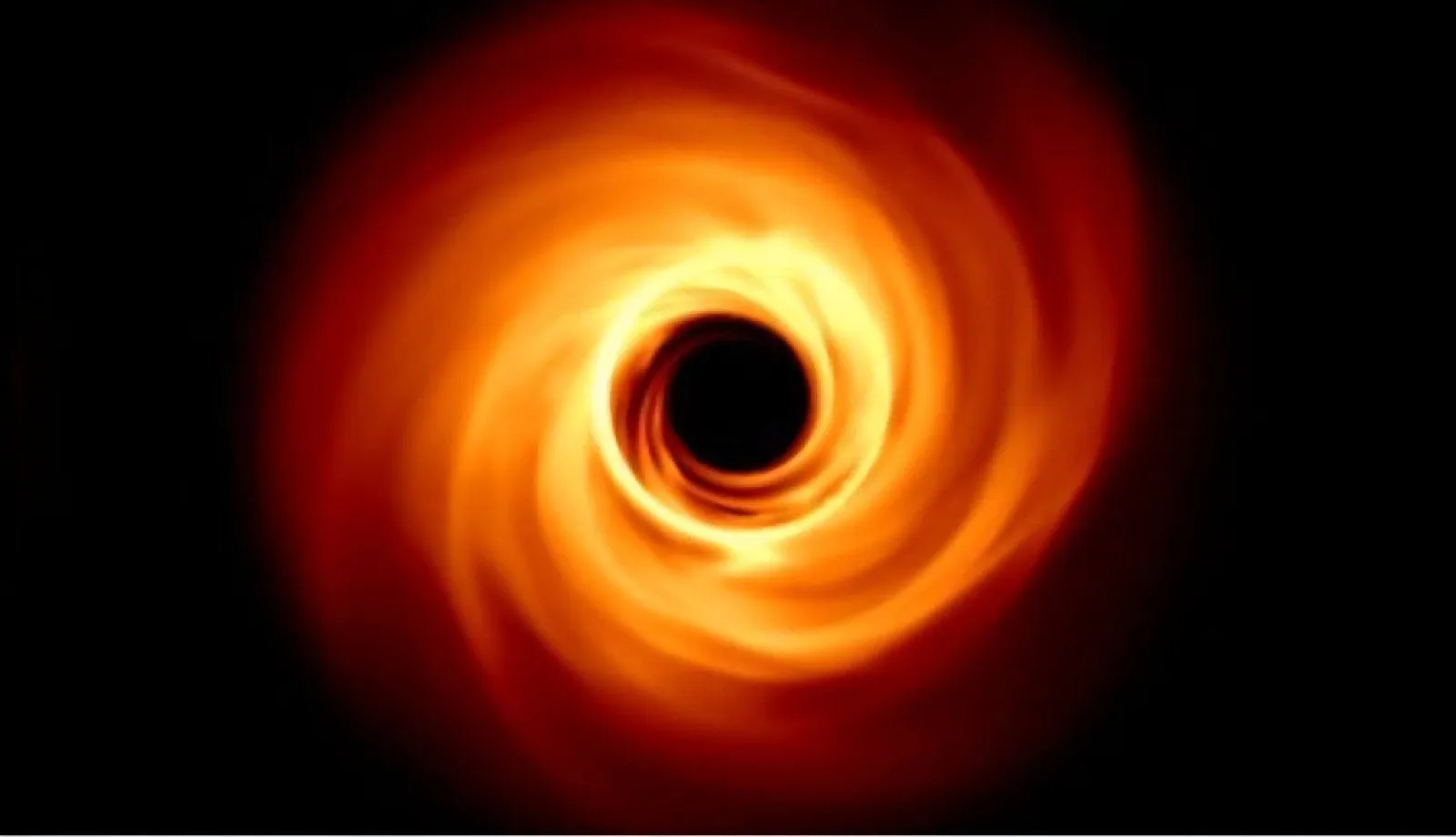
At the gravitational center of our Milky Way galaxy lies a colossal supermassive black hole designated Sagittarius A* (pronounced Sagittarius A-star). Harboring roughly 4.3 million times the mass of our Sun and situated approximately 26,000 light-years from Earth, its discovery earned astronomers Andrea Ghez and Reinhard Genzel the 2020 Nobel Prize in Physics. Like all black holes, its intense gravitational pull prevents even light from escaping once inside the event horizon.
Black Hole Rotation and the Ergosphere
Recent astrophysical observations reveal that our galaxy’s central black hole is far from static: it is rotating at extreme velocity. In 1963, New Zealand mathematician Roy Kerr solved Einstein’s general relativity equations for spinning black holes, demonstrating that a rotating mass drags the surrounding fabric of spacetime along with it—an effect known as frame-dragging. This creates a pumpkin-shaped region outside the horizon known as the ergosphere, where nothing can stand still; spacetime itself is forced into a relentless rotational vortex.
Harvesting Energy from a Black Hole
This frame-dragging is not merely a theoretical novelty. In 1969, physicist Roger Penrose proposed that energy could theoretically be extracted from the ergosphere. Through the Penrose process, if a particle enters the ergosphere and splits in two, one fragment can plunge into the black hole with negative energy while the second escapes with greater energy than the original parent particle. This demonstrates that spinning black holes can function as immense cosmic dynamos.
Spinning Near the Cosmic Speed Limit
Contemporary analyses of X-ray and radio emissions from observatories such as Chandra and the Event Horizon Telescope reveal that Sagittarius A* is spinning near the physical limit permitted by general relativity. Its rotational parameter indicates that spacetime immediately outside the event horizon is whipped around at velocities nearing the speed of light, generating a titanic gravitational whirlpool.
New Perspectives on Fundamental Physics
Coupled with gravitational-wave detections from observatories like LIGO and Virgo that capture black hole collisions, studies of Sagittarius A* showcase how black holes serve as premier cosmic laboratories. They enable physicists to test Einstein’s general relativity under extreme conditions and explore the deepest mysteries of spacetime.