Rare Einstein Ring Discovered by Euclid Telescope: A Cosmic Breakthrough
A Spectacular Discovery by the Euclid Telescope
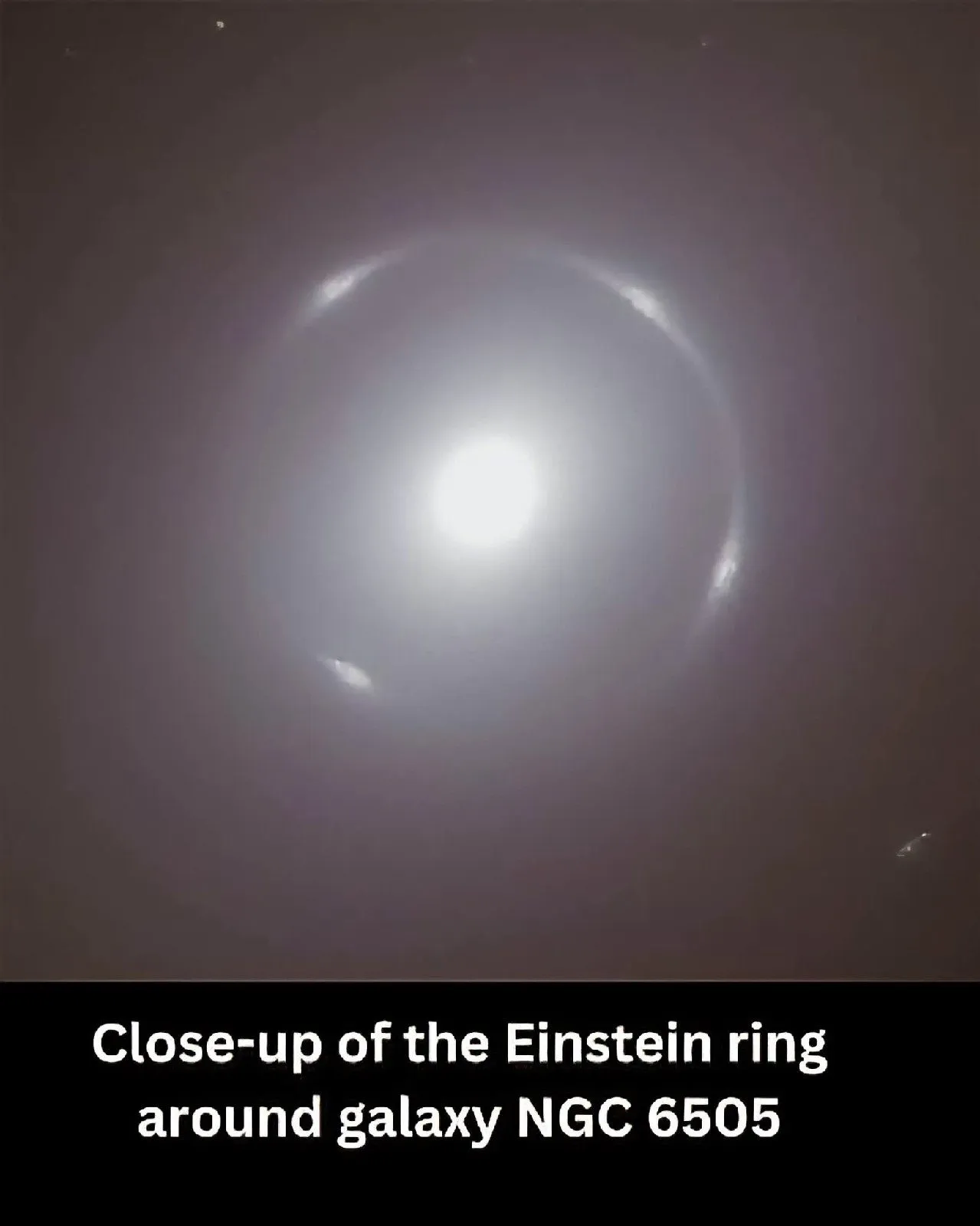
The European Space Agency’s (ESA) Euclid Telescope has captured a rare and breathtaking ‘Einstein ring‘ encircling the galaxy NGC 6505. Situated roughly 590 million light-years from Earth, NGC 6505 was first cataloged in the late nineteenth century. Yet across more than a century of astronomical observations, no Einstein ring had ever been detected around this celestial neighbor until now.
Einstein’s Theory of Relativity and Warped Spacetime
In 1915, Albert Einstein proposed in his General Theory of Relativity that massive celestial bodies warp the fabric of spacetime around them. The greater an object’s mass, the more severe the curvature it imposes on surrounding spacetime. We perceive this geometric warping as the force of gravity. This curvature paved the way for an extraordinary observational technique known as gravitational lensing. Just like an optical glass lens bends and magnifies rays of light, cosmic gravitational fields deflect and amplify faint light from distant objects, granting astronomers a natural cosmic telescope to peer into the deep universe.
Gravitational Lensing and the Formation of Einstein Rings
Imagine a distant, faint background galaxy positioned directly behind a massive foreground galaxy. Light rays emitted by the background galaxy are bent symmetrically around the intense gravitational well of the intervening giant. When the alignment between observer, lens, and distant source is nearly perfect, the warped light smears into a complete, luminous ring. Astronomers designated this phenomenon an “Einstein ring” in honor of the physicist who predicted it. While several Einstein rings have been documented across the cosmos, finding one around a well-known, relatively nearby galaxy like NGC 6505 is a rare cosmic marvel.
Euclid’s High-Precision Deep-Space Vision
The luminous ring revealed by Euclid originated from a newly observed background galaxy located approximately 4.42 billion light-years away, directly behind NGC 6505. This discovery highlights the remarkable sensitivity and resolving power of the Euclid Space Telescope. Operating with ultra-high-resolution imaging systems beyond Earth’s turbulent atmosphere, Euclid resolved fine celestial details that terrestrial observatories had missed for decades.
Unraveling Dark Matter and the Cosmic Architecture
Einstein rings serve as indispensable cosmic laboratories for investigating the hidden structure of the universe, particularly the distribution of elusive dark matter and dark energy. Over its six-year primary survey mission, Euclid aims to map billions of galaxies across more than a third of the sky. As the telescope continues scanning the cosmos, it promises to uncover many more gravitational anomalies that will deepen our understanding of cosmic evolution.