Nobel Prize in Physics 2020: Black Hole Discoveries Honored
A Landmark Year for Black Hole Astrophysics
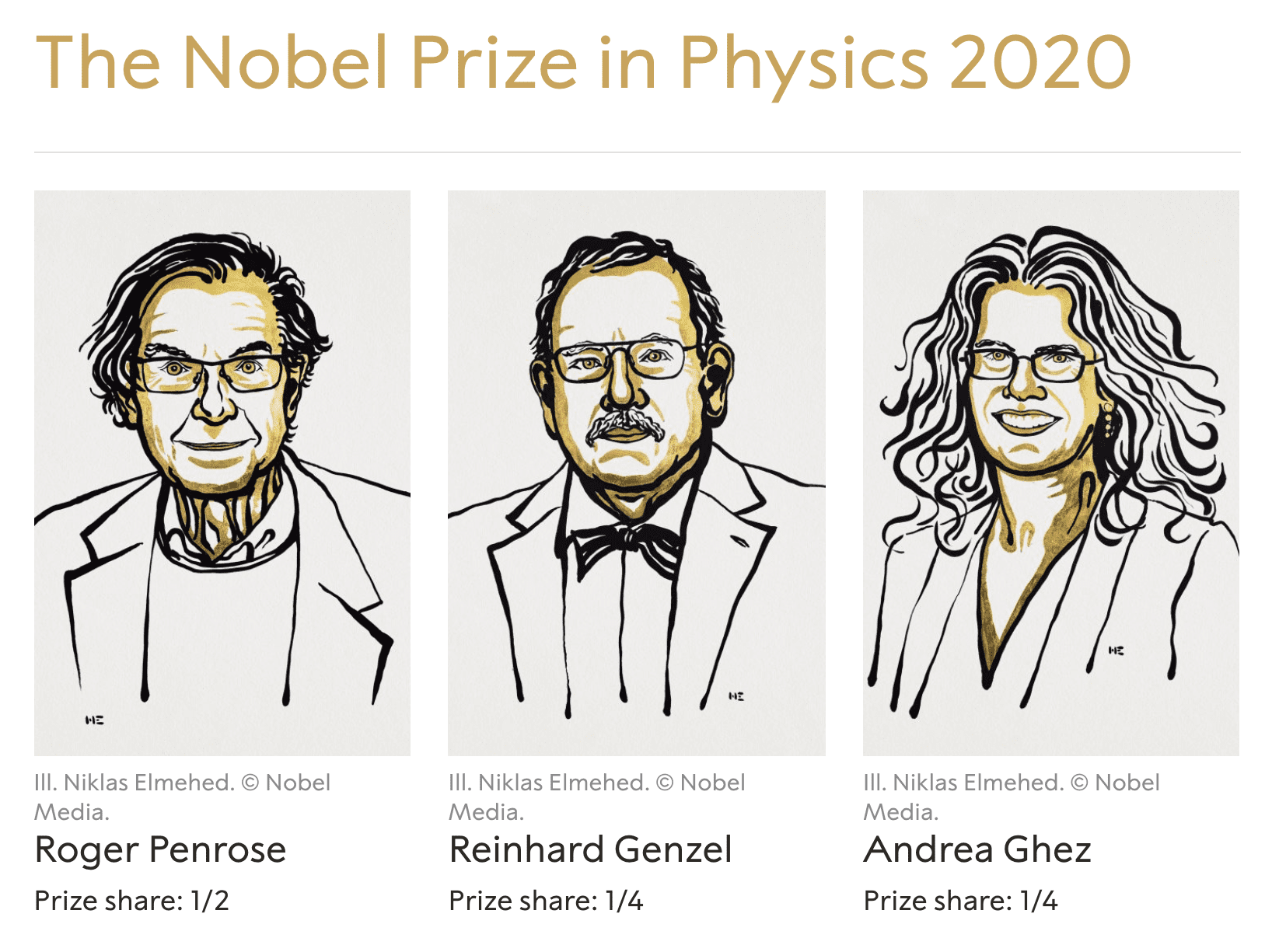
In October 2020, the Royal Swedish Academy of Sciences awarded the Nobel Prize in Physics 2020 to three scientists whose theoretical insights and observational ingenuity fundamentally deepened humanity’s understanding of black holes—the most enigmatic objects predicted by Albert Einstein’s general theory of relativity.
One half of the prize was awarded to celebrated British mathematical physicist Sir Roger Penrose of the University of Oxford. The remaining half was shared jointly between German astrophysicist Reinhard Genzel, director at the Max Planck Institute for Extraterrestrial Physics, and American astronomer Andrea Ghez, professor at the University of California, Los Angeles.
Roger Penrose and the Robust Prediction of Gravitational Singularity
Albert Einstein introduced his general theory of relativity in 1915, proposing that gravity is the curvature of spacetime induced by mass and energy. Although Karl Schwarzschild derived the exact spherically symmetric solution describing a black hole shortly thereafter, Einstein himself remained skeptical that such extreme gravitational collapses could actually occur in the physical universe under realistic, non-ideal conditions.
In 1965, fifty-five years before his Nobel recognition, Roger Penrose revolutionized theoretical relativity by publishing his seminal paper on gravitational collapse. Introducing revolutionary topological and differential geometry techniques—such as trapped surfaces—Penrose proved the Singularity Theorem. He rigorously demonstrated that black hole formation is a robust, inevitable consequence of general relativity rather than an artifact of idealized spherical symmetry. At the center of an event horizon, matter inevitably collapses into a gravitational singularity where spacetime curvature becomes infinite and classical physical laws cease to apply.
Reinhard Genzel and Andrea Ghez: Unmasking the Monster at the Galactic Heart
While Penrose proved the theoretical reality of black holes, Reinhard Genzel and Andrea Ghez provided the definitive empirical proof of a supermassive black hole at the center of our own Milky Way galaxy.
Beginning in the early 1990s, Genzel’s team used European Southern Observatory (ESO) telescopes in Chile, while Ghez’s team harnessed the Keck Observatory on Mauna Kea in Hawaii. Both independent teams developed cutting-edge near-infrared adaptive optics to peer through the immense clouds of interstellar dust and gas obscuring the galactic nucleus.
Over nearly three decades, both teams tracked the precise orbital trajectories of individual stars circling the compact radio source known as Sagittarius A* (Sgr A*). In particular, the star S2 (or S0-2) was observed completing a full sixteen-year elliptical orbit, swooping within $17$ light-hours of the invisible object at velocities exceeding $7,000$ kilometers per second. Applying Keplerian mechanics and relativistic orbital corrections, they determined that Sagittarius A* contains an extraordinary mass of approximately $4$ million suns crammed into a spatial radius no larger than our solar system—conclusive proof that only a supermassive black hole could reside there.
Conclusion
The Nobel Prize in Physics 2020 celebrated the perfect synthesis of theoretical brilliance and observational persistence. By uniting Roger Penrose’s mathematical foundation with the precise observational astrometry of Reinhard Genzel and Andrea Ghez, physics confirmed that black holes are not mere theoretical curiosities, but titanic gravitational anchors shaping cosmic evolution.